Informational + lip care research · 13 min read
Is Beef Tallow Good for Lips? How It Works as Lip Balm and How Much You Swallow
Plain, unscented beef tallow works as a lip balm for dry, chapped lips. Why lips lose water almost three times as fast as cheek skin, how little tallow you swallow, how it compares with petrolatum, and why people with alpha-gal syndrome should ask an allergist first.
Last updated November 16, 2026
Short answer: yes, when the tallow is plain
Yes. Plain beef tallow works as a lip balm for dry, chapped lips, and an unscented, unflavored tallow fits the chapped-lip advice of the American Academy of Dermatology (AAD), because fragrance and flavoring are both on the academy's list of ingredients to avoid while lips are chapped. The amount you swallow is small: at the European safety figure of 57 milligrams of lip product a day, it comes to under half of one percent of a tablespoon of a fat that the US Department of Agriculture (USDA) lists as an ordinary food. The limits are specific. Tallow carries no SPF, so it does not replace a sunscreen lip balm outdoors. PubMed lists no study that tests tallow on lips, while petrolatum has a published number for how much water it holds in. People with alpha-gal syndrome, the tick-linked allergy to red meat, should ask their allergist first, because the Centers for Disease Control and Prevention (CDC) names tallow among the mammal fats some of them may be sensitive to.
Why lips dry out faster than the rest of your face
The red part of the lips, the vermilion, is the only place on the face where the lining of the mouth stays exposed to outside air, and it does not hold water the way skin does. In a winter study of 303 healthy women aged 21 to 80, Kobayashi and Tagami measured water evaporating through the lips at almost three times the rate of cheek skin, and the cheek already loses far more water than most other body areas. Surface hydration on the lips averaged about one third of the cheek's. The outermost lip cells were larger than cheek cells and still held their nuclei, a sign they had not finished turning into the flat, keratin-filled cells of a normal skin barrier, and the authors attributed the lips' poor barrier function and water-holding capacity to that incomplete formation. Saliva adds to the problem. AAD notes that as saliva evaporates, lips become drier, so licking chapped lips keeps the cycle going. With so little barrier underneath, whatever you put on top has to do work the lip surface cannot do for itself.
What beef tallow is, in the numbers that matter on lips
Beef tallow is rendered beef fat. USDA's FoodData Central record for it lists 49.8 grams of saturated fat, 41.8 grams of monounsaturated fat and 4.0 grams of polyunsaturated fat in every 100 grams. Two things follow for lip use. The first is texture. Tallow melts over a range rather than at one temperature: Faridah and colleagues measured beef fat in 2025 at 36.85 percent solid at 77°F (25°C), 26.35 percent at 86°F (30°C) and 16.11 percent at 95°F (35°C), with a slip melting point of 40.77°C, about 105°F. That is why it sits in a jar as a soft solid and loosens as a fingertip and the lips warm it. The second is how slowly it turns. A fat oxidizes faster the more double bonds its fatty acids carry, and Huang and Ahn give relative rates of 1 for stearic acid, 100 for oleic acid, 1,200 for linoleic acid and 2,500 for linolenic acid; they trace the off-odors of oxidized meat mainly to aldehydes, especially hexanal. With only 4 percent of its weight polyunsaturated, tallow is slow to pick up that stale smell, which matters for something you wear directly under your nose. Oils rich in linoleic acid go off far sooner.
How much tallow you actually swallow
Some of anything worn on the lips is swallowed with food and drink, so the useful question is how much. In a two-week US study that weighed each woman's product before and after use, Loretz and colleagues found lipstick applied at a mean of 10 milligrams per application, 2.35 times a day, for 24 milligrams a day. The European Commission's Scientific Committee on Consumer Safety uses 0.057 grams, or 57 milligrams, a day as the estimated daily amount of lipstick and lip salve in its safety calculations. USDA puts a tablespoon of beef tallow at 12.8 grams. Even if every milligram of the European figure were swallowed, a day of lip use would be 0.45 percent of that tablespoon and about half a calorie at USDA's 902 calories per 100 grams, and it would take about 225 days to work through a single tablespoon. The committee describes lipstick as normally not intended to be ingested and expects the swallowed fraction to be small, so the real amount is lower still. For anyone who already eats beef, the tallow from a lip routine is a rounding error.
How tallow compares with petrolatum and the dermatologists' list
AAD's list of ingredients that can help chapped lips names castor seed oil, ceramides, dimethicone, hemp seed oil, mineral oil, petrolatum, shea butter, white petroleum jelly, and sun-protective ingredients such as titanium oxide or zinc oxide. Tallow is not on that list, and it is not on the list of ingredients to avoid either; the academy does not mention it. Petrolatum is the ingredient with a hard number. A 2016 review in the Indian Journal of Dermatology reports that petrolatum at a concentration of 5 percent or more reduces water loss through the skin by more than 98 percent, while lanolin, mineral oil and silicones reduce it by only 20 to 30 percent. AAD's advice for very dry lips points the same way: it recommends a thick ointment, because ointment seals in water longer than waxes or oils. If the strongest possible seal is the only goal, petrolatum is the measured choice. People pick tallow for other reasons: a single fat that is also a food, free of petroleum and lanolin, with nothing added for scent, and a feel that melts into the lips instead of sitting on them as a slick film. You can also use both, tallow through the day and petrolatum on the driest nights.
Fragrance and flavoring are what dermatologists flag on chapped lips
AAD's list of ingredients to avoid while lips are chapped reads: camphor, eucalyptus, flavoring, fragrance, lanolin, menthol, octinoxate or oxybenzone, phenol or phenyl, propyl gallate and salicylic acid, and it singles out cinnamon, citrus, mint and peppermint flavors as especially irritating to dry, chapped lips. Patch testing shows why fragrance belongs there. Of 10,061 patients tested by the North American Contact Dermatitis Group from 2001 to 2004, 196 had dermatitis on the lips and nowhere else. Of those, 75, or 38.3 percent, were diagnosed with allergic contact cheilitis, and fragrance mix, Myroxylon pereirae (balsam of Peru) and nickel were the most common relevant allergens. So on lips, what else is in the jar matters as much as the fat. Plain, unscented tallow contains nothing on the avoid list. A tallow lip balm scented with essential oils or flavored with peppermint or citrus adds back what the academy says to keep off chapped lips, and so does a blend that includes lanolin. The ingredient list, not the word tallow on the front, tells you which kind you are holding.
Why drugstore lip balms carry a Drug Facts panel and plain tallow does not
In the United States, whether a lip product is a cosmetic or a drug depends on its intended use, which FDA reads from the claims on the label, in advertising and in other promotional material. FDA's skin protectant monograph, M016, defines a lip protectant as a drug product that temporarily prevents dryness and helps relieve chapping of the exposed surfaces of the lips, traditionally called lip balm. To be sold that way, a product has to use an active ingredient from the monograph at a set strength, such as petrolatum or white petrolatum at 30 to 100 percent, lanolin at 12.5 to 50 percent, cocoa butter or hard fat at 50 to 100 percent, or dimethicone at 1 to 30 percent. In return it may print the monograph's lip claims, which say that it temporarily protects chapped or cracked lips and helps protect them from the drying effects of wind and cold weather. Beef tallow is not on the monograph's list. A tallow lip product is a cosmetic that moisturizes and softens, and it cannot carry those drug claims. The Drug Facts box on a drugstore stick tells you which regulated active it relies on, not whether it suits your lips.
Tallow is not sun protection, and lips need it
Tallow has no SPF, and nothing without a tested, labeled SPF counts as sun protection. AAD advises a non-irritating lip balm with SPF 30 or higher before going outdoors and reapplying it every 2 hours while you are outside. For chapped lips it lists sun-protective ingredients such as titanium oxide or zinc oxide among those that help, with octinoxate or oxybenzone on the avoid list. The routine that follows is a split by time of day. An SPF 30 lip balm goes on before you head outside and every two hours after that, and tallow covers the hours indoors, the evening and bedtime.
Alpha-gal syndrome: who should ask an allergist first
Alpha-gal is a molecule found in most mammals, such as cows and pigs, but not in people. CDC describes alpha-gal syndrome as a serious, potentially life-threatening allergy and tickborne disease, and in the United States the lone star tick is the tick most often associated with it. CDC's list of products that may contain alpha-gal includes products made or cooked with mammal fat, like lard, tallow or suet, and notes that people with the syndrome might not react to every product containing alpha-gal. The syndrome is not rare: a 2023 CDC analysis documented 110,229 suspected cases from 2010 to 2022 and estimated that 96,000 to 450,000 people in the United States might have been affected since 2010. Because some of what goes on the lips is swallowed, anyone with the diagnosis, or anyone who has reacted to red meat, should check with their allergist before putting a tallow product on the lips.
How to use tallow on dry or chapped lips
Start small. Warm a dot of tallow on a clean fingertip and press it onto the lips, aiming for a thin layer you can talk and drink through rather than a visible white coat; for scale, the women in the Loretz study applied about 10 milligrams of lipstick at a time. AAD advises applying a non-irritating lip balm several times a day and before bed, so reapply after meals, after brushing your teeth and whenever the lips start to feel tight, and use a thicker layer at bedtime, when nothing wipes it off for hours. When you catch yourself licking your lips, put on a thin layer instead, which is the academy's own suggestion. If you breathe through your mouth at night, AAD recommends a humidifier in the bedroom. Stop any product that burns or stings when it goes on, since the academy reads that as a sign the product is irritating your lips. Then give the routine 2 to 3 weeks, the window AAD gives for its self-care steps, before you judge it.
Whipped Tallow Cream or Beef Tallow Balm for lips
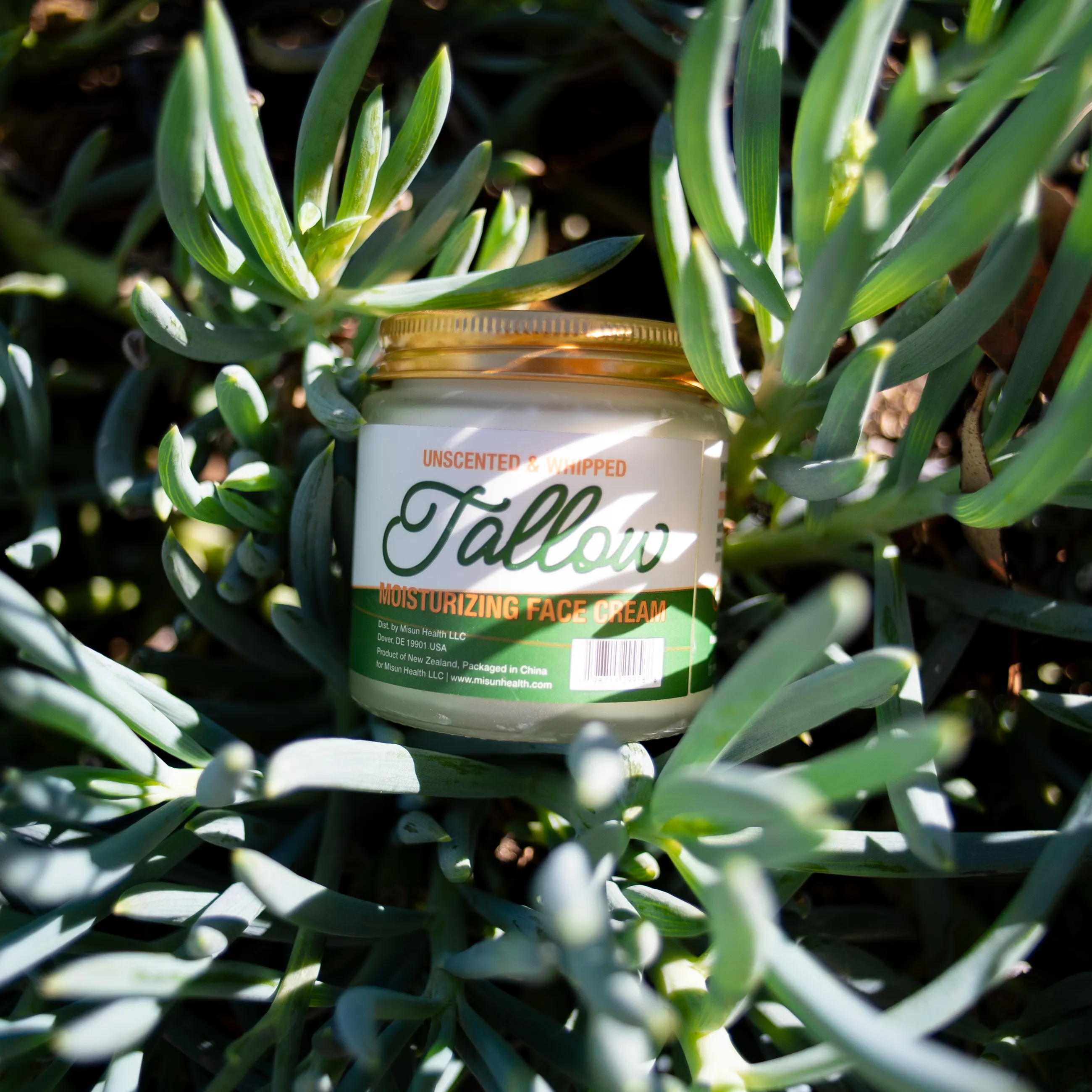
Both Misun Health products are fragrance-free and come in jars, so use a clean fingertip each time rather than going back in with one that has touched your mouth. Whipped Tallow Cream is 100 percent grass-fed New Zealand beef tallow, whipped so it spreads in a thin, even layer, which suits quick daytime touch-ups that should not look glossy. Beef Tallow Balm is denser and stays put better on the lips and at the corners of the mouth, so it is the better fit for the bedtime layer and for cold, windy days. If you want one jar just for lips, choose the balm. If the same jar also has to cover your face or hands, the whipped cream spreads further.
When dry lips need a dermatologist, not another layer
AAD's rule is simple: if dry, chapped lips have not healed after 2 to 3 weeks of self-care, see a board-certified dermatologist. The academy notes that other causes, including an allergic reaction or a yeast infection, can also leave lips dry, and it flags actinic cheilitis, the precancerous condition that makes one or both lips dry and scaly. Lips that swell or bleed, or that flare soon after a new toothpaste, lip product or food, need a diagnosis rather than a richer moisturizer. Tallow is a cosmetic for dry lips, and none of those is simple dryness.
FAQ
Common Questions
Is it safe to swallow the tallow on my lips?
For most people, yes. Beef tallow is an ordinary food fat, and even if all 57 milligrams of the European daily figure for lip products were swallowed, that is 0.45 percent of a 12.8 gram tablespoon and about half a calorie. The exception is alpha-gal syndrome: CDC lists products made or cooked with mammal fat, including tallow, among those some people with the syndrome may be sensitive to.
Is beef tallow better than Vaseline for chapped lips?
Not on sealing power alone. Petrolatum at 5 percent or more reduces water loss through skin by more than 98 percent, and tallow has not been measured the same way. Tallow is the pick if you want a single, fragrance-free fat without petroleum or lanolin, and you can use both: tallow by day, petrolatum on the driest nights.
Can I use beef tallow as a lip balm every day?
Yes. AAD recommends a non-irritating lip balm several times a day and before bed, and plain tallow contains none of the ingredients on the academy's avoid list for chapped lips. Keep daytime layers thin and save the thicker layer for bedtime.
Does tallow protect lips from the sun?
No. Tallow has no SPF. AAD advises a lip balm with SPF 30 or higher before going outdoors, reapplied every 2 hours while you are outside, and lists sun-protective ingredients such as titanium oxide or zinc oxide among those that help chapped lips.
Can tallow go rancid on my lips?
An open jar can oxidize over time, but tallow holds up better than oils rich in linoleic acid because only about 4 percent of it is polyunsaturated, the fraction that oxidizes fastest. If a jar starts to smell stale or rancid, replace it instead of putting it on your lips.
I react to lanolin lip balms. Is tallow different?
Yes. They are different substances: tallow is rendered beef fat, and lanolin is a wax from sheep's wool. AAD lists lanolin among the ingredients to avoid on chapped lips, and plain tallow contains none, so check that a tallow blend has not added it.
Should I use Whipped Tallow Cream or Beef Tallow Balm on my lips?
The balm for the bedtime layer and the corners of the mouth, because its denser texture stays put. The whipped cream for thin daytime touch-ups, or when the same jar also covers your face.
Primary sources
Sources and evidence limits
- American Academy of Dermatology: 7 dermatologists' tips for healing dry, chapped lips
Source for the ingredients to avoid while lips are chapped (camphor, eucalyptus, flavoring, fragrance, lanolin, menthol, octinoxate or oxybenzone, phenol or phenyl, propyl gallate, salicylic acid) with cinnamon, citrus, mint and peppermint flavors singled out; the ingredients that can help, a list that does not include tallow; ointment sealing in water longer than waxes or oils; lip balm several times a day and before bed; SPF 30 or higher before going outdoors with reapplication every 2 hours; saliva drying the lips as it evaporates; the bedroom humidifier for mouth breathing at night; the 2 to 3 week self-care window; and actinic cheilitis.
- Kobayashi H, Tagami H. Functional properties of the surface of the vermilion border of the lips are distinct from those of the facial skin. British Journal of Dermatology, 2004, volume 150, pages 563 to 567
303 healthy Japanese women aged 21 to 80, measured in winter. Source for lip water loss at almost three times the cheek, surface hydration about one third of the cheek, larger parakeratotic surface cells, and the authors' attribution of the lips' poor barrier function and water-holding capacity to incomplete corneocyte formation.
- Loretz LJ, Api AM, Barraj LM, et al. Exposure data for cosmetic products: lipstick, body lotion, and face cream. Food and Chemical Toxicology, 2005, volume 43, pages 279 to 291
Two-week US use study in which products were weighed at the start and the end. Source for lipstick use at a mean of 10 milligrams per application (median 5), a mean of 24 milligrams per day (median 13) and a mean of 2.35 applications per day.
- Scientific Committee on Consumer Safety: The SCCS Notes of Guidance for the Testing of Cosmetic Ingredients and Their Safety Evaluation, 12th revision, SCCS/1647/22 (adopted 15 May 2023, corrigendum 2 adopted 21 December 2023)
Table 3A gives 0.057 grams per day as the estimated daily amount applied for lipstick and lip salve, calculated from Hall et al. 2007 and 2011. Section 3-3.4.1.2 describes lipstick as normally not intended to be ingested and says the oral retention factor will normally be small.
- USDA FoodData Central: Fat, beef tallow (FDC ID 171400, SR Legacy)
Source for 12.8 grams per tablespoon, 902 calories per 100 grams, and 49.8 grams saturated, 41.8 grams monounsaturated and 4.0 grams polyunsaturated fat per 100 grams. The 0.45 percent, half a calorie and 225 day figures are our arithmetic from these values and the SCCS lip product figure.
- Faridah MR, Hairi ANA, Yusoff MM, Rozzamri A, Ibadullah WZW, Ismail-Fitry MR. Comparison of the physicochemical properties of palm-based shortenings of various melting temperatures and animal fats. Food Chemistry: X, 2025, volume 28, article 102583
Measured beef fat directly. Source for the slip melting point of 40.77°C and solid fat content of 36.85 percent at 25°C, 26.35 percent at 30°C and 16.11 percent at 35°C. Fahrenheit conversions are ours.
- Huang X, Ahn DU. Lipid oxidation and its implications to meat quality and human health. Food Science and Biotechnology, 2019, volume 28, pages 1275 to 1285
Source for relative oxidation rates against stearic acid at 1: oleic acid 100, linoleic acid 1,200 and linolenic acid 2,500, and for aldehydes, especially hexanal, as the main cause of off-odors in oxidized meat.
- Sethi A, Kaur T, Malhotra SK, Gambhir ML. Moisturizers: The Slippery Road. Indian Journal of Dermatology, 2016, volume 61, pages 279 to 287
Review source for petrolatum at a minimum concentration of 5 percent reducing transepidermal water loss by more than 98 percent, against 20 to 30 percent for lanolin, mineral oil and silicones. The review cites Lynde 2001 and Spruit 1971 for these figures.
- Zug KA, Kornik R, Belsito DV, et al. Patch-testing North American lip dermatitis patients: data from the North American Contact Dermatitis Group, 2001 to 2004. Dermatitis, 2008, volume 19, pages 202 to 208
Source for 196 of 10,061 patch-tested patients (2 percent) with lip-only involvement, 75 of them (38.3 percent) diagnosed with allergic contact cheilitis, and fragrance mix, Myroxylon pereirae and nickel as the most common relevant allergens.
- FDA Final Administrative Order OTC000005, Over-the-Counter Monograph M016: Skin Protectant Drug Products for Over-the-Counter Human Use (posted September 24, 2021)
Source for the definition of a lip protectant drug product, active ingredient strengths including petrolatum and white petrolatum at 30 to 100 percent, lanolin at 12.5 to 50 percent, cocoa butter and hard fat at 50 to 100 percent and dimethicone at 1 to 30 percent, and the permitted lip claims. Beef tallow is not among the listed active ingredients.
- FDA: Is It a Cosmetic, a Drug, or Both? (Or Is It Soap?) (content current as of September 11, 2024)
Source for a product's intended use, established by claims on labeling, in advertising and in other promotional materials, as what decides whether it is a cosmetic or a drug under the law.
- CDC: Fast Facts: Products That May Contain Alpha-gal (January 5, 2026)
Source for products made or cooked with mammal fat, like lard, tallow or suet, among those some people with alpha-gal syndrome may be sensitive to, and for people with the syndrome not reacting to every product containing alpha-gal.
- CDC: About Alpha-gal Syndrome (reviewed January 5, 2026)
Source for alpha-gal as a molecule found in most mammals, such as cows and pigs, but not in people; alpha-gal syndrome as a serious, potentially life-threatening allergy and tickborne disease; and the lone star tick as the tick most often associated with it in the United States.
- Thompson JM, Carpenter A, Kersh GJ, Wachs T, Commins SP, Salzer JS. Geographic Distribution of Suspected Alpha-gal Syndrome Cases, United States, January 2017 to December 2022. MMWR, 2023, volume 72, pages 815 to 820
Source for 110,229 suspected cases documented from 2010 to 2022 and the estimate that 96,000 to 450,000 people in the United States might have been affected by alpha-gal syndrome since 2010.
Use the tools
Related skincare tools
- Moisturizer Ingredient DecoderPaste a lip balm's ingredient list to see which entries are occlusives or emollients and which are fragrance-related, including essential oils such as peppermint or lavender.Open tool
- Fragrance Label CheckerCheck a lip product's ingredient declaration for fragrance, perfume or parfum before it goes on chapped lips.Open tool
- Fatty Acid Comparison for Skincare Oils and ButtersCompare the polyunsaturated share and relative oxidation index of tallow with shea, coconut and the other fats found in lip balms.Open tool
- Indoor Humidity Calculator for Dry SkinAAD suggests a bedroom humidifier if you breathe through your mouth at night. See how dry your heated indoor air actually gets before you buy one.Open tool
Keep reading
Related guides
Explore next
Related skin concerns
Shop the routine
Build your tallow routine
Shop the products that best match the concerns and routines covered in this guide.