Informational + safety research · 15 min read
Does Beef Tallow Have SPF? What a Sun Protection Number Actually Requires
A sourced answer to whether beef tallow works as sunscreen: where the SPF numbers quoted for natural oils come from, what US law requires before a product can print an SPF, and how a tallow moisturizer fits a summer routine without pretending to be sun protection.
Last updated August 16, 2026
The short answer, before anything else
Plain beef tallow is not sunscreen and does not carry an SPF. Neither does Whipped Tallow Cream, Beef Tallow Balm, or any other product that lists only rendered fat on its ingredient declaration. If you are outdoors and want to be protected from ultraviolet radiation, use a product that has been tested as a sunscreen and labeled as one. This is not a cautious hedge added by a lawyer. It is a statement about what SPF is, which turns out to be a specific measurement produced by a specific test, and about what US law requires before anyone is permitted to print that number on a jar. The rest of this guide explains where the SPF numbers you have seen attached to natural oils actually come from, why they do not mean what they appear to mean, and where a tallow moisturizer genuinely does belong in a routine during the months you are spending time in the sun.
SPF is a measured ratio, not a property you can estimate
Sun protection factor describes how much longer it takes ultraviolet radiation to produce the faintest visible reddening of protected skin compared with unprotected skin on the same person. The US test method is written into federal regulation at 21 CFR 201.327, and it is unusually prescriptive. The product has to be applied at 2 milligrams per square centimeter, a thickness the regulation specifies exactly because the number changes if the film changes. Valid results are required from a minimum of ten human subjects, with no more than three subjects rejected from a panel. Separate tests govern separate claims: a broad spectrum claim requires a mean critical wavelength of 370 nanometers or greater, and a water resistance claim requires either two or four twenty-minute water immersion periods with fifteen-minute air rests between them, which is what produces the 40 minute and 80 minute figures you see on labels. None of this can be inferred from an ingredient. It has to be run, on people, on the finished formula.
In the United States, sun protection is a drug claim
This is the part most shoppers have never been told, and it explains why the market looks the way it does. A moisturizer is a cosmetic. A sunscreen is an over-the-counter drug. The line between them in US law is intended use, and a claim of sun protection is a claim to prevent a condition, which places the product on the drug side. That is why sunscreens carry a Drug Facts panel with an active ingredients list rather than only a cosmetic ingredient declaration, and why the labeling is so tightly scripted. A product that meets SPF 15 or higher and passes the broad spectrum test may state that, if used as directed with other sun protection measures, it decreases the risk of skin cancer and early skin aging caused by the sun. A product that is below SPF 15 or fails the broad spectrum test is required to carry a Skin Cancer/Skin Aging Alert stating that it has been shown only to help prevent sunburn. Those sentences are not marketing copy that a brand chose. They are regulated text. A cosmetic moisturizer cannot opt into any of it, and a brand that prints an SPF without having run the test is not being generous, it is making an unsupported drug claim.
Where the SPF numbers quoted for natural oils actually come from
Almost every article claiming that a natural oil has an SPF traces back, directly or through a chain of citations, to a small number of laboratory papers that used a spectrophotometric shortcut rather than a human test. The most widely cited is Kaur and Saraf in Pharmacognosy Research in 2010, which reported figures such as olive oil and coconut oil near 8, castor oil near 6, almond oil near 5, and sesame oil near 2. Read the method section and the meaning of those numbers changes completely. The oils were not applied to skin. They were dissolved into a 40:60 ethanol and water mixture, prepared as a one percent stock and then diluted to one tenth of one percent, and read in a spectrophotometer at five nanometer intervals from 290 to 320 nanometers, with the absorbance figures plugged into an equation published by Mansur and colleagues. The authors are candid about the constraints: increasing the oil concentration made the solution turbid and unreadable, and decreasing it produced negative readings, so 0.1 percent was the window where the instrument would cooperate at all. They describe the technique as a rapid quality-control and screening method used before in vivo testing, not as a substitute for it. What that study measured is how a very dilute solution of oil absorbs a narrow band of ultraviolet light inside a cuvette. It did not measure how a film of that oil on human skin performs against sunlight, and it never claimed to.
Why an in vitro reading and a real SPF are not interchangeable
The gap between a spectrophotometer reading and a human test result is not a rounding issue, and the sunscreen industry has spent roughly half a century trying to close it. Attempts to correlate spectrophotometric results with human panel results have repeatedly failed to produce a good correlation, which is the reason the human test survived so long despite being expensive and ethically awkward. The physics of why is straightforward. A real sunscreen film is not a solution. It is an uneven layer sitting on a surface with hills, valleys, and pores, and its performance depends on how the film dries, how it distributes, whether the particles or molecules stay dispersed, and how it behaves against sweat and friction. A cuvette has none of that. The industry is only now arriving at validated alternative methods, and even those are contested: formulators using zinc oxide at 10 to 25 percent have argued that some in vitro methods report values below what the human test gives their products, because zinc particles scatter ultraviolet light in ways that distort an absorbance reading. That argument runs in the opposite direction from the natural oil claims, but it makes the same underlying point. An instrument reading a dilution is not a person standing in the sun.
Even taken at face value, those numbers are small
Suppose for a moment you accepted the cuvette figures as real. The arithmetic still does not support using an oil as sun protection, because the SPF scale is not linear in the way people read it. The fraction of erythema-causing ultraviolet that gets through is roughly one divided by the SPF. An SPF of 2 lets about half through. An SPF of 4 lets a quarter through. An SPF of 8, the highest figure in that oil study, lets about an eighth through, which is 87.5 percent blocked. That sounds respectable until you compare it with an SPF 30, which the American Academy of Dermatology describes as blocking 97 percent of UVB, or with the SPF 30 or higher that the AAD actually recommends alongside broad spectrum protection and water resistance. Put in terms of transmitted dose rather than percentage blocked, the comparison is starker: an SPF 8 lets through nearly four times as much as an SPF 30. And remember the regulatory floor. A product below SPF 15 is not permitted to claim anything about skin cancer or skin aging at all, only sunburn. A hypothetical SPF 8 oil would sit below that line even if the number were honestly earned, which it is not.
Real sunscreen filters are a short and specific list
In its 2019 proposed rule, the FDA reviewed the sixteen active ingredients then marketed in US sunscreens and reached a conclusion that surprises most people: only two, zinc oxide and titanium dioxide, were found generally recognized as safe and effective for sunscreen use, at concentrations up to 25 percent. Two others, aminobenzoic acid and trolamine salicylate, were found not to be. For the remaining twelve, including avobenzone, oxybenzone, octinoxate, octisalate, octocrylene and homosalate, the agency said the available safety data were insufficient to make a positive determination at that time, which is a request for more data rather than a finding of harm. The regulatory machinery around this changed shape in 2020, when the CARES Act replaced notice-and-comment rulemaking for over-the-counter monograph drugs with an administrative order process and deemed the existing sunscreen monograph final, and the FDA issued a proposed order to amend it in September 2021. The important thing for a shopper is the short list itself. Beef tallow is not on it. Neither is any other rendered fat, plant oil, or butter.
Tallow plus zinc oxide is a different product from tallow
There are products on the market that combine a tallow base with non-nano zinc oxide and sell as sunscreen, and it is worth being precise rather than dismissive about them. Zinc oxide is a legitimate filter, so a tallow-and-zinc product is not inherently unserious. But the base is not what protects you, the zinc is, and the only thing that tells you whether a particular formula actually delivers the number on the front is whether it was tested and labeled as a drug. That is checkable in about ten seconds. A product regulated as a sunscreen carries a Drug Facts panel. It lists an active ingredient with a percentage. It states an SPF value, and it states whether it is broad spectrum, and if it claims water resistance it says 40 minutes or 80 minutes rather than something vague. If a jar has none of that and instead has a cosmetic ingredient declaration with a marketing claim about sun protection on the front, the number has not been earned through the test that gives it meaning. This is a documentation question, not a naturalness question, and it applies identically to conventional brands.
The homemade version has a problem that good intentions cannot fix
Recipes for mixing zinc oxide powder into melted tallow circulate widely, and the failure mode is not the ingredient list, it is dispersion. Zinc oxide protects by forming an even layer across the skin surface, and getting a fine powder evenly and stably suspended in a fat that is solidifying as it cools is a manufacturing problem that industrial formulators use high-shear equipment and dispersing agents to solve. A kitchen mix that looks uniform in the jar can be uneven in the layer you actually spread, and the thin spots are exactly where you burn. There is a second, quieter problem: even a perfectly dispersed batch has no tested SPF, so the person applying it has no idea whether to reapply hourly or every three hours, and no idea whether it survives swimming. Adding zinc to a moisturizer you already own has the same defect in a worse form, because the dilution changes both the concentration and the film, and neither is measurable at home. The reasonable version of this instinct is to buy a mineral sunscreen that has been through the test.
A mechanism worth knowing: oil on skin can work the wrong way
There is a reason to be actively careful here rather than merely unimpressed, and it comes from tissue optics rather than dermatology. Skin scatters incoming light heavily, partly at the surface where the refractive index changes abruptly between air and the stratum corneum. Optical clearing is the well-documented practice of applying an index-matching agent to reduce that scattering so more light penetrates, and it is used deliberately in imaging and image-guided surgery to see deeper into tissue. Clear lipophilic liquids are among the agents shown to reduce regular reflectance by exactly this refractive-index-matching mechanism. Be precise about what this does and does not establish: no published study has measured the minimal erythema dose of human skin coated in beef tallow, so there is no number to quote, and this is a mechanistic reason for caution rather than a demonstrated effect for this material. But it does mean the intuitive picture, in which a layer of grease must surely block at least something, is not safe to rely on. A substance with no meaningful absorbance in the sunburn waveband that also reduces surface scattering is not obviously working in your favor. This is also the plain explanation for why tanning oils exist and look, ingredient for ingredient, a great deal like the oils being recommended as sunscreen.
Why so many people now believe the opposite
The belief that tallow or other natural fats can replace sunscreen is not a fringe position any more, and there is published work tracking how it spread. Content analyses of sunscreen material on TikTok have found that although the large majority of videos promote sunscreen use and only a small minority are critical of it, the posts containing misinformation attract disproportionately high audience interaction. A 2025 analysis in JMIR Dermatology examined the quality and accuracy of popular sunscreen content on the platform, and researchers documenting the #nosunscreen tag have catalogued videos advancing the claim that sunscreen is unnecessary or harmful. Dermatology commentary describing this wave names the substitution of beef tallow and other oils for regulator-approved sunscreens as one of the specific myths in circulation. Understanding the mechanism is useful because it explains why the claim feels so widely held: engagement, not prevalence, is what makes something look like consensus. Very few people are checking whether the SPF figure in a caption came from a human panel or from a tenth of a percent solution in a cuvette.
The application gap that affects your real sunscreen too
It would be dishonest to spend this much of a guide on what tallow cannot do without mentioning that most people are not getting the number printed on their sunscreen either. The 2 milligrams per square centimeter written into the test method is considerably more product than people apply in practice. Petersen and Wulf, reviewing the field in Photodermatology, Photoimmunology and Photomedicine, found real-world application clustering around 0.39 to 1.0 milligrams per square centimeter, with a beach study measuring 0.5, which is roughly 20 to 50 percent of the tested amount. The practical translations are well established: about one ounce, the volume of a shot glass, to cover the exposed skin of an average adult, and at least a teaspoon for the face alone, which the AAD describes as about the amount that covers the length of your index and middle fingers. Reapply approximately every two hours, and after swimming or sweating. The reason this belongs in a guide about tallow is that it changes the shape of the advice. Using more of a real sunscreen, more often, is a far larger improvement than anything you could add to your routine, and it is the step most people skip.
So where does a tallow moisturizer actually fit in summer?
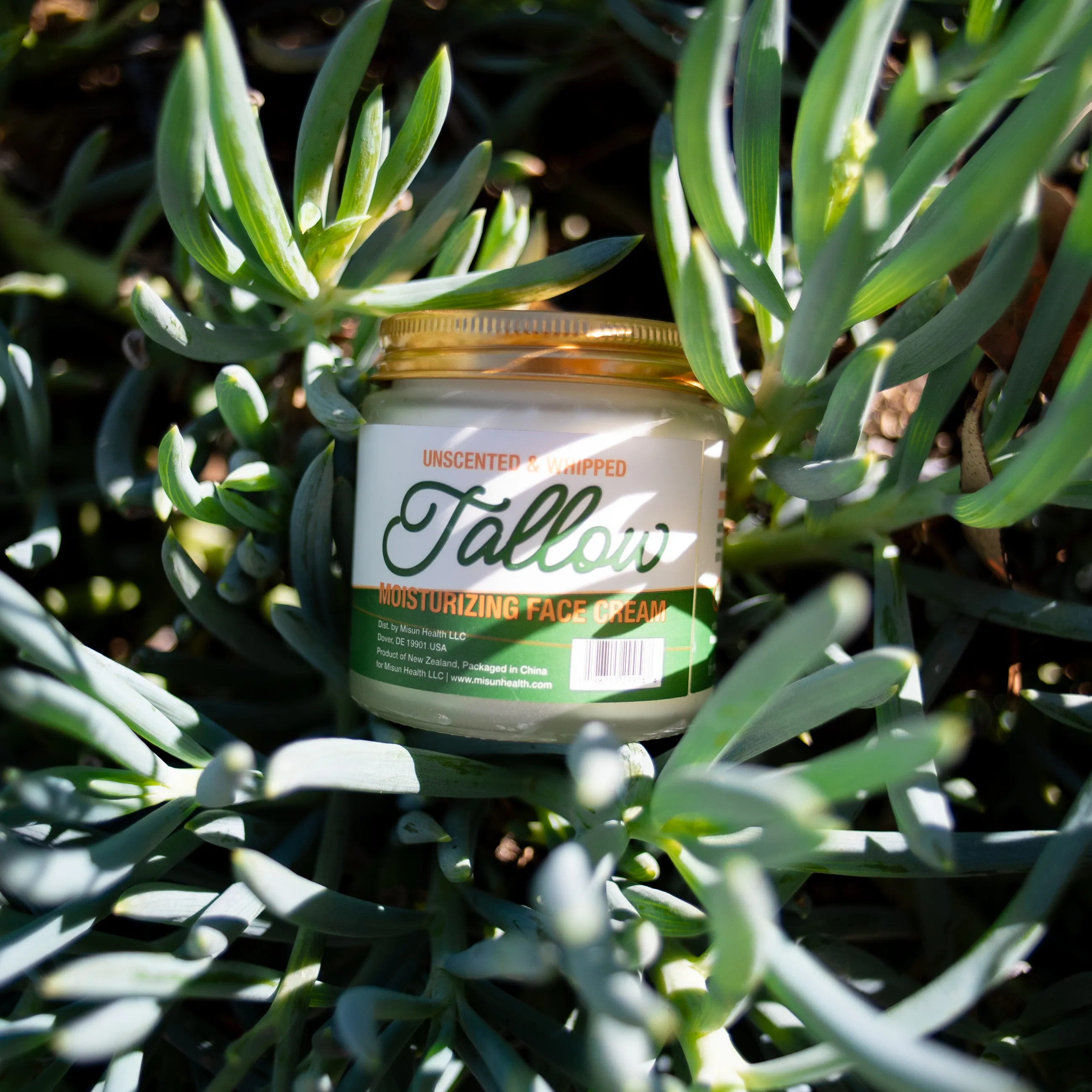
Underneath, and afterwards. In a morning routine, sunscreen has to finish as the outermost continuous film, so anything you apply over it can disturb that layer. A moisturizer goes on first, gets a minute or two to settle, and then sunscreen goes on top, with the AAD noting that it takes roughly fifteen minutes for skin to absorb sunscreen and be protected, so the sensible sequence ends indoors rather than at the front door. If your skin feels tight and dry after a day outdoors, in wind, or after repeated swimming and toweling, that is exactly the kind of dry-feeling skin a rich occlusive is for, and a thin layer of Whipped Tallow Cream in the evening is a reasonable answer. Beef Tallow Balm is the denser option for smaller targeted areas such as hands, knuckles, and heels. Both are cosmetic moisturizers for skin that feels dry, they are not treatments for sun damage or for any skin condition, and neither one contributes any sun protection. Our skincare layering order planner works out the sequence and the waiting intervals if you are combining several products in the morning.
A short checklist for any sun protection claim
Five questions settle almost every case. Does the package have a Drug Facts panel, or only a cosmetic ingredient declaration? Is there a named active ingredient with a percentage, and is it zinc oxide or titanium dioxide or one of the other listed filters? Does it state an SPF number and the words broad spectrum, and is the SPF 30 or higher? If it claims water resistance, does it say 40 minutes or 80 minutes specifically? And if the seller cites a study for an SPF figure, does that study describe applying the finished product to human skin at 2 milligrams per square centimeter across a panel, or does it describe a dilution measured in a spectrophotometer? That last question is the one that quietly resolves most of the natural sunscreen debate, and almost nobody asks it. A brand that has done the work will answer all five without hesitation, because the answers are printed on the package by law.
FAQ
Common Questions
Does beef tallow have an SPF?
No. Plain beef tallow has no tested SPF and is not a sunscreen. SPF is a value produced by a specific human test, applied at 2 milligrams per square centimeter across a panel of at least ten subjects under 21 CFR 201.327, and rendered fat has never been shown to earn a meaningful figure that way. Any SPF number you see attached to a natural oil almost certainly comes from a laboratory absorbance reading of a dilute solution rather than from that test.
Can I use tallow instead of sunscreen?
No. Use a product tested and labeled as a sunscreen. The American Academy of Dermatology recommends broad spectrum, SPF 30 or higher, and water resistant. Tallow is a cosmetic moisturizer for skin that feels dry, and using it in place of sunscreen leaves you unprotected while feeling covered, which is the worst combination.
Is a tallow sunscreen with zinc oxide legitimate?
It can be, and the deciding factor is documentation rather than the base. Zinc oxide is one of only two active ingredients the FDA found generally recognized as safe and effective for sunscreen use in its 2019 proposed rule, at up to 25 percent. What tells you a specific product delivers its claimed protection is that it is labeled as an over-the-counter drug: a Drug Facts panel, a named active ingredient with a percentage, an SPF value, a broad spectrum statement, and a specific 40 or 80 minute water resistance claim if it makes one.
Where did the claim that coconut oil has SPF 7 come from?
From Kaur and Saraf, published in Pharmacognosy Research in 2010, which reported spectrophotometric values near 8 for coconut and olive oil. The oils in that study were diluted to one tenth of one percent in an ethanol and water mixture and read in an instrument between 290 and 320 nanometers. Nothing was applied to skin. The authors describe the technique as a rapid screening method used before in vivo testing, and note that higher concentrations made the solution too turbid to read.
Should I put tallow on before or after sunscreen?
Before. Sunscreen needs to sit on the outside as an unbroken film, so it goes on last in a morning routine, and anything spread over it afterwards can pull that film into an uneven layer. Apply your moisturizer, give it a minute or two to settle, then apply sunscreen, and allow about fifteen minutes before going outdoors, which is roughly how long the AAD says it takes for skin to absorb sunscreen and be protected.
Does putting oil on skin block any UV at all?
Not in any amount you should count on, and there is a mechanism suggesting caution rather than reassurance. Optical clearing is the documented practice of applying an index-matching agent to skin to reduce surface scattering so more light penetrates, and clear lipophilic liquids are among the agents shown to do it. No study has measured the minimal erythema dose of skin coated in beef tallow, so there is no figure to quote either way, but the assumption that a greasy layer must block something is not a safe one to rely on.
Can I make my own tallow sunscreen by mixing in zinc oxide powder?
It is not a good idea, and the reason is dispersion rather than ingredients. Zinc oxide only protects where it forms an even layer, and suspending a fine powder evenly in a fat that is setting as it cools is a manufacturing problem that industrial formulators solve with high-shear equipment. A batch that looks uniform in the jar can be uneven in the film, and the thin spots are where you burn. A homemade batch also has no tested SPF, so you have no basis for a reapplication interval.
Is tallow useful after a day in the sun?
For skin that feels dry and tight, yes, in the ordinary way any rich moisturizer is. Wind, water, and repeated toweling leave skin feeling dry, and a thin layer of an occlusive in the evening addresses that feeling. That is a cosmetic use. Tallow is not a treatment for sunburn, sun damage, or any skin condition, and it does not undo an exposure you were not protected from.
Am I getting the SPF printed on my sunscreen?
Probably not, and this is the most useful thing in this guide. The test applies 2 milligrams per square centimeter, while field studies reviewed by Petersen and Wulf found people applying roughly 0.39 to 1.0, which is about 20 to 50 percent of the tested amount. The practical fix is volume and frequency: about an ounce for the body, at least a teaspoon for the face, and reapplication approximately every two hours or after swimming or sweating.
Primary sources
Sources and evidence limits
- 21 CFR 201.327: Over-the-counter sunscreen drug products, required labeling based on effectiveness testing
Source for the 2 mg/cm2 application amount, the minimum of ten valid test subjects, the 370 nanometer critical wavelength threshold for broad spectrum, the 40 and 80 minute water resistance protocols, and the exact required wording of both the skin cancer claim and the Skin Cancer/Skin Aging Alert.
- FDA: Sunscreen Drug Products for Over-the-Counter Human Use, proposed rule (February 2019)
Source for the finding that of the sixteen marketed active ingredients, only zinc oxide and titanium dioxide are generally recognized as safe and effective at up to 25 percent, that two are not, and that data were insufficient for the remaining twelve.
- FDA: Amending Over-the-Counter Monograph M020, Sunscreen Drug Products, proposed order (September 2021)
Source for the current regulatory posture after the CARES Act replaced rulemaking with administrative orders and deemed the existing sunscreen monograph final.
- Kaur and Saraf, 2010: In vitro sun protection factor determination of herbal oils used in cosmetics (Pharmacognosy Research)
The origin of most SPF figures quoted for natural oils. Source for the reported values, the 0.1 percent hydroalcoholic dilution, the 290 to 320 nanometer spectrophotometric method, the turbidity constraint, and the authors' own description of it as a screening method used before in vivo testing.
- Petersen and Wulf, 2014: Application of sunscreen, theory and reality (Photodermatology, Photoimmunology and Photomedicine)
Source for the gap between the 2 mg/cm2 test thickness and real-world application of roughly 0.39 to 1.0 mg/cm2, and for the finding that people apply about 20 to 50 percent of the amount needed to achieve the labeled SPF.
- American Academy of Dermatology: Sunscreen FAQs
Source for the broad spectrum, SPF 30 or higher, water resistant recommendation, the figure that SPF 30 blocks 97 percent of UVB, the one ounce and one teaspoon application amounts, and the approximately two hour reapplication interval.
- American Academy of Dermatology: How to select a sunscreen
Source for the fifteen minute interval between applying sunscreen and being protected outdoors, which sets the order of operations for a morning routine.
- Perception, Quality, and Accuracy of Sunscreen Content on TikTok (JMIR Dermatology, 2025)
Cross-sectional content analysis of popular sunscreen material on the platform, used here for the state of public sunscreen information rather than for any claim about a product.
- Sunscreen is overwhelmingly promoted on TikTok, but content with misinformation exhibits proportionally high levels of audience interaction (PLOS Digital Health)
Source for the finding that misinformation is a small minority of sunscreen posts but attracts disproportionate engagement, which explains why substitution claims feel more widely held than they are.
- Anderson and Parrish, 1981: The optics of human skin (Journal of Investigative Dermatology)
Background on how skin attenuates ultraviolet radiation, including the role of epidermal thickness and melanin at different wavelengths, used for the scattering discussion.
- Optical Clearing of the Skin for Near-Infrared Fluorescence Image-Guided Surgery (Journal of Biomedical Optics)
Source for optical clearing by refractive index matching as a documented way to reduce skin surface scattering and increase light penetration. Cited as a mechanism for caution, not as a measured effect for tallow.
Use the tools
Related skincare tools
- Skincare Layering Order PlannerWork out the order and the waiting intervals for a morning routine that ends with sunscreen, including how long to leave between a moisturizing layer and the sunscreen film.Open tool
- Moisturizer Ingredient DecoderPaste an ingredient list to see what each entry is doing, which makes it easier to tell a cosmetic declaration apart from a Drug Facts active ingredient panel.Open tool
- Fragrance Label CheckerCheck a sunscreen or moisturizer declaration for fragrance, perfume, or parfum before trusting a fragrance-free line on the front of the package.Open tool
Keep reading
Related guides
Shop the routine
Build your tallow routine
Shop the products that best match the concerns and routines covered in this guide.