Informational + pre-purchase research · 13 min read
Is Beef Tallow Good for Dry Skin? How It Works and How to Use It
Yes, for most dry skin. Beef tallow is a water-free fat that softens rough, flaky skin and slows the water skin loses to the air, which is what a moisturizer for dry skin is meant to do. It holds water in rather than adding any, so it works best smoothed onto damp skin straight after washing, with a humectant underneath if tightness comes back.
Last updated November 23, 2026
Short answer: yes, as a softener and a seal
Beef tallow is good for most dry skin. It is a fat, and on skin it does two of the three jobs a moisturizer can do: it softens rough, flaky patches, and it leaves a film that slows the water skin loses to the air. Dermatology reviews call these the emollient and occlusive jobs. The third job, attracting water into the outer skin, belongs to humectants such as glycerin. Tallow is not one. It is a water-repelling fat with no water of its own, and USDA lists beef tallow at zero grams of water per 100 grams. So tallow works by keeping in water that is already there, which pairs it with the American Academy of Dermatology (AAD) advice to apply moisturizer while skin is still damp after a shower or bath. PubMed lists no controlled trial of beef tallow on dry skin, so the case for it rests on its chemistry and on studies of fats that behave like it.
What dry skin is, in numbers
The AAD's definition is plain: when skin loses water too quickly, it becomes dry. A 2016 review in the Indian Journal of Dermatology places the visible threshold at a moisture content below 10 percent in the stratum corneum, the outer layer of dead skin cells. Dry skin is common, and it climbs with age. When dermatologists examined 48,630 employees in 343 German companies, they rated 29.4 percent as having dry skin, and older age, not gender, was the factor linked to it. The AAD says nearly everyone has dry skin by age 60. Everyday causes come down to stripping and evaporation: deodorant soaps and harsh cleaning products that remove the skin's oils and fats, long hot showers, and cold air, which holds less moisture. The AAD also names medicines such as statins and diuretics, and conditions including diabetes, thyroid disease and kidney disease.
Two of the three moisturizer jobs
Moisturizer ingredients are grouped by what they do. Humectants such as glycerin and hyaluronic acid attract water, mostly up from the deeper layers of skin. Emollients are lipids and oils that make skin softer, more flexible and smoother. Occlusives lay down a water-repelling film that physically slows transepidermal water loss, the steady evaporation of water through the skin. Beef tallow is rendered beef fat, made of triglycerides, so it sits with the emollients and the occlusives. The 2016 review adds a point that matters here: humectants used alone can increase water loss, because they pull water into the outer skin where it is easily lost, and that is why they are usually combined with an occlusive. Tallow can be the occlusive half of that pairing. Used alone, it needs water underneath it to hold.
How strong a seal tallow makes
Petrolatum is the benchmark for a seal. In the 2016 review, petrolatum at a concentration of at least 5 percent reduced transepidermal water loss by more than 98 percent, while lanolin, mineral oil and silicones reduced it by 20 to 30 percent. We found no measurement of the same kind for beef tallow, in PubMed or in the 2024 scoping review described below, so any percentage quoted for tallow's seal is an estimate rather than a result. Its physical state has been measured. In a 2025 study in Food Chemistry: X, fat extracted from beef was 26.35 percent solid at 30 °C (86 °F) and 16.11 percent solid at 35 °C (95 °F), a commonly used reference value for average skin temperature, and its slip melting point was 40.77 °C (105.4 °F). Part of a tallow layer stays crystalline on skin, which is why tallow feels denser than a liquid oil.
What tallow shares with your skin's own oil
Skin has two lipid systems, and tallow resembles part of one. On the surface sits sebum, the oil made by sebaceous glands. A 2009 review in Dermato-Endocrinology describes sebaceous lipids as mainly triglycerides, wax esters and squalene, while the lipids the skin cells make themselves are ceramides, free fatty acids and cholesterol. Tallow is triglycerides, so it resembles the triglyceride part of sebum, not all of it. USDA lists beef tallow at 36.0 grams of oleic acid, 24.9 grams of palmitic acid and 18.9 grams of stearic acid per 100 grams, with 3.1 grams of linoleic acid and 49.8 grams of saturated fat in all. Below the surface, the lipids holding skin together are a different mix.
What tallow does not supply: the barrier lipids
The stratum corneum is often compared to a brick wall: flattened cells held together by a lipid mortar. A 2007 review in the Journal of Lipid Research puts that mortar at roughly 50 percent ceramides, 25 percent cholesterol and 15 percent free fatty acids. Tallow does not supply that mix. It is triglyceride fat with a trace of cholesterol, which USDA lists at 109 milligrams per 100 grams, about 0.1 percent, and its fatty acids are bound into triglycerides rather than free. The same review notes that physiologic lipids applied to the skin can improve barrier function, and ceramide moisturizers are built on that idea. Tallow and a ceramide cream are different tools: tallow softens and seals from the outside, and a ceramide cream supplies some of the mortar. On very dry skin they can be layered, the ceramide cream first and a thin layer of tallow over it.
A useful comparison: coconut oil against mineral oil
A controlled trial of coconut oil shows what this kind of evidence looks like. In 2004, Agero and Verallo-Rowell randomized 34 people with mild to moderate xerosis, the medical term for dry skin, to apply virgin coconut oil or mineral oil to their legs twice a day for two weeks, in a double-blind design. Both oils improved skin hydration and raised surface lipid levels by comparable amounts, the groups did not differ on transepidermal water loss or skin pH, and no adverse reactions were reported. Coconut oil is a plant fat with a different fatty acid makeup from tallow, so the result does not carry over directly, and tallow has not had a test of this kind.
What has been published on tallow itself
Very little. A PubMed search for tallow together with xerosis, dry skin, moisturizer, moisturiser, emollient or emollients in a title or abstract returns a single paper, a 2024 scoping review in Cureus. Its authors screened 147 records from PubMed and EMBASE, kept 19, and found that most of the published evidence on tallow and skin lacks human subjects. Several of the 19 concern tallow amine, a surfactant made from tallow for herbicide formulations, rather than the fat itself. The nearest human data are ratings, not measurements: in a 2015 study in the International Journal of Cosmetic Science, 83 respondents assessed cosmetic emulsions made from mutton tallow that had been enzymatically interesterified with walnut oil. That is sheep fat, chemically reworked and blended into a cream, which says little about a jar of plain beef tallow.
Why a tallow jar says moisturizer
US law sorts skin products by intended use. Under the Federal Food, Drug, and Cosmetic Act, a cosmetic is applied to the body for cleansing, beautifying, promoting attractiveness or altering the appearance, while a product intended for the diagnosis, cure, mitigation, treatment or prevention of disease, or to affect the structure or function of the body, is a drug. FDA judges intended use partly from the claims made for a product, and it names skin moisturizers among cosmetics. Social media often goes further. A 2025 analysis in the Journal of Cosmetic Dermatology of 200 posts about beef tallow skincare counted 29 claiming benefits for acne, 25 for eczema and 12 for psoriasis, and only 9 of the 200 cited any evidence. A tallow moisturizer is sold for dry skin, and that is the use the evidence on fats supports.
Cocoa butter, the nearest fat on FDA's skin protectant list
FDA keeps a separate list for drug claims about chapped skin. Its over-the-counter skin protectant monograph, M016, lets a product say it temporarily protects and helps relieve chapped or cracked skin when it contains a listed ingredient at a listed strength, such as cocoa butter at 50 to 100 percent, lanolin at 12.5 to 50 percent, petrolatum at 30 to 100 percent or glycerin at 20 to 45 percent. Tallow is not on the list, so a tallow moisturizer is sold as a cosmetic. The listed fat closest to tallow is cocoa butter, built from the same three fatty acids: USDA lists 25.4 grams of palmitic, 33.2 grams of stearic and 32.6 grams of oleic acid per 100 grams of cocoa butter, against 24.9, 18.9 and 36.0 grams for beef tallow. Tallow carries less stearic acid and more oleic, but the two fats are close chemical relatives.
Damp skin, straight after washing
Because tallow holds water in rather than adding it, timing does much of the work. The AAD's advice is to apply moisturizer when your skin is still damp after a shower or bath, after washing your hands, and whenever skin feels dry. The 2016 review says occlusive oils have their most pronounced effect on slightly dampened skin, such as skin dabbed dry after a bath, and the NHS tells people to apply emollients as soon as they have patted their skin dry. The AAD keeps baths and showers to five to ten minutes in warm water and suggests patting skin dry with a clean towel, because rubbing can irritate extremely dry skin. Put together, that is a short warm shower, a pat with the towel, and tallow on while the skin still feels slightly damp. On skin that has already dried, a fat still softens the surface but has less water to keep.
How much to use and how often
The fingertip unit gives a measured answer. It is the amount squeezed from a 5 millimeter nozzle along an adult index finger, from the last crease to the tip, and a 1992 follow-up put it at about 0.5 grams. In the original 1991 measurements, one unit covered about 286 square centimeters, face and neck took 2.5 units, each hand 1.2 and each leg and thigh 5.8. So a full layer on both hands is about 1.2 grams, and on both legs about 5.8 grams. For frequency, the 2016 review gives one to three applications a day depending on how dry the skin is, and notes that an emollient's moisturizing effect peaks 30 minutes to an hour after use and usually lasts about four hours. That timing fits the AAD's advice to reapply after washing your hands.
If tightness comes back, add a humectant underneath
If skin still feels tight an hour after tallow, the next step is a humectant underneath it, not more fat on top. Humectants such as glycerin, hyaluronic acid and lactic acid draw water into the outer skin, and the AAD lists all three among the ingredients to look for in a dry-skin moisturizer. On their own they can let that water escape again, which is the 2016 review's reason for pairing them with an occlusive. So the humectant product goes on first, on damp skin, and a thin layer of tallow goes on over it as the thickest layer. A ceramide cream can take the same first position.
Whipped or dense: matching the texture to the area
The AAD says ointments and creams add more moisture to skin and are more effective than lotions, and the NHS describes the day-to-day split: creams for daytime because they absorb quickly, ointments for very dry, thickened skin and for night. Plain tallow is water-free, like an ointment, and the texture of the jar decides which of those two roles it plays. A whipped tallow spreads thin and works in quickly over large areas such as the legs, arms and face after a shower, the daytime role. A dense balm suits small rough areas such as knuckles, cuticles, elbows and heel rims, and a heavier layer at night. Skin that is dry everywhere and rough in a few places is the case for keeping one of each.
Winter, indoor heat and hard water
Dry skin tends to worsen in winter for a measurable reason. A 2016 review in the Journal of the European Academy of Dermatology and Venereology concluded that low humidity and low temperatures lead to a general decrease in skin barrier function and make skin more reactive to irritants and allergens. Indoors, heating lowers relative humidity further, because cold outdoor air warmed without added water ends up drier. The AAD's answers are a humidifier, cleaned regularly to prevent mold, and gloves for dishes, gardening and cold, dry weather. Hard water can add to the problem. In a 2018 study in the Journal of Investigative Dermatology, 80 people had skin washed with sodium lauryl sulfate, a common surfactant, in water of varying hardness: hard water left more surfactant on the skin, those residues raised water loss and irritation, and softening the water reduced the effect. The AAD's advice to use a small amount of gentle cleanser, only where needed, applies either way.
When to skip tallow or see a dermatologist
Alpha-gal syndrome is the clearest reason to ask first. CDC's list of products that may contain alpha-gal includes, among foods, products made or cooked with mammal fat, like lard, tallow or suet, and notes that people with the syndrome might not react to every product containing it. If you have it, ask your doctor before putting beef fat on your skin. On the face, the NHS lists blocked or inflamed hair follicles and facial rashes that can aggravate acne among emollient side effects, and it advises smoothing emollients on in the direction of hair growth rather than rubbing them in. The NHS also warns that fabric that has absorbed any emollient, paraffin-free types included, can easily catch fire, so keep greasy gloves, socks and bedding away from flames and cigarettes. See a dermatologist if dryness persists despite home care, and get cracked skin checked if it shows signs of infection the AAD describes, such as yellow crusts, pus or swelling.
Misun Health's cream and balm
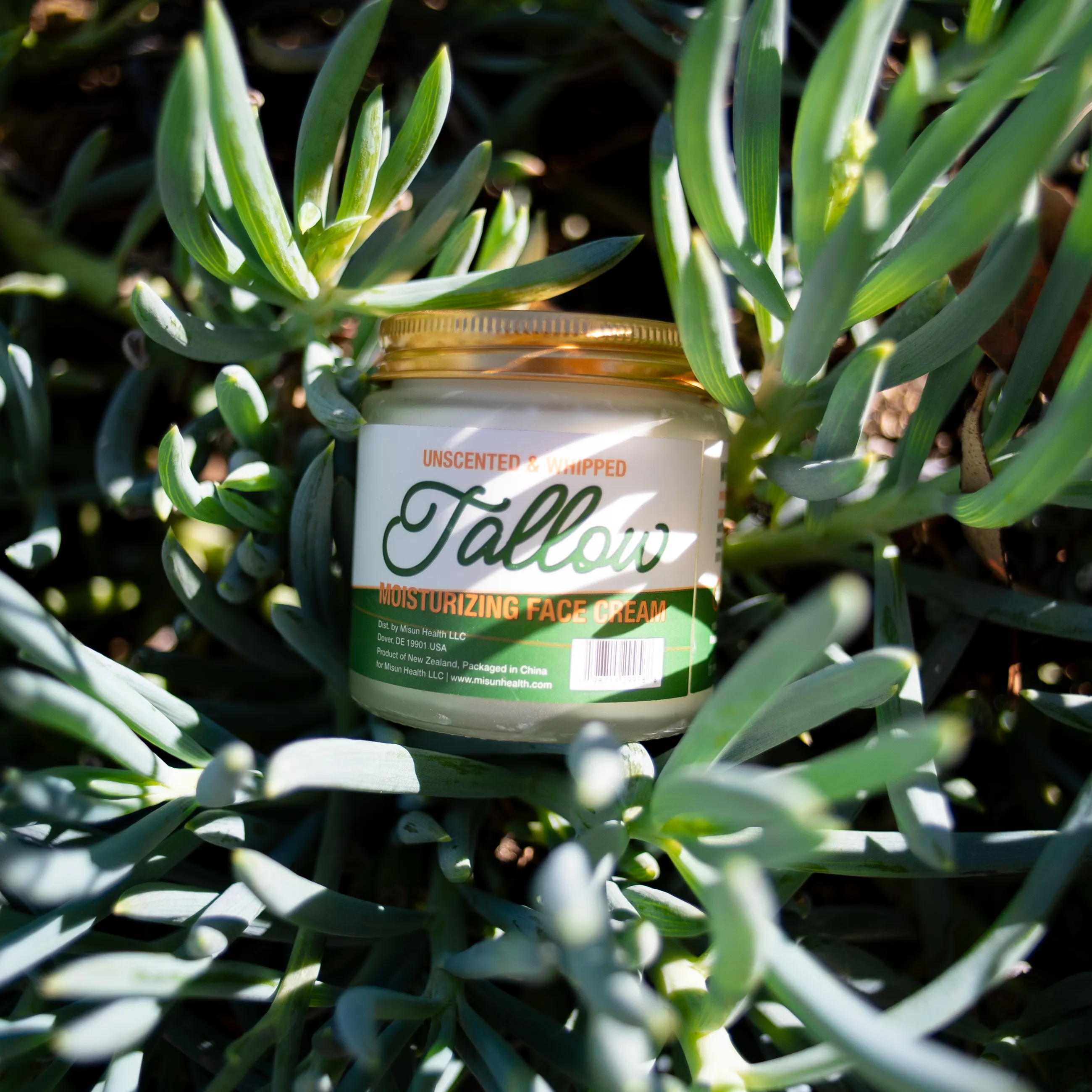
Misun Health makes one of each texture. Whipped Tallow Cream lists one ingredient, 100 percent grass-fed New Zealand beef tallow, and is labeled unscented and fragrance-free; it is whipped so a small scoop spreads thin and even across the face or body, which suits broad dry areas after a shower. Beef Tallow Balm is the denser jar, made for targeted use on dry-feeling hands, elbows, heels and cuticles. For dry skin, apply either one while your skin is still damp, and match the jar to the area: the cream for the large surfaces that feel tight, the balm for the small spots that stay rough.
FAQ
Common Questions
Is beef tallow good for very dry skin?
Yes, as a softening layer that slows water loss, applied to damp skin, and especially on rough areas such as hands, elbows and heels. If very dry skin still feels tight, put a humectant such as glycerin, or a ceramide cream, underneath it. If dryness persists despite home care, the AAD advises seeing a dermatologist.
Does beef tallow hydrate skin?
It hydrates by keeping water in. Tallow contains no water and does not attract it the way glycerin does; it slows the evaporation of water already in the outer layer of skin. That is why it works best on skin that is still damp from a shower or from washing your hands.
Is tallow better than Vaseline for dry skin?
They are different tools. Petrolatum, the ingredient in Vaseline, is the strongest seal among the ingredients a 2016 review compared, reducing water loss by more than 98 percent, and FDA lists it as a skin protectant for chapped skin. Tallow has not been measured the same way; it is a fat that softens as well as seals. One way to use both is petrolatum on a few deep cracks at night and tallow on broad dry areas through the day.
Should I put tallow on wet or dry skin?
On damp skin. Pat yourself dry after a short, warm shower so your skin is no longer dripping, then smooth tallow on while it still feels slightly damp. The AAD advises applying moisturizer to damp skin after bathing and after washing your hands, and a 2016 review notes that occlusive oils work best on slightly dampened skin.
How often should I put tallow on dry skin?
One to three times a day for most dry skin, according to a 2016 dermatology review, and after each hand wash for hands, as the AAD advises. The review notes that an emollient's effect peaks within an hour and usually lasts about four hours.
Can tallow make dry skin worse?
It can if your skin reacts to it. If you have alpha-gal syndrome, ask your doctor first. On the face, the NHS notes that emollients can block or inflame hair follicles and aggravate acne in some people. To check a new jar, the AAD suggests applying the normal amount to a quarter-sized spot, such as the bend of the elbow, twice a day for seven to 10 days, and stopping if the skin turns red, itchy or swollen.
Whipped tallow or tallow balm for dry skin?
Whipped tallow for large areas such as the legs, arms and face, because it spreads thin after a shower. A dense balm for small rough spots such as knuckles, cuticles, elbows and heel rims, and for a heavier layer at night. Plain tallow contains no water, so both work best on damp skin.
Primary sources
Sources and evidence limits
- American Academy of Dermatology: Dermatologists' top tips for relieving dry skin (last updated January 2, 2026)
Source for applying moisturizer when skin is still damp after a shower or bath, after washing your hands and when skin feels dry; for baths and showers of five to ten minutes in warm water and patting skin dry; for ointments and creams adding more moisture and being more effective than lotions, with jojoba oil, dimethicone, glycerin, hyaluronic acid, lactic acid, lanolin, mineral oil, petrolatum and shea butter as ingredients to look for; for a gentle cleanser in small amounts, only where needed; for a humidifier cleaned regularly and for gloves; and for seeing a dermatologist when dry skin persists.
- American Academy of Dermatology: Dry skin: Who gets and causes
Source for skin becoming dry when it loses water too quickly; for nearly everyone having dry skin by 60 years of age; for deodorant soaps and harsh cleaning products stripping oils and fats, long hot showers, and colder air holding less moisture; and for statins, diuretics, diabetes, thyroid disease and kidney disease as causes of excessively dry skin.
- American Academy of Dermatology: Dry skin: Signs and symptoms
Source for the signs of infection in broken dry skin: yellow crusts, fluid or pus leaking from an area, and swelling with discoloration.
- American Academy of Dermatology: How to test skin care products (last updated August 10, 2021)
Source for the at-home test: the normal amount on a quarter-sized spot that will not be rubbed or washed away, such as the underside of the arm or the bend of the elbow, twice daily for seven to 10 days, stopping if red, itchy or swollen skin develops.
- Sethi A, Kaur T, Malhotra SK, Gambhir ML. Moisturizers: The Slippery Road. Indian Journal of Dermatology, 2016, volume 61, pages 279 to 287
Source for emollients as lipids and oils that improve softness, flexibility and smoothness, occlusives as substances that physically block transepidermal water loss, and humectants as hygroscopic compounds; for dry skin at a stratum corneum moisture content below 10 percent; for petrolatum at a minimum of 5 percent reducing water loss by more than 98 percent and lanolin, mineral oil and silicones by 20 to 30 percent; for humectants increasing water loss and so being combined with occlusives; for occlusive oils having their most pronounced effect on slightly dampened skin; and for an emollient's effect peaking 30 minutes to 1 hour after use and usually lasting 4 hours, with application 1 to 3 times daily.
- Augustin M, Kirsten N, Körber A, et al. Prevalence, predictors and comorbidity of dry skin in the general population. Journal of the European Academy of Dermatology and Venereology, 2019, volume 33, pages 147 to 150
Whole-body examinations by dermatologists of 48,630 employees in 343 German companies: 14,300 people (29.4 percent) were rated as having dry skin, and older age but not gender was associated with it.
- Feingold KR. The role of epidermal lipids in cutaneous permeability barrier homeostasis. Journal of Lipid Research, 2007, volume 48, pages 2531 to 2546
Source for the extracellular lipids of the stratum corneum being approximately 50 percent ceramides, 25 percent cholesterol and 15 percent free fatty acids, and for topically applied physiologic lipids improving permeability barrier function.
- Pappas A. Epidermal surface lipids. Dermato-Endocrinology, 2009, volume 1, pages 72 to 76
Source for sebaceous lipids being primarily triglycerides, wax esters and squalene, and for lipids of epidermal origin being a mixture of ceramides, free fatty acids and cholesterol.
- USDA FoodData Central: Fat, beef tallow (FDC ID 171400, SR Legacy)
Per 100 grams: 0 grams of water, 100 grams of total fat, 109 milligrams of cholesterol and 49.8 grams of saturated fatty acids, including 36.0 grams oleic, 24.9 grams palmitic, 18.9 grams stearic and 3.1 grams linoleic acid. Cholesterol as about 0.1 percent of the fat is our arithmetic.
- USDA FoodData Central: Oil, cocoa butter (FDC ID 171421, SR Legacy)
Per 100 grams: 25.4 grams palmitic, 33.2 grams stearic and 32.6 grams oleic acid, with 59.7 grams of saturated fatty acids in total.
- Faridah et al., 2025: Comparison of the physicochemical properties of palm-based shortenings of various melting temperatures and animal fats (Food Chemistry: X)
Beef fat extracted from beef adipose tissue was 26.35 percent solid at 30 °C and 16.11 percent solid at 35 °C, with a slip melting point of 40.77 °C.
- Yu et al., 2024: Thermal mapping: assessing the optimal sites for temperature measurement in the human body and emerging technologies (Physiological Reports)
Gives 35 °C as the commonly used reference value for average skin temperature.
- Agero AL, Verallo-Rowell VM. A randomized double-blind controlled trial comparing extra virgin coconut oil with mineral oil as a moisturizing agent for mild to moderate xerosis. Dermatitis, 2004, volume 15, pages 109 to 116
34 patients with mild to moderate xerosis applied coconut oil or mineral oil to the legs twice daily for two weeks. Both oils significantly improved skin hydration and increased skin surface lipid levels with comparable effects, transepidermal water loss and skin pH did not differ, and no adverse reactions were reported.
- PubMed search: tallow with xerosis, dry skin, moisturizer, moisturiser, emollient or emollients, in title or abstract (run November 2026)
Returned one paper, the 2024 Cureus scoping review below. A broader search for tallow and skin in title or abstract returned 24 records, none of them a controlled trial of plain beef tallow on human skin.
- Russell MF, Sandhu M, Vail M, Haran C, Batool U, Leo J. Tallow, Rendered Animal Fat, and Its Biocompatibility With Skin: A Scoping Review. Cureus, 2024, volume 16, e60981
Searched PubMed and EMBASE, screened 147 records and included 19, among them studies of polyethoxylated tallow amine surfactants in herbicide formulations. Reported that most published evidence on tallow and skin lacks human subjects and called for randomized controlled trials.
- Kowalska M, Mendrycka M, Zbikowska A, Stawarz S. Enzymatically interesterified fats based on mutton tallow and walnut oil suitable for cosmetic emulsions. International Journal of Cosmetic Science, 2015, volume 37, pages 82 to 91
Mutton tallow was enzymatically interesterified with walnut oil, and 83 respondents assessed the sensory and skin moisturizing properties of emulsions made from the resulting fats.
- Almatroud L, Choi S, Libson K, Ashack K. Beef Tallow-Based Skincare Claims in Social Media: A Cross-Sectional Analysis. Journal of Cosmetic Dermatology, 2025, volume 24, e70544
Analysis of 200 YouTube, Instagram and TikTok posts collected in December 2024: 29 endorsed benefits for acne, 25 for eczema and 12 for psoriasis, and 9 cited evidence. The authors concluded that evidence remains insufficient to support those claims.
- FDA: Is It a Cosmetic, a Drug, or Both? (Or Is It Soap?) (content current as of September 11, 2024)
Source for the Federal Food, Drug, and Cosmetic Act definitions of cosmetics and drugs, for intended use being established partly by the claims made for a product, and for skin moisturizers as an example of a cosmetic.
- FDA: Over-the-Counter Monograph M016, Skin Protectant Drug Products for Over-the-Counter Human Use (Final Administrative Order OTC000005, posted September 24, 2021)
Section M016.10 lists the permitted skin protectant active ingredients, including cocoa butter at 50 to 100 percent, glycerin at 20 to 45 percent, lanolin at 12.5 to 50 percent and petrolatum at 30 to 100 percent, and section M016.50 lets products containing them state that they temporarily protect and help relieve chapped or cracked skin. Tallow is not listed.
- NHS: Emollients (page last reviewed October 24, 2023)
Source for creams suiting daytime use and ointments suiting very dry, thickened skin and night-time use; for applying emollients as soon as skin has been patted dry and smoothing them in the direction of hair growth; for side effects including blocked or inflamed hair follicles and facial rashes that can aggravate acne; and for the warning that fabric in contact with any emollient, paraffin-based or paraffin-free, can easily catch fire.
- Engebretsen KA, Johansen JD, Kezic S, Linneberg A, Thyssen JP. The effect of environmental humidity and temperature on skin barrier function and dermatitis. Journal of the European Academy of Dermatology and Venereology, 2016, volume 30, pages 223 to 249
Review concluding that low humidity and low temperatures lead to a general decrease in skin barrier function and make skin more reactive to irritants and allergens.
- Danby SG, Brown K, Wigley AM, et al. The Effect of Water Hardness on Surfactant Deposition after Washing and Subsequent Skin Irritation in Atopic Dermatitis Patients and Healthy Control Subjects. Journal of Investigative Dermatology, 2018, volume 138, pages 68 to 77
80 participants had skin washed with sodium lauryl sulfate in water of varying hardness. Hard water increased surfactant deposits, which increased transepidermal water loss and caused irritation, and ion-exchange water softening mitigated the effect.
- Long CC, Finlay AY. The finger-tip unit: a new practical measure. Clinical and Experimental Dermatology, 1991, volume 16, pages 444 to 447
In 30 adults, one fingertip unit covered about 286 square centimeters, and the mean units needed were 2.5 for face and neck, 1.2 for a hand and 5.8 for a leg and thigh.
- Long CC, Finlay AY, Averill RW. The rule of hand: 4 hand areas = 2 FTU = 1 g. Archives of Dermatology, 1992, volume 128, pages 1129 to 1130
Source for one fingertip unit weighing about 0.5 grams.
- CDC: Fast Facts: Products That May Contain Alpha-gal (January 5, 2026)
Lists, among foods, products made or cooked with mammal fat, like lard, tallow or suet, and notes that people with alpha-gal syndrome might not react to every product containing alpha-gal.
Use the tools
Related skincare tools
- Indoor Humidity Calculator for Dry SkinEnter the outdoor humidity and your thermostat setting to see how dry heated indoor air gets, and how far it sits below the range the EPA gives for homes.Open tool
- Skincare Layering Order PlannerPut a humectant serum, a ceramide cream and tallow in order for a morning or evening routine, with the reason for each position.Open tool
- Moisturizer Cost Per Use CalculatorTurn fingertip units into grams per application for the areas you cover, and see how long a jar lasts.Open tool
- Patch Test PlannerGet the site, the amount and the twice-daily schedule for testing a new jar of tallow before you use it widely.Open tool
Keep reading
Related guides
Explore next
Related skin concerns
Shop the routine
Build your tallow routine
Shop the products that best match the concerns and routines covered in this guide.