Informational + pre-purchase research · 12 min read
What Is Whipped Tallow? How It's Made and What the Air Changes
Whipped tallow is beef tallow beaten while it sets, so fat crystals trap air and turn a firm fat soft and quick to spread. The air changes how much fat each scoop carries and how the jar copes with heat, not what the fat does on your skin, so compare jars by net weight and keep them out of a hot car.
Last updated November 18, 2026
Short answer: beef tallow with air beaten into it
Whipped tallow is rendered beef fat that has been beaten while it sets, so that air is trapped inside it. As tallow cools, part of it crystallizes, and those fat crystals coat the air bubbles and hold them in place. The result is soft and light enough to scoop with a fingertip and spread in a thin layer, where plain tallow at room temperature is firm and waxy. It is the same fat that goes into a dense tallow balm. The air changes how the product feels in the jar, how much fat each scoop carries, how far a layer stretches and how well the texture survives heat. It does not change what reaches your skin: rubbing it in breaks the bubbles and leaves the same thin layer of tallow a balm would. Some whipped tallows contain tallow and nothing else. Others blend in a liquid oil such as olive or jojoba, and some add vitamin E, or essential oils for scent, so the ingredient list tells you which kind you have. Sellers call it whipped tallow, whipped tallow balm, whipped tallow cream or tallow butter. Whatever the name, it is made for dry-feeling skin on the face and body, applied in a thin layer while the skin is still damp from washing.
What tallow is before anyone whips it
Tallow is a defined material. The Codex Alimentarius standard for named animal fats describes edible tallow as the product of rendering the clean, sound fatty tissues of cattle, sheep or both, including trimming and cutting fats, attendant muscles and bones. Rendering melts the fat out of the tissue, and what comes out is a mixture of fats that melt at very different temperatures. A 2025 study in Food Chemistry: X measured beef fat extracted from adipose tissue at 30.29 percent palmitic acid, 18.65 percent stearic acid, 28.80 percent oleic acid and 1.78 percent linoleic acid, and charted how much of it stays solid as it warms: 48.88 percent at 20 °C (68 °F), 36.85 percent at 25 °C (77 °F) and 26.35 percent at 30 °C (86 °F). At an ordinary room temperature, then, tallow is a network of fat crystals with liquid oil held between them. That mix is what makes it firm but workable, and it is also what lets it hold air.
How whipping traps air in a fat
Food scientists call this kind of material an oleofoam: gas bubbles held in a continuous oil phase. In a 2020 review in Frontiers in Sustainable Food Systems, Anne-Laure Fameau and Arnaud Saint-Jalmes describe what holds it together. After aeration, mostly by whipping, crystals adsorb to the surfaces of the air bubbles, and the crystals left over in the oil form a gel, called an oleogel, around them. The review says crystals are needed both at the bubble surfaces and in the bulk for long-term stability, and that a foam can form only while crystals are present. That is why tallow is whipped while it sets. The usual method is to melt the rendered fat, let it cool until crystals form and it turns opaque and soft, then beat it so air folds in and the crystals coat each bubble. A fat that is too stiff takes in less air: in a 2021 study in Crystal Growth & Design, oleogels made with 30 percent cocoa butter in high oleic sunflower oil incorporated less air than softer ones, which the authors attributed to their relatively high elastic modulus. How much air ends up in a jar of whipped tallow depends on the recipe, the temperature and the whipping, and no label rule requires a maker to state it. The same study gives a sense of scale. Mixtures with 15 and 22 percent cocoa butter whipped to an overrun of 200 percent, which the authors describe as a reduction in calorific density to one-third: the foam took up three times the space of the fat that went in.
What the air changes
Four things change, and the first is how much fat you get per scoop. A jar of whipped tallow holds less fat than the same jar packed with dense balm, so each fingertip carries less fat than it appears to. Feel is the second. The Fameau review notes that how flowable a foam is depends strongly on how much gas it holds, which is why whipped tallow gives under a fingertip in a cool room where plain tallow, about half solid at 20 °C (68 °F), has to be scraped. Spread is the third. Part of every fingertip of whipped tallow is air, so the same size scoop lays down a thinner film, which suits the face, neck, arms and legs, where a heavy layer feels waxy. The fourth is heat, because the air stays in only as long as the crystals do. US labeling rules already account for the first change. Under 21 CFR 701.13, a cosmetic label has to state net quantity in fluid measure if the product is liquid and by weight if it is solid, semisolid or viscous, in pounds and ounces, and the statement has to sit on the principal display panel. Whipped tallow is semisolid, so the net weight on the front tells you how much product you are buying, however big the jar looks. To compare two jars, divide each price by its net weight in ounces. A $24 jar with a net weight of 2 ounces costs $12 an ounce, and a $24 jar holding 3 ounces costs $8 an ounce, even if the first jar is the bigger one on the shelf.
A spoon test for how much of a jar is air
You can estimate the air in any whipped product with a kitchen scale and a tablespoon. Codex puts the relative density of edible tallow at 0.894 to 0.904, measured at 40 °C against water at 20 °C, so tallow with no air in it weighs roughly 0.9 grams per milliliter, and a level tablespoon, about 15 milliliters, weighs roughly 13.5 grams. Set a small dish on the scale, zero it, level a tablespoon of the whipped product into the dish and read the weight. At 9 grams, about two-thirds of what you scooped is fat and one-third is air. At 4.5 grams, the product is about two-thirds air, which is where the 200 percent overrun foams in the 2021 study landed. The result is rough, but it is close enough to compare brands, and it tells you how to read your own fingertips: a scoop that is half air puts down half the fat it seems to.
What stays the same once it is on your skin
Whipping does not change the fat itself. Its fatty acids and melting range are those of the tallow that went into the bowl, and none of the air stays on your skin. Skin is warm enough to see to that: the commonly used reference value for average skin temperature is 35 °C (95 °F), and in the 2025 measurements beef fat was only 16.11 percent solid at that temperature, so most of the crystals holding the bubbles melt as you rub it in. What you press onto your face or hands is a thin layer of tallow, the same material a dense tallow balm leaves behind, in a smaller amount per scoop. Whipping adds no water either. A whipped tallow made from tallow alone has none of its own, so it works with the water already in your skin. That is the reason to follow the American Academy of Dermatology (AAD) advice to apply moisturizer while your skin is still damp after a shower or bath. The same AAD page says ointments and creams add more moisture to skin and are more effective than lotions.
Heat is what undoes a whip
Because crystals hold the air, anything that melts the crystals lets the air out. The 2025 measurements show how fast that happens as beef fat warms: 26.35 percent solid at 30 °C (86 °F), 16.11 percent at 35 °C (95 °F), 7.27 percent at 40 °C (104 °F) and 0.13 percent at 45 °C (113 °F), with a slip melting point of 40.77 °C (105.4 °F). One sure way to lose a whip is a car dashboard: the National Weather Service notes that a dark dashboard or seat can easily reach temperatures in the range of 180 to over 200 °F. Once the bubbles have escaped, stirring the melted fat will not bring them back. It cools into a dense layer with the texture of a balm, and it is still tallow, usable as it is. To get the whip back, melt it all the way and whip it again as it sets, since a foam forms only while crystals are present. Cold works the other way on feel: at 10 °C (50 °F) beef fat was 66.20 percent solid in the same study, so a jar kept in the fridge turns stiff and hard to scoop. A cool, steady room away from sunny windows and heaters suits it best, and our Tallow Texture Troubleshooter covers the other changes heat and time can cause.
Does the air make tallow go rancid sooner?
Whipping does put oxygen through the whole jar, and lipid oxidation, the chemistry behind rancidity, needs oxygen. A 2019 review in Food Science and Biotechnology notes that the propagation stage of lipid oxidation does not occur in the absence of oxygen, and it ranks fatty acids by how fast they oxidize relative to stearic acid at 1: oleic acid at 100, linoleic acid at 1,200 and linolenic acid at 2,500. Tallow sits mostly at the slow end of that scale. In the 2025 measurements, palmitic and stearic acid, both saturated, made up nearly half of beef fat, and linoleic acid only 1.78 percent. A blend can change the picture. A whipped product built on a liquid oil rich in linoleic acid carries more of the fast-oxidizing kind than tallow alone, so it can turn rancid sooner, and our fatty acid comparison tool shows how tallow lines up against common plant oils. The same review notes that photooxidation requires light as well as oxygen, so a closed lid and a jar kept out of direct sun help any whipped fat last. A rancid smell means the fat in a jar has oxidized, and no amount of whipping or warming will fix it.
Reading a whipped tallow label
The ingredient list comes first. Under 21 CFR 701.3, cosmetic ingredients are declared in descending order of predominance, so whatever is listed first is what the jar holds the most of. Tallow alone means the jar is fat and air. If a liquid oil is listed before tallow, there is more of that oil in the jar than tallow. If water or aqua appears, the product contains water, which makes it an emulsion, a cream in the usual sense, rather than a whipped fat. Scent comes next. The same regulation allows fragrance to be listed simply as fragrance, and the FDA notes that there is no regulatory definition for essential oils, such as the lavender or frankincense some makers add to whipped tallow for scent. For dry skin, AAD says dermatologists recommend products labeled fragrance-free, and it warns that a product labeled unscented can contain chemicals that neutralize or hide the odors of other ingredients. The net weight on the front panel comes last, and it turns any price into a price per ounce.
Whipped or dense: matching the texture to the job
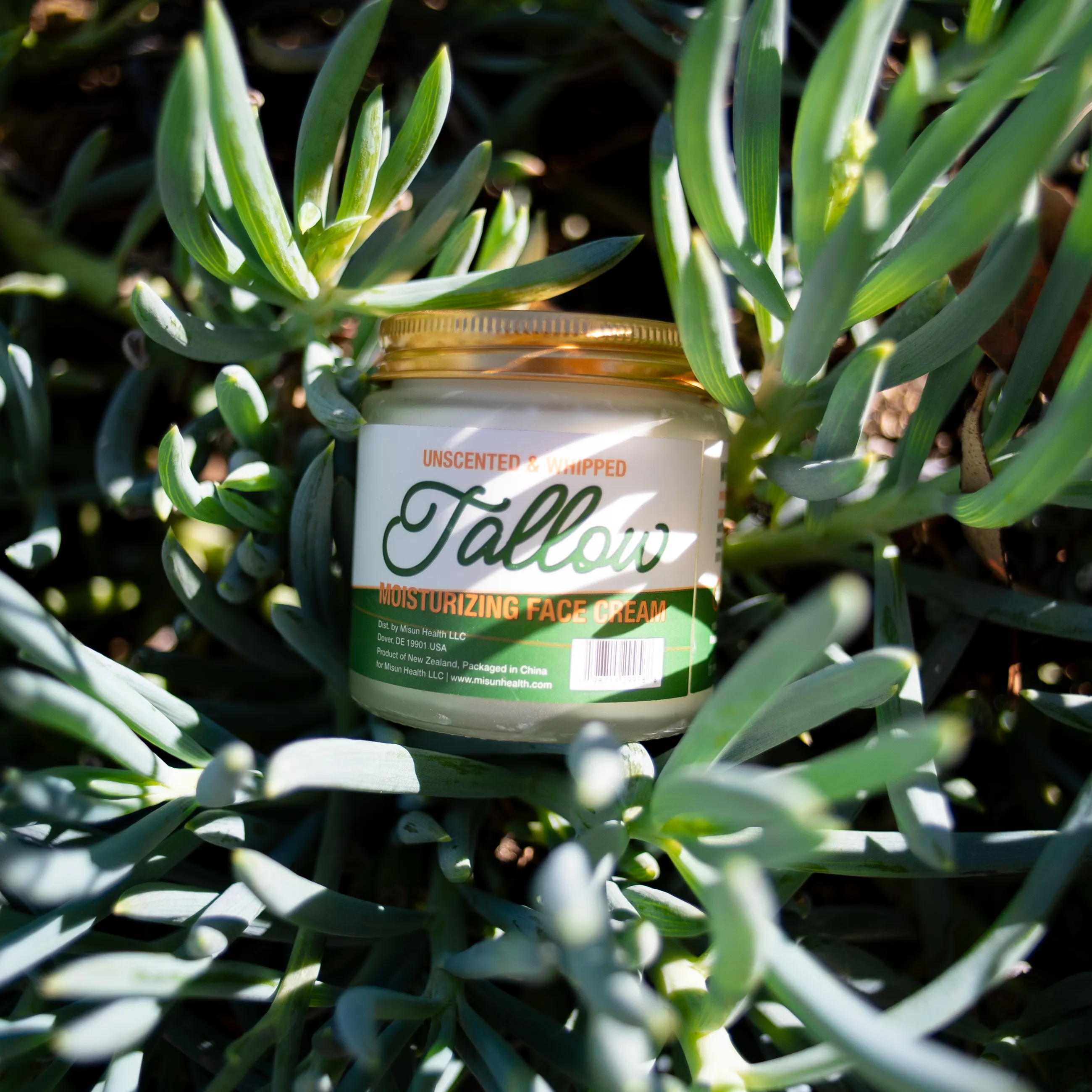
The two textures do the same job at different thicknesses, so the choice depends on where the product goes. The NHS describes the general split for emollients this way: creams are good for daytime use as they are not very greasy and are absorbed quickly, while ointments are good for very dry, thickened skin and night-time use as they are greasy, thick and very moisturizing. Whipped tallow takes the first role. It suits the face, neck, chest, arms and legs after washing or showering, in a layer thin enough to wear under clothes. A dense tallow balm takes the second, on small rough areas such as knuckles, cuticles, elbows and the rims of the heels, and as a heavier layer at night. You can keep one of each, and Misun Health makes both. Whipped Tallow Cream lists one ingredient, 100 percent grass-fed New Zealand beef tallow, and is labeled unscented and fragrance-free; with a single ingredient on the list, there is no fragrance or masking agent in it. Beef Tallow Balm is the denser jar, made for targeted use on dry-feeling hands, elbows, heels and cuticles.
Who should skip tallow, whipped or not
Tallow is a beef product, so it is out for anyone avoiding animal ingredients. It also matters for people with alpha-gal syndrome, which CDC describes as a serious, potentially life-threatening allergy and tickborne disease, in the United States primarily associated with the bite of a lone star tick. CDC's list of products that may contain alpha-gal includes, among foods, products made or cooked with mammal fat, like lard, tallow or suet. It also notes that people with alpha-gal syndrome might not react to every product containing alpha-gal, and that patients should work with their healthcare providers to manage symptoms. If you have it, ask yours before putting beef fat on your skin. For everyone else, try any new product on a small patch of skin for a few days before using it all over, and stop if it itches or stings.
FAQ
Common Questions
Is whipped tallow the same as tallow balm?
It is the same fat in a different texture. Whipped tallow has air beaten into it while it sets, so it is softer and lighter and lays down a thinner film per scoop. A balm is left dense, so each scoop carries more fat, which suits small rough areas and a heavier layer at night.
Is whipped tallow mostly air?
That depends on the maker, and no label rule requires them to say. The net weight on the front panel, which US rules require for semisolid cosmetics, tells you how much product you are paying for. At home, a level tablespoon of tallow with no air in it weighs roughly 13.5 grams, so a whipped product that weighs 9 grams per level tablespoon is about one-third air.
Why did my whipped tallow go flat and hard?
It got warm enough to melt the crystals holding the air, then set again without being whipped. Beef fat is only 7.27 percent solid at 40 °C (104 °F), and a dark car dashboard can pass that easily. It is still tallow. Use it as a balm, or melt it fully and whip it again as it cools.
Does whipped tallow need to be refrigerated?
No. Cold only makes it stiff: beef fat is 66.20 percent solid at 10 °C (50 °F). Keep it at room temperature with the lid closed, out of direct sun and away from heaters, since light drives oxidation and heat melts the crystals that hold the air.
Does whipped tallow have water in it?
Not if tallow is the only ingredient. With no water of its own, it works with the water already in your skin, so apply it while your skin is still damp from washing, as AAD advises for moisturizer after a shower or bath. If water or aqua is on the label, the product is a tallow cream made as an emulsion, not a whipped fat.
How much whipped tallow should I use?
Judge it by how it spreads rather than by how much is on your finger, since part of every scoop is air. Start with a fingertip scoop for the face, warm it between your fingers until it turns glossy, and press it onto damp skin. Add a little more to any spot that still feels tight after a couple of minutes.
Is whipped tallow good for your face?
The whipped texture is the one made for faces. A small amount spreads into a thin, even layer across the cheeks, jaw and neck, which is harder to do with a dense balm. Apply it to damp skin after washing, and save a balm for small rough spots such as the corners of the mouth or wind-chapped cheeks.
Primary sources
Sources and evidence limits
- Codex Alimentarius: Standard for Named Animal Fats (CXS 211-1999)
Source for edible tallow as the product of rendering the clean, sound fatty tissues, including trimming and cutting fats, attendant muscles and bones, of cattle, sheep or both, and for its relative density of 0.894 to 0.904, measured at 40 °C against water at 20 °C, which the spoon test uses.
- Faridah et al., 2025: Comparison of the physicochemical properties of palm-based shortenings of various melting temperatures and animal fats (Food Chemistry: X)
Measurements of beef fat extracted from beef adipose tissue: 30.29 percent palmitic, 18.65 percent stearic, 28.80 percent oleic and 1.78 percent linoleic acid; solid fat content of 66.20 percent at 10 °C, 48.88 percent at 20 °C, 36.85 percent at 25 °C, 26.35 percent at 30 °C, 16.11 percent at 35 °C, 7.27 percent at 40 °C and 0.13 percent at 45 °C; slip melting point 40.77 °C.
- Fameau and Saint-Jalmes, 2020: Recent Advances in Understanding and Use of Oleofoams (Frontiers in Sustainable Food Systems)
Source for oleofoams as gas bubbles in a continuous oil phase, crystals adsorbing to air bubble surfaces after aeration that is mostly done by whipping, the excess crystals forming an oleogel, crystals being needed at the interface and in the bulk for long-term stability, foam formation being possible only when crystals are present, and a foam's flowable character depending strongly on the amount of incorporated gas.
- Metilli et al., 2021: The Effect of Crystallization Conditions on the Structural Properties of Oleofoams Made of Cocoa Butter Crystals and High Oleic Sunflower Oil (Crystal Growth & Design)
Oleofoams whipped from oleogels with 15 and 22 percent cocoa butter reached an overrun of 200 percent, which the authors describe as a calorific density reduction to one-third, while 30 percent cocoa butter oleogels incorporated less air because of their relatively high elastic modulus. The fat here is cocoa butter in sunflower oil, not tallow; it is cited for the scale of aeration a whipped fat can reach.
- 21 CFR 701.13: Declaration of net quantity of contents
Requires a cosmetic label to declare net quantity in fluid measure if the cosmetic is liquid and in weight if it is solid, semisolid or viscous, or a mixture of solid and liquid, with weight stated in avoirdupois pounds and ounces and the declaration located on the principal display panel.
- 21 CFR 701.3: Designation of ingredients
Requires cosmetic ingredients to be declared in descending order of predominance and allows fragrance or flavor to be listed as fragrance or flavor.
- FDA: Fragrances in Cosmetics (content current as of February 28, 2022)
Source for fragrance ingredients being listable simply as Fragrance under US regulations and for there being no regulatory definition for essential oils.
- American Academy of Dermatology: Dermatologists' top tips for relieving dry skin (last updated January 2, 2026)
Source for applying moisturizer while skin is still damp after a shower or bath, ointments and creams adding more moisture to skin and being more effective than lotions, dermatologists recommending products labeled fragrance-free, and a product labeled unscented possibly containing chemicals that neutralize or hide the odors of other ingredients.
- NHS: Emollients (page last reviewed October 24, 2023)
Source for creams being good for daytime use as they are not very greasy and are absorbed quickly, and ointments being good for very dry, thickened skin and night-time use as they are greasy, thick and very moisturizing.
- Huang and Ahn, 2019: Lipid oxidation and its implications to meat quality and human health (Food Science and Biotechnology)
Table 1 gives relative oxidation rates by fatty acid: stearic 1, oleic 100, linoleic 1,200 and linolenic 2,500. The review also states that propagation of lipid oxidation does not occur in the absence of oxygen and that photooxidation requires light, a photosensitizer and oxygen.
- Yu et al., 2024: Thermal mapping: assessing the optimal sites for temperature measurement in the human body and emerging technologies (Physiological Reports)
Gives 35 °C as the commonly used reference value for average skin temperature.
- National Weather Service: Children, Pets and Vehicles
Source for a dark dashboard or seat easily reaching temperatures in the range of 180 to over 200 °F.
- CDC: About Alpha-gal Syndrome (January 5, 2026)
Source for alpha-gal syndrome being a serious, potentially life-threatening allergy and tickborne disease that in the United States is primarily associated with the bite of a lone star tick.
- CDC: Fast Facts: Products That May Contain Alpha-gal (January 5, 2026)
Lists products made or cooked with mammal fat, like lard, tallow or suet, among foods that may contain alpha-gal, notes that people with alpha-gal syndrome might not react to every product containing alpha-gal, and advises patients to work with their healthcare providers to manage symptoms.
Use the tools
Related skincare tools
- Tallow Texture TroubleshooterFind out why a jar went flat, grainy or hard after a hot car or a cold room, and which of those changes can be reversed.Open tool
- Moisturizer Cost Per Use CalculatorEnter a price and a net weight to see what each application of a whipped jar or a dense balm costs and how long a jar lasts.Open tool
- Fragrance Label CheckerPaste a whipped tallow's ingredient list to check it for fragrance, perfume or parfum before you buy.Open tool
- Fatty Acid Comparison for Skincare Oils and ButtersSee how tallow's fatty acid profile compares with the plant oils some makers blend into whipped tallow, including how much linoleic acid each one carries.Open tool
Keep reading
Related guides
Explore next
Related skin concerns
Shop the routine
Build your tallow routine
Shop the products that best match the concerns and routines covered in this guide.