Informational + pre-purchase research · 12 min read
Bison Tallow vs Beef Tallow for Skin: What the Fat Research Shows
No study has tested bison tallow against beef tallow on skin, and no lab has published a fatty acid profile of fat from modern bison. In bison meat studies from 2002 to 2026, the finishing diet reshaped the fat and range-fed bison resembled forage-fed beef cows, so how the animal was finished tells you more than the name on the jar.
Last updated November 21, 2026
Short answer: the animal's diet matters more than the animal
Bison tallow has no measured advantage over beef tallow for skin. PubMed lists no study of bison fat or bison tallow on skin, and no fatty acid analysis of fat from modern bison, so any composition claim made for a bison jar is borrowed from studies of bison meat. In those studies, meat from bison finished on range or pasture had a lower omega-6 to omega-3 ratio and a larger polyunsaturated share than meat from bison finished in pens on grain, and a 2010 review in Nutrition Journal reported the same lower ratio for grass-fed beef. A 2002 study in the Journal of Animal Science compared range and feedlot bison with range beef cows and feedlot steers, and concluded that the muscle lipids of range-fed bison were similar to those of forage-fed beef cows and wild elk. For a jar of tallow, two questions matter more than bison or beef: what the animal ate in its last months, and whether the jar holds anything besides the fat.
Why bison fat and beef fat start out so close
Bison and cattle are both ruminants, and the rumen reworks fat before the animal stores any of it. A 2010 review in the journal Animal by Lourenço, Ramos-Morales and Wallace states the paradox directly: the ruminant diet is rich in polyunsaturated fatty acids, yet ruminant meat, milk and dairy contain mainly saturated fatty acids, because rumen bacteria break down the fats an animal eats and then hydrogenate the polyunsaturated ones. Much of the unsaturated fat in a bison's or a steer's feed is converted before it reaches the animal's own fat.
Beef tallow against lard: the rumen divide in numbers
USDA FoodData Central shows the result in beef tallow. Per 100 grams it lists 49.8 grams of saturated fat, 41.8 grams of monounsaturated fat and 4.0 grams of polyunsaturated fat, made up mostly of oleic acid (36.0 grams), palmitic acid (24.9 grams) and stearic acid (18.9 grams), with 3.1 grams of linoleic acid. Lard comes from pigs, which have no rumen, and the same database lists 11.2 grams of polyunsaturated fat and 10.2 grams of linoleic acid per 100 grams of lard, more than three times the linoleic acid in beef tallow. Among animal fats, the large divide runs between ruminants and animals without a rumen. Bison and cattle sit on the same side of it.
What the bison studies measured
Four studies supply most of what is known about the fat in bison, and all four analyzed meat. Rule and colleagues (2002) sampled three muscles from 10 animals in each group: range bison at 31 months, feedlot bison at 18 months, range beef cows aged 4 to 7 years and feedlot steers at 18 months. Range-fed animals of both species had more omega-3 fatty acids than feedlot animals, feedlot bison and feedlot steers had the most total fatty acids in their muscle, and range bison had the lowest cholesterol, 43.8 milligrams per 100 grams in two of the three muscles.
Grain against grass in 201 bison heifers
Janssen and colleagues (2021, in the journal Foods) followed 108 grain-finished and 93 grass-finished bison heifers. The grain group spent 130 days in an open lot on hay plus a concentrate of 83 percent corn and 17 percent dried distillers grains, while the grass group stayed on native range. In the steaks, polyunsaturated fat made up 20.53 percent of the fatty acids from grass-finished heifers against 13.75 percent from grain-finished heifers, oleic acid 37.38 percent against 45.60 percent, and the omega-6 to omega-3 ratio was 4.64 against 5.74.
Pasture against pen: the two newest bison studies
Van Vliet and colleagues (2023) compared 20 pasture-finished and 20 pen-finished bison from one herd after 146 days in each system. The pasture-finished striploins held 2.7 percent fat against 4.6 percent, had an omega-6 to omega-3 ratio of 1.8 against 3.2, and carried about 5.8 times the alpha-tocopherol (vitamin E) and twice the carotene. The newest, from Varre and colleagues in the Journal of Animal Science and Biotechnology in November 2026, compared seven finishing systems and found omega-6 to omega-3 ratios of 2.8 to 3.6 in range-finished bison against 5.0 to 7.3 in pen-finished bison. The contrast between range and pen finishing outweighed the effects of forage diversity and stocking density.
The gap between bison meat and bison tallow
Tallow is rendered from body fat: suet from around the kidneys and other internal organs, or fat trimmed from the outside of cuts. The studies above sampled striploins and other muscles, which hold the fat marbled through lean meat. That is a different tissue, so the meat numbers are not the values you would find in a jar, and beef shows that not every shift carries over from meat to tallow. A PubMed search pairing bison with tallow, suet, adipose tissue, kidney fat, subcutaneous fat or backfat returns eight papers, and none reports the fatty acid profile of fat from modern bison.
The closest look at bison body fat, from 1995
The nearest thing to a composition study of bison body fat is a 1995 paper by Koch and colleagues in the Journal of Animal Science, which fed 14 bison, 39 cattle and 20 bison and cattle crosses diets with different proportions of roughage and concentrate across three experiments. The bison carried less fat trim than the cattle in most wholesale cuts, most of their carcass fat lay over the thoracic area, and their subcutaneous fat held less cholesterol. The abstract reports no fatty acid profile for either species.
A bison label does not tell you what the animal ate
Bison is easy to picture on open grass, but the species does not guarantee a grass diet. Van Vliet's team notes that bison meat can come from animals finished on grains in confinement or on pasture, and the studies above show what confinement can look like: 130 days of hay plus a corn-based concentrate in Janssen's study, 146 days of free-choice hay, alfalfa and whole shell corn in van Vliet's, and a conventional total mixed ration among the pen systems Varre compared. Finishing changes how much fat an animal carries as well as what the fat is made of. Janssen's grain-finished heifers carried more than twice the backfat of the grass-finished group, 2.16 centimeters against 0.89. The same question applies to a jar of beef tallow, which is why a label that names the diet tells you more than one that names only the animal.
What pasture finishing changes in a jar of tallow
Measured in tallow rather than meat, grass-fed fat came out ahead on omega-3 but lower in polyunsaturated fat overall. A side-by-side analysis of one grass-fed and one grain-fed beef tallow, run by gas chromatography at the Burnsides Laboratory of the University of Illinois, found four times the alpha-linolenic acid, an omega-3, in the grass-fed sample: 0.8 against 0.2 percent of the fatty acids. The grass-fed tallow also carried about a third of the linoleic acid, 1.1 against 3.25 percent, so its total polyunsaturated share was lower, 1.9 against 3.45 percent, and its omega-6 to omega-3 ratio was about 1.4 against more than 16. That is one sample of each, and no one has published the same comparison for bison tallow.
Fat color is a diet signal
Fresh forage also tints the fat. In Janssen's study, 52.67 percent of grass-finished carcasses had fat graded moderately yellow, while the most common grade for grain-finished carcasses was moderately white, at 64.89 percent. The Daley review in Nutrition Journal (2010) attributes the yellower fat of grass-finished cattle to carotenoids from forage, and reports beta-carotene of 0.45 micrograms per gram in beef from pasture-fed cattle against 0.06 in grain-fed beef. A cream or pale yellow tint in tallow is a diet signal, not a defect.
How tallow keeps, whatever the animal
Tallow is slow to turn rancid because so little of it is polyunsaturated. Huang and Ahn (2019) give relative oxidation rates against stearic acid at 1: oleic acid at 100, linoleic acid at 1,200 and linolenic acid at 2,500. USDA lists 4.0 grams of polyunsaturated fat per 100 grams of beef tallow, and the grass-fed tallow in the laboratory comparison held 1.9 percent, so the fast-oxidizing share of a jar is small. Pasture finishing also adds vitamin E, the fat's own antioxidant; van Vliet's pasture-finished bison meat carried about 5.8 times as much. Even so, keep tallow closed, cool and out of direct light. Huang and Ahn identify aldehydes, hexanal above all, as the main source of off-odors when meat fat oxidizes, so a sharp or stale smell is the signal to stop using a jar.
Is bison tallow closer to human sebum?
Bison tallow is sometimes sold as closer to the oil skin makes. No published analysis supports that, and tallow from either animal matches only part of sebum. A review of epidermal surface lipids in Dermato-Endocrinology (Pappas, 2009) gives the average composition of sebum as about 45 percent triglycerides, 25 percent wax esters, 12 percent squalene and 10 percent free fatty acids. Tallow from bison or cattle is almost entirely triglycerides, so it resembles the largest share of sebum and carries no wax esters or squalene to speak of. What tallow offers skin is a rich emollient layer over the surface. The American Academy of Dermatology (AAD) advises applying moisturizer while skin is still damp after a shower, a bath or hand washing, and says creams and ointments are more effective than lotions.
Alpha-gal syndrome: bison is no workaround
Switching from beef to bison does not avoid alpha-gal. The CDC describes alpha-gal as a molecule found in most mammals, such as cows and pigs, but not in people, and lists products made with mammal fat, like lard, tallow or suet, among those some people with alpha-gal syndrome may be sensitive to. Bison are mammals, so bison tallow sits on that list alongside beef tallow. The CDC also notes that people with the syndrome do not react to every product containing alpha-gal, and a 2023 CDC analysis in MMWR estimated that 96,000 to 450,000 people in the United States might have been affected since 2010. Anyone with the diagnosis should ask their allergist before putting any tallow on skin.
Why bison tallow is harder to find
Supply is the plainest difference between the two. The 2022 Census of Agriculture counted 192,477 bison on 1,986 US farms and ranches, up from 183,780 in 2017, and 60,804 bison sold during 2022. USDA's January 2026 cattle report counted 86.2 million cattle and calves. Set side by side, those counts work out to roughly 450 cattle for every farmed bison, and Koch's comparison found that bison carcasses carried less fat trim in most wholesale cuts. That leaves a bison tallow maker a small, lean supply to buy from, and consistency from batch to batch depends on getting the same grade of fat from animals on the same finishing program. Differences in the fat and in rendering show up as differences in color, smell and texture.
How to compare two jars of tallow, whatever the animal
Start with the ingredient list. A single-ingredient jar lets you judge the fat itself, while a blend with plant oils, beeswax or essential oils is a different product, and the AAD cautions that plant-based botanical ingredients may still carry fragrance-related ingredients. Next, ask how the animals were finished, since diet, more than species, decides how much omega-3, vitamin E and carotene the fat carries. When the jar arrives, look and smell: a cream or pale yellow tone is consistent with pasture-fed fat, and a sharp or stale smell points to oxidation. Last, test a new jar before using it widely. The AAD's at-home test is the normal amount on a quarter-sized spot that will not be rubbed or washed away, such as the underside of the arm or the bend of the elbow, twice a day for seven to 10 days, stopping if red, itchy or swollen skin develops.
Cream or balm: the choice you will notice every day
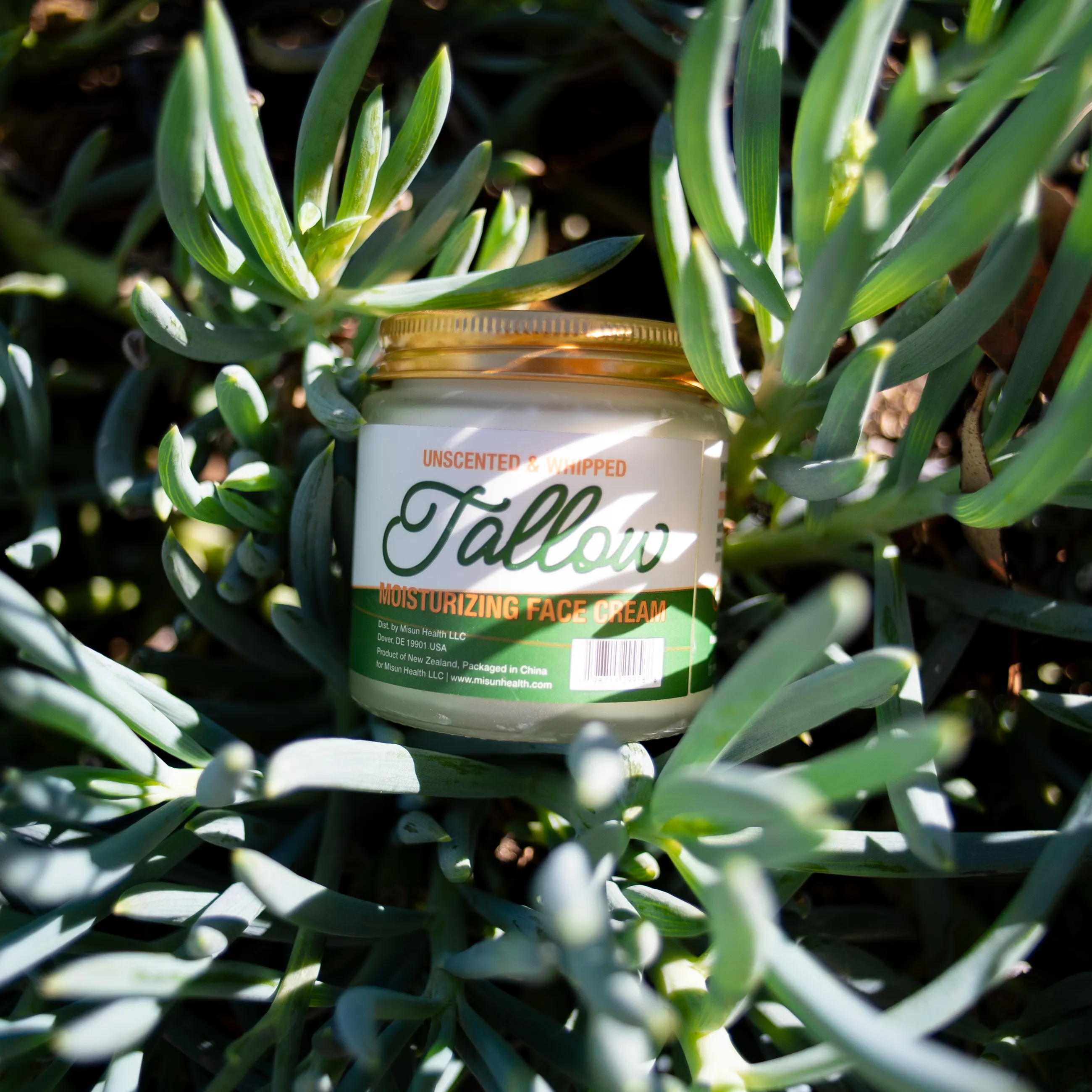
Once the source question is settled, texture decides most of how tallow feels in use. A whipped tallow spreads thin over broad areas such as the face, hands, arms and legs after washing. A dense balm stays put on small rough areas such as knuckles, cuticles, elbows and the rims of the heels, and works as a heavier layer at night. Misun Health makes one of each. Whipped Tallow Cream lists one ingredient, 100 percent grass-fed New Zealand beef tallow, and is labeled unscented and fragrance-free; it is whipped so a small scoop spreads thin and even across the face or body. Beef Tallow Balm is the denser jar, made for targeted use on dry-feeling hands, elbows, heels and cuticles. Apply either one while your skin is still damp, as the AAD advises.
FAQ
Common Questions
Is bison tallow better than beef tallow for skin?
No study shows that it is. PubMed lists no study of bison fat or tallow on skin and no fatty acid analysis of fat from modern bison. In bison meat studies from 2002 to 2026, the finishing diet reshaped the fat, and a 2002 comparison found range-fed bison similar to forage-fed beef cows, so compare jars by how the animals were finished and what else is in the jar.
Is bison tallow grass-fed?
Not by default. Bison can be finished on grain in pens or on pasture. In published studies, pen-finished bison ate hay with a corn-based concentrate or whole shell corn for 130 to 146 days before slaughter, so ask the seller how the animals were finished.
Does bison tallow have more omega-3 than beef tallow?
That depends on diet more than species. A 2026 study found omega-6 to omega-3 ratios of 2.8 to 3.6 in range-finished bison meat against 5.0 to 7.3 in pen-finished bison, and a 2002 comparison found range-fed bison muscle lipids similar to those of forage-fed beef cows. Polyunsaturated fat is a small share of tallow either way: USDA lists 4.0 grams per 100 grams of beef tallow.
Is bison tallow closer to human sebum than beef tallow?
No published analysis shows that. Sebum averages about 45 percent triglycerides, 25 percent wax esters, 12 percent squalene and 10 percent free fatty acids, according to a 2009 review in Dermato-Endocrinology, while tallow from either animal is almost entirely triglycerides.
Can I use bison tallow if I have alpha-gal syndrome?
Bison tallow carries the same concern as beef tallow. The CDC lists products made with mammal fat, including tallow, among those some people with alpha-gal syndrome may react to, and bison are mammals. Ask your allergist before using any tallow on skin.
Why is bison tallow harder to find than beef tallow?
There are far fewer bison, and each carries less trimmable fat. The 2022 Census of Agriculture counted 192,477 bison on US farms, while USDA counted 86.2 million cattle and calves in January 2026, roughly 450 cattle for every farmed bison.
Is grass-fed beef tallow similar to grass-fed bison tallow?
No lab has compared the two directly, but the evidence points that way. Both animals are ruminants whose rumen bacteria hydrogenate much of the polyunsaturated fat they eat, and range-fed bison muscle lipids resembled those of forage-fed beef cows in a 2002 comparison.
Primary sources
Sources and evidence limits
- Rule DC, Broughton KS, Shellito SM, Maiorano G. Comparison of muscle fatty acid profiles and cholesterol concentrations of bison, beef cattle, elk, and chicken. Journal of Animal Science, 2002, volume 80, pages 1202 to 1211
Three muscles from 10 animals per group: range bison at 31 months, feedlot bison at 18 months, range beef cows aged 4 to 7 years and feedlot steers at 18 months. Source for range-fed animals having more omega-3 fatty acids than feedlot animals, feedlot bison and feedlot cattle having the highest total fatty acid concentration in muscle, range bison having the lowest cholesterol in two muscles (43.8 milligrams per 100 grams), and the conclusion that range-fed bison muscle lipids were similar to those of forage-fed beef cows and wild elk.
- Janssen J, Cammack K, Legako J, Cox R, Grubbs JK, Underwood K, Hansen J, Kruse C, Blair A. Influence of Grain- and Grass-Finishing Systems on Carcass Characteristics, Meat Quality, Nutritional Composition, and Consumer Sensory Attributes of Bison. Foods, 2021, volume 10, article 1060
108 grain-finished and 93 grass-finished heifers, about 28 months old at slaughter. Source for the 130-day grain finish on hay plus a concentrate of 83 percent corn and 17 percent dried distillers grains, backfat of 2.16 against 0.89 centimeters, 52.67 percent of grass-finished carcasses with moderately yellow fat against 64.89 percent of grain-finished carcasses graded moderately white, and steak polyunsaturated fat at 20.53 against 13.75 percent of fatty acids, oleic acid at 37.38 against 45.60 percent and omega-6 to omega-3 ratios of 4.64 against 5.74.
- van Vliet S, Blair AD, Hite LM, Cloward J, Ward RE, Kruse C, van Wietmarchsen HA, van Eekeren N, Kronberg SL, Provenza FD. Pasture-finishing of bison improves animal metabolic health and potential health-promoting compounds in meat. Journal of Animal Science and Biotechnology, 2023, volume 14, article 49
Twenty pasture-finished and 20 pen-finished bison from one herd, 146 days in each system, with the pen group on free-choice meadow hay, alfalfa hay and whole shell corn. Source for bison meat coming from animals finished on grains in confinement or on pasture, striploin fat of 2.7 against 4.6 percent, omega-6 to omega-3 ratios of 1.8 against 3.2, and alpha-tocopherol and carotene about 5.8 and 2 times higher in pasture-finished meat.
- Varre JV, Weldy G, O'Sullivan L, Blair A, Ward R, Ahsin M, Xi Y, Kruse C, van Vliet S. Range-based finishing enhances omega-3 fatty acids and forage-derived metabolites in bison meat across a seven-treatment comparison. Journal of Animal Science and Biotechnology, 2026, volume 17, article 200
Striploins from seven finishing systems, from range finishing on native grassland of about 200 or about 90 plant species, with or without corn, to pen finishing that included a conventional total mixed ration. Source for omega-6 to omega-3 ratios of 2.8 to 3.6 in range-finished against 5.0 to 7.3 in pen-finished bison, and for forage diversity and stocking density having smaller effects than range against pen finishing.
- Koch RM, Jung HG, Crouse JD, Varel VH, Cundiff LV. Growth, digestive capability, carcass, and meat characteristics of Bison bison, Bos taurus, and Bos x Bison. Journal of Animal Science, 1995, volume 73, pages 1271 to 1281
Three experiments with 39 cattle, 14 bison and 20 crosses fed diets with different roughage to concentrate proportions. Source for bison and crosses having less fat trim in all wholesale cuts except chuck and rib, most bison carcass fat lying over the thoracic area, and less cholesterol in bison subcutaneous fat. The abstract reports no fatty acid profile of fat.
- Lourenço M, Ramos-Morales E, Wallace RJ. The role of microbes in rumen lipolysis and biohydrogenation and their manipulation. Animal, 2010, volume 4, pages 1008 to 1023
Source for ruminant meat, milk and dairy containing mainly saturated fatty acids despite a diet rich in polyunsaturated fatty acids, because of bacterial lipolysis and biohydrogenation of ingested polyunsaturated fatty acids in the rumen.
- PubMed search: bison with skin, cosmetic, moisturizer or emollient, and fat, tallow or lipid, in title or abstract (run November 21, 2026)
Returned no results: no study of bison fat or bison tallow on skin.
- PubMed search: bison with tallow, suet, adipose, kidney fat, subcutaneous fat or backfat, in title or abstract (run November 21, 2026)
Returned eight papers: Koch 1995, Janssen 2021, a study of frozen early Holocene bison from the Siberian permafrost, a retracted 2025 feedlot heifer study and four papers on unrelated topics. None reports a fatty acid profile of fat from modern bison.
- USDA FoodData Central: Fat, beef tallow (FDC ID 171400, SR Legacy)
Per 100 grams: 49.8 grams saturated, 41.8 grams monounsaturated and 4.0 grams polyunsaturated fatty acids, including 36.0 grams oleic, 24.9 grams palmitic, 18.9 grams stearic and 3.1 grams linoleic acid.
- USDA FoodData Central: Lard (FDC ID 171401, SR Legacy)
Per 100 grams: 39.2 grams saturated, 45.1 grams monounsaturated and 11.2 grams polyunsaturated fatty acids, including 10.2 grams linoleic acid. The comparison of 10.2 with 3.1 grams of linoleic acid is our arithmetic.
- Masterjohn C. Fatty Acid Analysis of Grass-fed and Grain-fed Beef Tallow. Wise Traditions, Winter 2013 (posted online January 21, 2014)
One grass-fed and one grain-fed beef tallow sample, analyzed by gas chromatography at the Burnsides Laboratory, University of Illinois, in research funded by the Weston A. Price Foundation and published in its own journal rather than a peer-reviewed one. Source for alpha-linolenic acid at 0.8 against 0.2 percent of fatty acids, linoleic acid at 1.1 against 3.25 percent, total polyunsaturated fatty acids at 1.9 against 3.45 percent, and omega-6 to omega-3 ratios of about 1.4 against more than 16, grass-fed against grain-fed.
- Daley CA, Abbott A, Doyle PS, Nader GA, Larson S. A review of fatty acid profiles and antioxidant content in grass-fed and grain-fed beef. Nutrition Journal, 2010, volume 9, article 10
Source for the more yellow carcass fat of grass-finished cattle being attributed to carotenoids from fresh forage, and for beta-carotene of 0.45 micrograms per gram in beef from pasture-fed cattle against 0.06 in grain-fed beef, reported from Descalzo and colleagues (2005).
- Huang X, Ahn DU. Lipid oxidation and its implications to meat quality and human health. Food Science and Biotechnology, 2019, volume 28, pages 1275 to 1285
Source for relative oxidation rates against stearic acid at 1: oleic acid 100, linoleic acid 1,200 and linolenic acid 2,500, and for aldehydes, especially hexanal, as the main cause of off-odors in oxidized meat.
- Pappas A. Epidermal surface lipids. Dermato-Endocrinology, 2009, volume 1, pages 72 to 76
Source for the average composition of sebum: about 45 percent triglycerides, 25 percent wax esters, 12 percent squalene and 10 percent free fatty acids.
- CDC: About Alpha-gal Syndrome (reviewed January 5, 2026)
Source for alpha-gal as a molecule found in most mammals, such as cows and pigs, but not in people.
- CDC: Fast Facts: Products That May Contain Alpha-gal (January 5, 2026)
Source for products made or cooked with mammal fat, like lard, tallow or suet, among those some people with alpha-gal syndrome may be sensitive to, and for people with the syndrome not reacting to every product containing alpha-gal.
- Thompson JM, Carpenter A, Kersh GJ, Wachs T, Commins SP, Salzer JS. Geographic Distribution of Suspected Alpha-gal Syndrome Cases, United States, January 2017 to December 2022. MMWR, 2023, volume 72, pages 815 to 820
Source for the estimate that 96,000 to 450,000 people in the United States might have been affected by alpha-gal syndrome since 2010.
- USDA National Agricultural Statistics Service: 2022 Census of Agriculture, United States, Table 32 (Other Animals, Inventory) and Table 33 (Other Animals and Animal Products, Sales)
Bison inventory of 192,477 head on 1,986 farms in 2022 against 183,780 on 1,775 farms in 2017, and 60,804 bison sold from 1,201 farms in 2022.
- USDA National Agricultural Statistics Service: Cattle (released January 30, 2026)
All cattle and calves in the United States totaled 86.2 million head on January 1, 2026. The ratio of roughly 450 cattle per farmed bison is our arithmetic from this figure and the 2022 Census bison inventory.
- American Academy of Dermatology: Dermatologists' top tips for relieving dry skin (last updated January 2, 2026)
Source for applying moisturizer while skin is still damp after a shower or bath and after washing your hands, and for ointments and creams being more effective than lotions.
- American Academy of Dermatology: How to test skin care products (last updated August 10, 2021)
Source for the at-home test: the normal amount on a quarter-sized spot that will not be rubbed or washed away, such as the underside of the arm or the bend of the elbow, twice daily for seven to 10 days, stopping if red, itchy or swollen skin develops, and for caution with plant-based botanical ingredients, which may still have fragrance-related ingredients.
Use the tools
Related skincare tools
- Fatty Acid Comparison for Skincare Oils and ButtersSee measured grass-fed and grain-fed beef tallow side by side with shea, coconut and plant oils, with a relative oxidation index for each fat.Open tool
- Tallow Texture TroubleshooterTick what a jar of tallow is doing, from grainy or hard to an off smell, and get the mechanism behind it and the signal that means stop.Open tool
- Patch Test PlannerGet the site, the amount and the twice-daily schedule for testing a new jar of tallow before you use it widely.Open tool
Keep reading
Related guides
Explore next
Related skin concerns
Shop the routine
Build your tallow routine
Shop the products that best match the concerns and routines covered in this guide.