Informational + pre-purchase research · 14 min read
How Beef Tallow Skincare Is Made: Rendering, Sourcing, Smell, and Shelf Life
A deeply sourced look at how tallow for skincare is produced: which fat is used, how rendering method and temperature change color and odor, what the fatty acid profile is, why some tallow smells beefy, and what grass-fed sourcing measurably changes.
Last updated August 11, 2026
Tallow is a defined material, not a vague one
Most articles about tallow skincare treat the word tallow as if it names one substance. It does not. The clearest published description of the material comes from food law, where the Codex Alimentarius Standard for Named Animal Fats (CXS 211-1999) separates two grades of bovine fat that shoppers usually hear called by the same name. Premier jus, also called oleo stock, is defined as the product obtained by rendering at low heat the fresh fat, described in the standard as killing fat, from the heart, caul, kidney and mesentery of bovine animals in good health at slaughter, along with cutting fats. Edible tallow, also called dripping, is defined more broadly as the product obtained by rendering the clean, sound fatty tissues, including trimming and cutting fats, attendant muscles and bones of bovine animals or sheep. Read those two definitions side by side and the practical difference is obvious. One starts with the cleanest internal fat and low heat. The other permits general trim, attached muscle, and bone. Cosmetic tallow is not sold under Codex, so a skincare brand is not bound by that standard, but the distinction is still the single most useful lens for understanding why two jars of the same named ingredient can smell, look, and feel so different.
Where the fat sits on the animal changes the starting material
Suet, the hard fat around the kidneys and internal organs, is the material the Codex definition of premier jus is built around. It is dense, comparatively free of muscle fiber and blood, and it renders to a pale, close to neutral fat. Subcutaneous and trim fat, the pieces cut away from steaks and roasts during butchery, carry more connective tissue, more residual muscle, and more blood. Neither is dirty or unsafe. They are simply different starting points, and everything a producer has to remove later is a function of what came in at the beginning. A rendering run that starts with clean suet has very little non-fat material to separate. A run that starts with mixed trim has protein, myoglobin, and water to deal with, and every one of those components is a precursor to color and odor once heat is applied. This is why the question a careful shopper asks is not simply whether a product contains beef tallow, but which fat it was rendered from. That question separates producers who know their supply chain from producers who buy an undifferentiated commodity drum.
Rendering method: wet, dry, and the temperature that decides everything
Rendering means applying heat to break down fat cells and separate the fat from water, protein, and connective tissue. It is done two ways. Wet rendering uses water or steam, either at or below the boiling point of water or under pressure in a closed vessel, and it is the method traditionally chosen for edible products where color, flavor, and keeping quality matter most. Dry rendering applies heat without added water, so the fat and the tissue dehydrate together. Dry rendering is faster and gives a higher yield, which is why it dominates industrial production, but the same absence of water that makes it efficient also lets the residual protein reach higher temperatures. Protein and sugars heated together brown, and browning generates aroma compounds. That is a virtue in a roasting pan and a defect in a skincare jar. Low temperature wet rendering, patient straining, and washing the melted fat with water to pull out water-soluble residue are the steps that produce pale, low-odor tallow. They cost time and yield, which is precisely why not everyone does them.
What is actually in the fat: the fatty acid profile
Codex publishes gas chromatography ranges for compliant bovine fat, and they are narrower than the internet usually suggests. Expressed as a percentage of total fatty acids, edible tallow and premier jus both fall in these bands: myristic acid (C14:0) at 2 to 6 percent, palmitic acid (C16:0) at 20 to 30 percent, palmitoleic acid (C16:1) at 1 to 5 percent, stearic acid (C18:0) at 15 to 30 percent, oleic acid (C18:1) at 30 to 45 percent, and linoleic acid (C18:2) at only 1 to 6 percent. Three things follow from that table. First, the single most abundant fatty acid in beef tallow is oleic acid, a monounsaturated fat, not a saturated one. Second, palmitic and stearic together make up roughly half the material, and those two are what make tallow a solid at room temperature rather than a pourable oil. Third, the polyunsaturated fraction is very small. That last point matters more than it looks, and it is the subject of the next two sections.
Why a low linoleic content matters for a jar on a shelf
Oxidation rates are not equal across fatty acids. Polyunsaturated chains have multiple double bonds and the carbons between them are the easiest targets for oxygen, so linoleic and linolenic acids oxidize far faster than oleic acid, which in turn oxidizes faster than the fully saturated palmitic and stearic acids. Beef tallow tops out around 6 percent linoleic acid under the Codex range. A typical seed oil can carry ten times that. This is the real, unglamorous reason that a simple animal fat can sit in a jar at room temperature for months without a preservative system while a bottle of unstabilized polyunsaturated oil turns. It is a compositional fact about the material, not a marketing claim about a brand, and it is not a promise of permanence. Tallow does eventually oxidize. What its profile buys is time, and how much time depends on how clean the render was, how much oxygen and light the jar sees, and how warm the room is.
The chemistry behind a rancid smell
Fat oxidation runs in two acts. In the first, oxygen attacks the fatty acid chain and forms hydroperoxides. These primary products are odorless, which is the frustrating part: a fat can be well into oxidation before anything is detectable. In the second act, those peroxides break apart at the carbon backbone and release volatile secondary products, mainly aldehydes along with ketones and alcohols. The aldehydes are what your nose registers. Hexanal is the compound most often measured as a marker of this stage, and headspace hexanal is a standard laboratory method for gauging how far a fat has oxidized. In practical terms, the crayon, cardboard, or old-cooking-oil note people describe in a bad jar is not the smell of beef. It is the smell of secondary oxidation products. Codex sets the corresponding quality ceilings for edible bovine fat at a peroxide value of 10 milliequivalents of active oxygen per kilogram and free fatty acids of 1.00 percent for premier jus and 1.25 percent for edible tallow. You cannot run a peroxide titration at your kitchen counter, but you can smell act two, and you should trust it when you do.
So why does some tallow smell beefy?
Two separate causes get blamed on the same word. The first is residue. Blood, myoglobin, muscle fiber, and connective tissue that were not removed before or during rendering carry and generate savory aroma, and high dry heat browns exactly those components into stronger, roastier notes. That is a production outcome, not a property of beef fat. The second is oxidation, described above, which produces a sharper, staler smell that people also file under beefy because they have no other word for it. Clean fat, gently rendered, strained well, and washed, has very little of either. It reads as faintly fatty and close to neutral, and whatever trace remains dissipates within a few minutes of application as the fat warms and thins on skin. If a jar smells strongly of anything at all on opening, the useful diagnostic question is which of the two causes it is: a savory roasted note points at the render, and a sharp stale note points at age or storage.
What grass-fed sourcing measurably changes in the fat
Misun Health uses 100 percent grass-fed New Zealand beef tallow, and it is worth being precise about what feeding regime actually changes, because the published record is quite specific. The Daley review in Nutrition Journal (2010) compiled three decades of data and found that grass-finished cattle produce fat with an omega-6 to omega-3 ratio averaging 1.53 against 7.65 for grain-finished, two to three times more conjugated linoleic acid, a shift toward stearic acid with proportionally less myristic and palmitic acid, alpha-tocopherol (vitamin E) at 2.1 to 7.73 micrograms per gram of tissue against 0.75 to 2.92 for grain-fed, and beta-carotene at 0.45 micrograms per gram against 0.06. A 2022 review in Food Science of Animal Resources reached compatible conclusions on the fatty acid side. These studies were designed to compare beef as food, so they establish differences in the fat itself rather than outcomes on skin. What they support is the sourcing claim and the compositional consequence: pasture-finished fat is a slightly different material, it is naturally higher in tocopherol, and tocopherol is the fat's own built-in antioxidant.
Color is a diet signal, not a defect
A creamier or faintly golden tallow often worries first-time buyers who expect a stark white. The pigment responsible is beta-carotene, with lutein playing a smaller part. A review of bovine subcutaneous adipose tissue color in Meat Science identifies carotenoids from green forage as the cause of yellower carcass fat in pasture-based systems, and reports beta-carotene in concentrate-fed animals at 0.09 micrograms per gram against 0.49 to 0.54 for pasture groups. The reason is upstream of the animal: fresh green forage can carry roughly 200 to 700 milligrams of beta-carotene per kilogram of dry matter, while maize carries around 1 to 3. Several beef export markets grade yellow fat down as a cosmetic fault in meat, which is an economic convention rather than a quality judgment about the fat. For skincare, the practical reading is the reverse of the trade convention. Pure white is achievable through washing, filtering, and processing, and a warmer tone in a minimally processed product is consistent with a pasture-fed source.
Texture is a processing decision, not only an ingredient
Two products can be made from the identical rendered fat and feel nothing alike, because fat texture is governed by crystal structure and air. Triglycerides can pack into several crystal forms, and which one you get depends on how the fat was cooled and whether it was agitated while it set. Cooled fast with agitation, the fat forms small crystals and stays smooth. Cooled slowly and left alone, larger crystals grow and the product can feel firm or grainy. Whipping adds a third variable by beating air into the setting fat, which lowers the density, softens the initial contact with skin, and lets a thin layer spread further per scoop. A dense balm skips the aeration and keeps the mass compact, which is what you want when you are targeting a small area of thick skin rather than covering a limb. Neither texture is a purity signal. They are formulation choices aimed at different jobs.
What heat does to a jar after it belongs to you
Tallow softens well below the boiling point of water and a jar left in a car, on a windowsill, or next to a heat vent can partially or fully melt. Nothing is contaminated by that, but the fat that resolidifies has been cooled slowly and without agitation, so it usually sets grainier and firmer than it arrived. That is the single most common cause of a texture complaint about a whipped product. Warming a small amount between clean fingers restores a normal feel at the point of use even after the jar has been through a warm spell. The two habits worth keeping are storing the jar somewhere consistently cool and out of direct sun, and keeping water out of it, since an anhydrous fat has nothing for microbes to grow in until someone introduces moisture with wet fingers or a wet spatula. Our guide on storing beef tallow skincare covers the day to day handling in more detail.
What to check on a label before you buy
United States cosmetic labeling rules require the ingredient declaration to list ingredients in descending order of predominance, under 21 CFR 701.3, so position on the list is information. A single-ingredient product has nowhere to hide. A product whose list runs to a dozen entries with tallow in the middle is a different proposition from one that begins and ends with tallow, whatever the front of the jar says. Scent wording deserves the same scrutiny. The FDA states plainly that the terms fragrance-free and unscented are not defined by regulation, and that a product marketed as unscented may still contain a masking agent whose job is to cover the smell of other ingredients. If avoiding fragrance is the reason you are shopping for tallow at all, read the declaration rather than the marketing line. Check the net weight so you can compare price honestly across jar sizes, and check whether the product is packed in an opaque jar, since light accelerates the oxidation chemistry described above.
Questions worth asking any tallow producer
A short list will separate most producers quickly. Which fat is used, suet and internal fat or general trim? Is the herd grass-fed through to finishing, or grass-raised and grain-finished, which are different claims? What rendering method and roughly what temperature, and is the fat washed or filtered after rendering? Is anything else in the jar, including essential oils, vitamin E as an added antioxidant, or a carrier oil? What is the net weight, and is there a batch or fill date? Is the packaging opaque, and is the jar wide enough to scoop from without contaminating the rest? A producer who knows the answers will give them without hesitation. A producer who cannot say what part of the animal the fat came from is reselling a commodity and is not in a position to tell you why their jar smells the way it does.
How the Misun products fit this picture
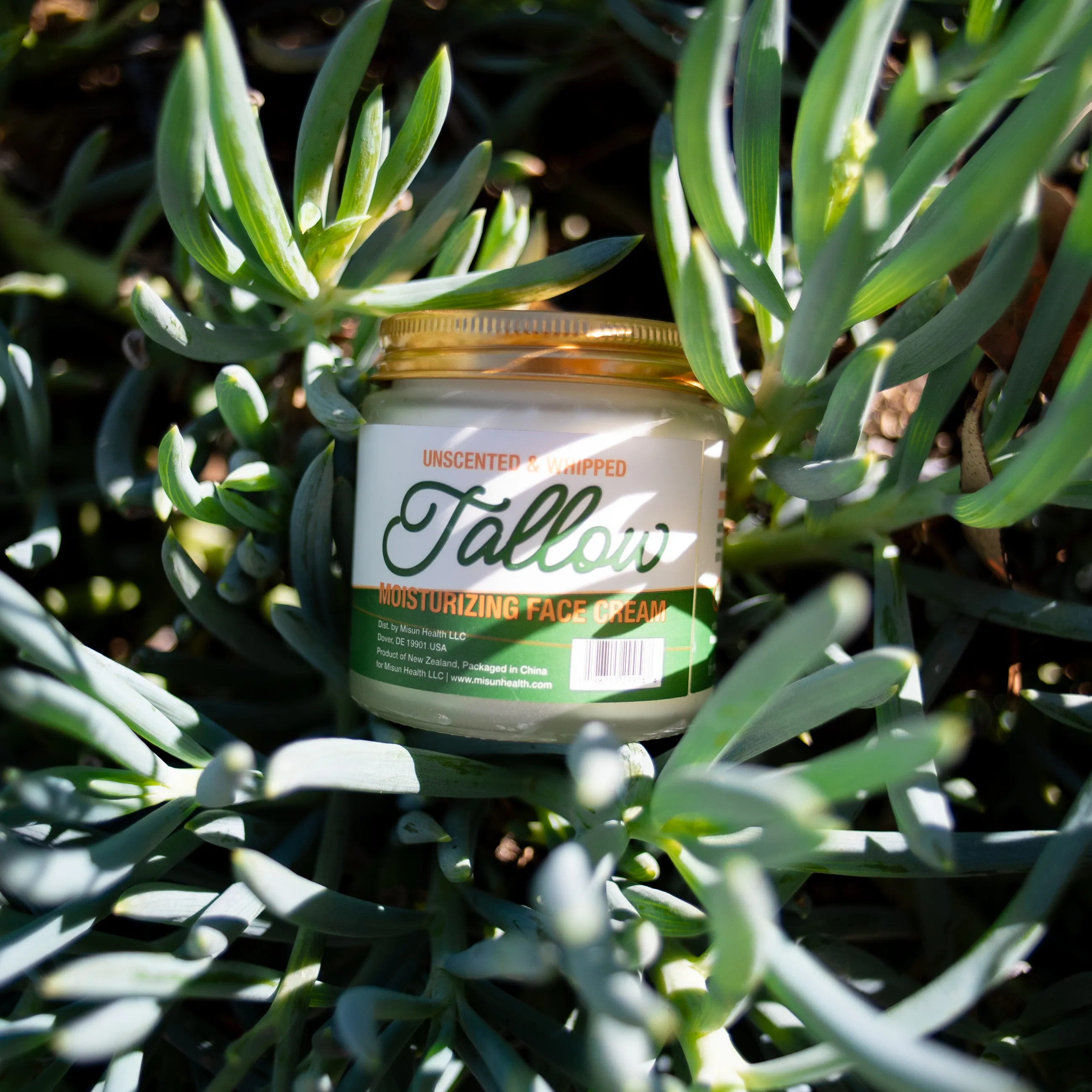
Whipped Tallow Cream is made from 100 percent grass-fed New Zealand beef tallow, whipped so that a small scoop spreads thin and even across the face or body, and the package shown says unscented and fragrance free. That combination is the practical expression of everything above: a single named material from a pasture-finished source, aerated for spreadability rather than diluted for it, with no fragrance added and nothing added to mask one. Beef Tallow Balm is the dense counterpart, built for targeted work on hands, elbows, heels, and cuticles where you want the fat to stay put rather than spread. If you are deciding between the two, the choice is about the job and the area rather than about ingredient quality. Broad coverage and a light finish point to the whipped cream. Small patches of thick, rough-feeling skin point to the balm. Both are cosmetic moisturizers meant to soften dry-feeling skin, and neither is intended to treat a skin condition.
FAQ
Common Questions
Does beef tallow skincare smell like beef?
Well rendered tallow from clean fat smells faintly fatty and close to neutral, and that trace fades within a few minutes of application. A strong savory smell usually points to residual blood and muscle tissue left in the fat or to high dry heat during rendering. A sharp, stale, cardboard-like smell is a different problem and points to oxidation rather than to the render.
Does beef tallow go rancid?
Yes, eventually. All fats oxidize. Tallow oxidizes slowly compared with polyunsaturated oils because the Codex range puts its linoleic acid content at only 1 to 6 percent of total fatty acids. Heat, light, and oxygen speed the process up, which is why an opaque jar kept somewhere cool lasts better than one on a sunny shelf.
What is the difference between suet tallow and trim tallow?
Suet is the hard fat around the kidneys and internal organs, and it renders pale and close to odorless because it carries very little muscle or blood. Trim fat is cut from meat during butchery and carries more connective tissue and residual protein, so it takes more washing and filtering to reach the same result. The Codex standard draws essentially this line between premier jus and edible tallow.
Is grass-fed tallow actually different from grain-fed tallow?
In the fat itself, yes, and the differences are documented. Pasture-finished cattle produce fat with a lower omega-6 to omega-3 ratio, more conjugated linoleic acid, proportionally more stearic acid, and roughly three times the vitamin E and seven times the beta-carotene of grain-finished cattle. Those studies measured beef as a food, so they establish composition rather than skin outcomes.
Why is my tallow balm or cream grainy?
Graininess is a crystal structure issue, not a spoilage issue. Fat that melts and then cools slowly without agitation forms larger crystals and sets firmer and grainier than fat that was cooled quickly while being worked. A jar that spent time in a hot car or near a heat source is the usual explanation. Warming a small amount between clean fingers restores a normal feel at the point of use.
Why is some tallow white and some slightly yellow?
The pigment is beta-carotene from green forage, with lutein contributing less. Pasture-fed cattle carry several times more beta-carotene in their fat than concentrate-fed cattle, so a warmer tone is consistent with a grass-fed source. Heavier washing, filtering, and processing move the color toward white.
Does tallow skincare need a preservative?
Anhydrous products contain no water, and microbes need water to grow, which is why simple fat-only products are often sold without a preservative system. That protection depends on the jar staying dry. Introducing water with wet fingers or a wet tool changes the situation, so use clean dry hands and keep the lid closed.
Primary sources
Sources and evidence limits
- Codex Alimentarius: Standard for Named Animal Fats (CXS 211-1999)
Source for the premier jus and edible tallow definitions, the gas chromatography fatty acid ranges quoted here, and the peroxide value and free fatty acid ceilings for edible bovine fat.
- Daley et al., 2010: A review of fatty acid profiles and antioxidant content in grass-fed and grain-fed beef (Nutrition Journal)
Source for the omega-6 to omega-3 ratios, conjugated linoleic acid difference, stearic acid shift, and the alpha-tocopherol and beta-carotene figures. Measures beef as a food, not skin outcomes.
- Nogoy et al., 2022: Fatty Acid Composition of Grain- and Grass-Fed Beef and Their Nutritional Value and Health Implication (Food Science of Animal Resources)
Independent review reaching compatible conclusions on how finishing diet shifts the fatty acid profile of bovine fat.
- Dunne et al., 2009: Colour of bovine subcutaneous adipose tissue, a review of contributory factors (Meat Science)
Source for beta-carotene as the main pigment behind fat color, the pasture versus concentrate carotenoid figures, and the trade treatment of yellow fat.
- Lipid oxidation in foods and its implications on proteins (Frontiers in Nutrition, 2023)
Source for the two-stage oxidation mechanism, the odorless nature of primary peroxides, and aldehydes including hexanal as the volatiles responsible for rancid odor.
- FDA: Fragrances in Cosmetics
Source for the statement that fragrance-free and unscented are not defined by regulation and that an unscented product may contain a masking agent.
- 21 CFR 701.3: Designation of ingredients
Source for the requirement that cosmetic ingredients be declared in descending order of predominance, which is what makes list position readable.
Use the tools
Related skincare tools
- Fragrance Label CheckerPaste an ingredient declaration to check it for fragrance, perfume, or parfum before you trust a fragrance-free line on the front of a jar.Open tool
- Moisturizer Ingredient DecoderWork out what each entry on a moisturizer ingredient list is doing, which makes a long tallow blend easier to compare against a single-ingredient product.Open tool
- Moisturizer Cost Per Use CalculatorTurn net weight and price into cost per application so jar sizes can be compared honestly across brands.Open tool
Keep reading
Related guides
Shop the routine
Build your tallow routine
Shop the products that best match the concerns and routines covered in this guide.