Informational + ingredient research · 10 min read
Beef Tallow INCI Name: Tallow and Its Derivatives on Skincare Labels
The INCI name for beef tallow is Tallow, a name that also covers sheep fat, and some labels use Adeps Bovis, Latin for cattle fat. Most ingredients made from tallow keep the word, such as Sodium Tallowate, but Sodium Tallate comes from a wood-pulp by-product, and Stearic Acid or Glycerin can come from tallow or plant oils under the same name.
Last updated November 24, 2026
Short answer: the INCI name is Tallow
The INCI name for beef tallow is Tallow, though some labels use Adeps Bovis, Latin for cattle fat. INCI names are the standard ingredient names developed by the International Nomenclature Committee and published by the Personal Care Products Council, the US cosmetics trade association, so that one ingredient carries one labeling name whatever country a product comes from. The council's consumer site, CosmeticsInfo.org, defines Tallow as the fat derived from the fatty tissue of sheep or cattle, so Tallow on its own does not say beef. Most ingredients made from tallow keep the word in their names, from Tallow Glycerides to Sodium Tallowate, the soap that tallow becomes. A second group is harder to spot: Stearic Acid, Oleic Acid and Glycerin can be made from tallow or from plant oils, and the label reads the same either way.
What the word Tallow leaves out
An INCI name identifies a material, not a farm. Tallow on an ingredient list tells you the product contains rendered animal fat. It does not say whether the fat came from cattle or sheep, what the animals ate, where they were raised, or how the fat was rendered and refined. The council describes tallow and its glycerides as ranging from soft, cream-colored waxes to white solids, and the Cosmetic Ingredient Review (CIR), the expert panel that assesses cosmetic ingredient safety in the United States, describes tallow as mainly glycerides of fatty acids 14 to 18 carbons long. FDA's definition is narrower on one point: its rule on cattle materials in cosmetics, 21 CFR 700.27, defines tallow as the rendered fat of cattle. When a brand wants you to know more, it says so on the front panel or in a descriptive ingredient line such as grass-fed New Zealand beef tallow.
Adeps Bovis: the INCI name that says cattle
Some labels list Adeps Bovis, Latin for cattle fat, where you would expect Tallow. FDA's substance registry files both names, with CAS number 61789-97-7, under its record for beef tallow and tags each as an INCI name. The practical difference is the animal: Tallow can be sheep or cattle fat, while Adeps Bovis names cattle. It tells you no more than Tallow does about feed, origin or rendering.
The tallow names you will see on labels
Several INCI names start from the same fat. Tallow Glyceride is the monoglyceride derived from tallow, and Tallow Glycerides is a mixture of mono-, di- and triglycerides derived from it; the council lists them as emollients and emulsifiers. Hydrogenated Tallow Glyceride and Hydrogenated Tallow Glycerides are the same ingredients with hydrogen added. Hydrogenation turns unsaturated fatty acid chains such as oleic acid into saturated ones such as stearic acid, and CIR notes that melting points rise as saturation increases, which is why the council lists Hydrogenated Tallow Glycerides as a thickener for the oily part of a formula.
Glyceryl Tallowate, Tallow Acid and its soaps
Glyceryl Tallowate is a glyceryl monoester from the same fat, covered in CIR's 2004 amended report on that ingredient family. Tallow Acid names the fatty acids obtained from tallow, and its salts are soaps: CIR defines Sodium Tallowate as the sodium salt of Tallow Acid, and its 2019 review of fatty acids also covers Potassium Tallowate, Magnesium Tallowate, Sodium Hydrogenated Tallowate and Potassium Hydrogenated Tallowate. FDA's cattle rule has one term for chemicals like these: a tallow derivative is any chemical obtained by first hydrolyzing, saponifying or transesterifying tallow, whatever chemistry follows.
Tallowate is tallow, Tallate is wood
One pair of names catches careful readers. Sodium Tallowate is soap made from tallow. Sodium Tallate is soap made from tall oil acid, which CIR describes as a mixture of oleic and linoleic acids and rosin acids derived from tall oil, a by-product of pulp from resinous woods. Potassium Tallate and Ammonium Tallate come from the same wood source, and CIR found the group safe as surfactants at the concentrations reported to it, up to 8 percent. If you want a tallow soap, or want to avoid animal ingredients, check whether the name ends in tallowate or tallate before you buy. Lard is the other close neighbor. CIR's lard report describes cosmetic lard as obtained from the rendering of fatty porcine tissue, so Lard, Lard Glycerides, Hydrogenated Lard and Sodium Lardate all point to pork fat rather than beef.
Names that do not reveal their source
Many common ingredients carry one INCI name whether they started as tallow or as a plant. Stearic Acid is the clearest case. CIR's 2019 review says fatty acids are usually made by splitting animal and vegetable fats and oils, and that stearic acid in particular comes either from hydrolysis of tallow or from hydrogenating the unsaturated fatty acids in cottonseed and other vegetable oils. The council's page on the ingredient says stearic acid is found mainly in animal tallow but also in cocoa butter and other vegetable fats. Oleic acid has been prepared from both tallow and olive oil, and palmitic acid from palm oil, tallow and coconut oil, among other sources. These names are common: in FDA's 2019 voluntary registration data, stearic acid was reported in 6,265 cosmetic formulations, up from 2,133 in 2006, mostly eye makeup and leave-on skin care.
Glycerin and the other shared names
Glycerin follows the same pattern. The council lists soybeans, cane and corn syrup sugar as sources and notes that glycerin can also be made synthetically, with the synthetic form chemically identical to the natural one, while glycerin made from animal raw materials has to meet EU animal by-product rules. CDC's list of products that may contain alpha-gal names glycerin and magnesium stearate among the additives in some medications and vaccines that may contain alpha-gal, and both appear in cosmetics as well. Neither name tells you the source. If it matters to you, ask the brand which raw material it buys.
Where tallow ingredients turn up
The council lists tallow and its glycerides in eye makeup, lipsticks, makeup bases and foundations, shampoos, shaving soaps, moisturizers and skin care products. The soap salts mostly end up in the shower. In FDA's 2019 voluntary registration data, Sodium Tallowate was reported in 121 formulations, 117 of them rinse-off, and a 2016 survey by the council found it at up to 80 percent of a rinse-off product, a level that fits a bar of soap. That split matters when you shop for a moisturizer. A cream or balm that leads with Tallow leaves the fat itself on your skin, while a bar that leads with Sodium Tallowate has turned most of its tallow into a cleanser that goes down the drain.
What the order of the list tells you
Position on the list carries information. Under 21 CFR 701.3, cosmetic ingredients are declared in descending order of predominance, and ingredients present at 1 percent or less may follow in any order. Take a hypothetical balm whose list reads Tallow, Olea Europaea (Olive) Fruit Oil, Simmondsia Chinensis (Jojoba) Seed Oil, Lavandula Angustifolia (Lavender) Oil, Tocopherol. Tallow is the largest single ingredient, but it does not have to be most of the jar: 40 percent tallow, 35 percent olive oil, 24 percent jojoba oil and 1 percent shared by the lavender oil and vitamin E would produce exactly that list. The lavender oil is there for its scent, so a fragrance-free shopper should look for essential oils as well as the word fragrance. Now take a cream that opens with Water (Aqua), Glycerin, Cetearyl Alcohol, Tallow. Water is the main ingredient, and the jar holds less tallow than glycerin.
The US rule on cattle materials in cosmetics
Worries about mad cow disease, bovine spongiform encephalopathy (BSE), have a specific regulatory answer in the United States. FDA bars cosmetics from being manufactured from, processed with or otherwise containing prohibited cattle materials, a requirement first issued as an interim final rule in July 2004 and finalized in March 2016 as 21 CFR 700.27. Prohibited cattle materials include the specified risk materials, tissues such as the brain, eyes and spinal cord of cattle 30 months and older and the tonsils and distal ileum of all cattle, as well as material from cattle that cannot rise or walk and mechanically separated beef.
How the rule treats tallow and its derivatives
Tallow is allowed on a condition: it must be made from tissues that are not prohibited cattle materials, or contain no more than 0.15 percent insoluble impurities by AOCS Official Method Ca 3a-46 or an equivalent method. Tallow derivatives fall outside the prohibition entirely, whatever tallow they started from, and FDA's final rule describes the processes that make them as sufficiently rigorous, involving high temperature and pressure. Companies that use cattle material must keep records showing that prohibited materials are absent, for two years. The EU sets its own limit in Annex II of its Cosmetics Regulation, (EC) No 1223/2009, which bans Category 1 and Category 2 material as EU animal by-product law defines them, and ingredients derived from them.
What the safety panel concluded
CIR first assessed Tallow, Tallow Glyceride, Tallow Glycerides and the two hydrogenated glycerides in a report published in 1990 and concluded they were safe as cosmetic ingredients in the present practices of use. The panel re-reviewed the group in 2006, considered the BSE question, and did not reopen that conclusion; the re-review was published in 2008. The council's summary of the re-review says the panel noted the ingredients were processed and purified enough that there was no free protein, and that FDA's source and processing controls help assure they present no risk of BSE.
The panel's 2019 view of tallow derivatives
CIR's 2019 review of fatty acids and soaps returned to the BSE question: tallow is highly processed, tallow derivatives even more so, and the panel agreed with FDA that tallow derivatives are not risk materials for transmission of infectious agents. That review found the fatty acids and their salts safe as used when formulated to be non-irritating and non-sensitizing, a condition attached to the soaps and fatty acids in that report; plain tallow is covered by the 1990 assessment.
Where the cattle come from
Cattle are usually infected with BSE through feed, according to the World Organisation for Animal Health (WOAH): the risk arises when feed contains products derived from ruminants, such as ruminant protein meal. WOAH classifies countries by BSE risk, and its current list, adopted as Resolution No. 23 at its General Session in May 2026, places both New Zealand and the United States in the negligible risk category. Food Standards Australia New Zealand states that BSE has never been detected in cattle in New Zealand.
When the source of an ingredient matters
For most shoppers the INCI name settles the practical question of whether a product contains tallow at all. A few readers need more. CDC lists products made with mammal fat, like lard, tallow or suet, among those some people with alpha-gal syndrome may react to, while noting that not every patient reacts to every such product, so anyone with that diagnosis should ask an allergist before using tallow on skin. If you avoid beef, pork or all animal ingredients, tallow and lard names are easy to rule out from the list, but Stearic Acid, Glycerin, Magnesium Stearate and the other shared names need an answer from the brand. If you specifically want beef tallow, look for Adeps Bovis on the list or read past Tallow to the product name and front panel, since Tallow alone can also mean sheep fat.
Misun Health's cream and balm
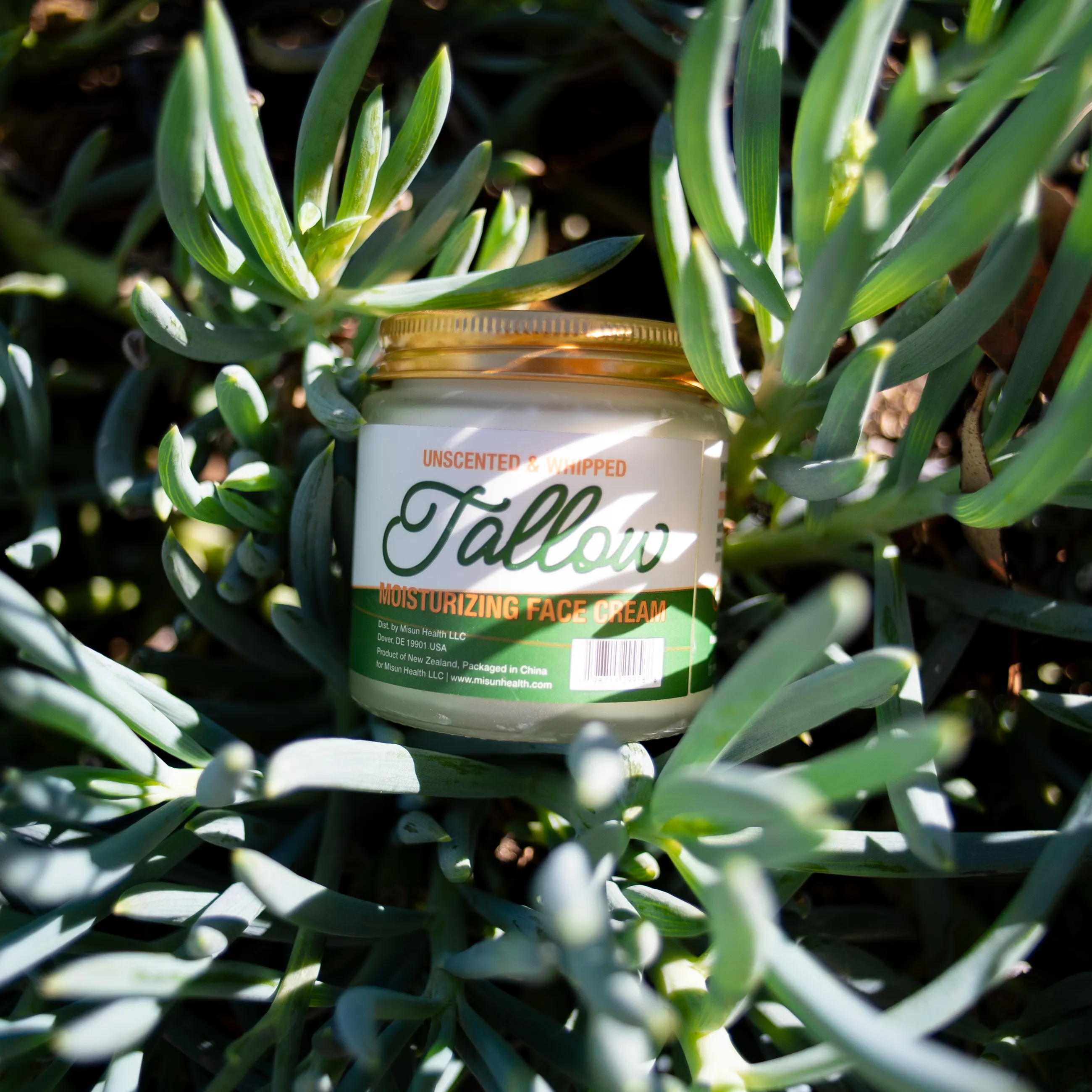
Misun Health makes two fragrance-free tallow moisturizers. Whipped Tallow Cream lists one ingredient, 100 percent grass-fed New Zealand beef tallow, and is labeled unscented and fragrance-free; it is whipped so a small scoop spreads thin and even across the face or body. Beef Tallow Balm is the denser jar, made for targeted use on dry-feeling hands, elbows, heels and cuticles. Both are leave-on products, so the tallow stays on your skin instead of rinsing away with a lather.
FAQ
Common Questions
What is the INCI name for beef tallow?
Tallow, though some labels use Adeps Bovis, Latin for cattle fat, which FDA's substance registry also tags as an INCI name for beef tallow. The Personal Care Products Council, which publishes INCI names, defines Tallow as the fat derived from the fatty tissue of sheep or cattle, so Tallow does not specify beef. Brands that use beef tallow usually say so on the front panel or in a descriptive ingredient line.
Is sodium tallowate the same as tallow?
No. Sodium Tallowate is soap: CIR defines it as the sodium salt of Tallow Acid, the fatty acids obtained from tallow. In FDA's 2019 voluntary registration data it appeared in 121 formulations, 117 of them rinse-off, so you will mostly find it in bar soap rather than in moisturizers.
What is hydrogenated tallow glyceride?
It is Tallow Glyceride, the monoglyceride derived from tallow, with hydrogen added. Hydrogenation turns unsaturated fatty acid chains into saturated ones, which raises the melting point, and the council lists the hydrogenated tallow glycerides among emulsifiers and thickeners.
Is sodium tallate made from tallow?
No. Sodium Tallate is made from tall oil acid, which CIR describes as a mixture of oleic, linoleic and rosin acids derived from tall oil, a by-product of pulp from resinous woods. The soap made from tallow is Sodium Tallowate.
Is stearic acid made from tallow?
Sometimes. CIR lists hydrolysis of tallow and hydrogenation of cottonseed and other vegetable oils among the ways stearic acid is made, and the INCI name is Stearic Acid either way. If the source matters to you, ask the brand.
Can you get mad cow disease from tallow skincare?
US rules are designed to keep high-risk cattle tissues out of cosmetics. FDA prohibits cosmetics from containing specified risk materials and other prohibited cattle materials. Tallow is allowed only if it is made from tissue outside those materials or contains no more than 0.15 percent insoluble impurities, and tallow derivatives fall outside the prohibition because FDA found their processing sufficiently rigorous. The CIR panel agrees that tallow derivatives are not risk materials for infectious agents, and WOAH rates New Zealand and the United States as negligible BSE risk.
Does tallow listed first mean a product is mostly tallow?
Not necessarily. Ingredients are listed in descending order of predominance, so tallow listed first is the largest single ingredient, but a blend could hold 40 percent tallow and still list it first if nothing else is present in a larger amount. Only a list that names tallow alone describes a product that is all tallow.
Primary sources
Sources and evidence limits
- Personal Care Products Council, CosmeticsInfo.org: Tallow
Defines Tallow as the fat derived from the fatty tissue of sheep or cattle, Tallow Glyceride as the monoglyceride and Tallow Glycerides as a mixture of mono-, di- and triglycerides derived from tallow, and the hydrogenated forms as those ingredients with hydrogen added. Source for the product types that use them, their listed functions, the CIR conclusion of safe as cosmetic ingredients reaffirmed in a 2006 re-review that considered BSE, and the panel's note that the ingredients were purified so that there was no free protein.
- Personal Care Products Council: International Nomenclature of Cosmetic Ingredients (INCI)
Describes INCI names as systematic names internationally recognized to identify cosmetic ingredients, developed by the International Nomenclature Committee, so that an ingredient is identified by a single labeling name regardless of the national origin of the product.
- FDA Global Substance Registration System: Beef Tallow (UNII 98HPY76U4W)
FDA's record for beef tallow, CAS 61789-97-7. Lists Adeps Bovis and Tallow among the substance's names, and the linked GSRS full record tags both as INCI names in the cosmetic domain.
- Cosmetic Ingredient Review: Safety Assessment of Fatty Acids & Fatty Acid Salts as Used in Cosmetics (final report, released May 15, 2019)
Copy hosted by the FDA. Source for Sodium Tallowate as the sodium salt of Tallow Acid, with tallow mainly C14, C16, C18, C18:1 and C18:2 fatty acid glycerides; the tallowate salts among the 102 ingredients reviewed; stearic acid made by hydrolysis of tallow or hydrogenation of vegetable oils, oleic acid from tallow and olive oil, and palmitic acid from palm oil, tallow and coconut oil; melting points rising with saturation; 2019 VCRP counts of 6,265 formulations for stearic acid (2,133 in 2006) and 121 for Sodium Tallowate (117 rinse-off, up to 80 percent in the 2016 survey); Tallow's 1990 assessment and 2008 re-review, not reopened; and the panel's statement that tallow is highly processed, tallow derivatives even more so, and that tallow derivatives are not risk materials for transmission of infectious agents.
- Robinson V, Bergfeld WF, Belsito DV, et al. Amended Safety Assessment of Tall Oil Acid, Sodium Tallate, Potassium Tallate, and Ammonium Tallate. International Journal of Toxicology, 2009, volume 28, issue 6, supplement 2, pages 252S to 258S
Describes tall oil acid as a mixture of oleic and linoleic acids and rosin acids derived from tall oil, a by-product of pulp from resinous woods, used in cosmetics as a surfactant at up to 8 percent, and finds the four ingredients safe in the given practices of use and concentration.
- Final report on the safety assessment of Lard Glyceride, Hydrogenated Lard Glyceride, Lard Glycerides, Hydrogenated Lard Glycerides, Lard and Hydrogenated Lard. International Journal of Toxicology, 2001, volume 20, supplement 2, pages 57 to 64
Source for lard used in cosmetic products being obtained from the rendering of fatty porcine tissue.
- Final report of the amended safety assessment of Glyceryl Laurate, Glyceryl Laurate SE ... Glyceryl Tallowate, Glyceryl Thiopropionate, and Glyceryl Undecylenate. International Journal of Toxicology, 2004, volume 23, supplement 2, pages 55 to 94
CIR's amended report on 43 glyceryl monoesters first assessed in 2000, with Glyceryl Tallowate among the ingredients named in its title.
- Personal Care Products Council, CosmeticsInfo.org: Stearic Acid
Says stearic acid is obtained from animal and vegetable fats and oils, and is found mainly in animal tallow but also in cocoa butter and other vegetable fats.
- Personal Care Products Council, CosmeticsInfo.org: Glycerin
Lists soybeans, cane and corn syrup sugar as natural sources, says synthetic glycerin is chemically identical to naturally occurring glycerin, and notes that glycerin derived from raw materials of animal origin must comply with EU animal by-product regulations.
- CDC: Fast Facts: Products That May Contain Alpha-gal (January 5, 2026)
Lists products made or cooked with mammal fat, like lard, tallow or suet, names glycerin and magnesium stearate among medication and vaccine ingredients that may contain alpha-gal, and notes that not all patients with alpha-gal syndrome react to these ingredients.
- 21 CFR 701.3: Designation of ingredients
Requires cosmetic ingredients to be declared in descending order of predominance, and allows ingredients present at not more than 1 percent to be listed without respect to order after those present at more than 1 percent.
- 21 CFR 700.27: Use of prohibited cattle materials in cosmetic products
Bars cosmetics from being manufactured from, processed with, or otherwise containing prohibited cattle materials; defines tallow as the rendered fat of cattle, produced from tissues that are not prohibited cattle materials or containing no more than 0.15 percent insoluble impurities by AOCS Official Method Ca 3a-46; defines a tallow derivative as any chemical obtained through initial hydrolysis, saponification or trans-esterification of tallow; and requires records to be kept for 2 years.
- FDA: Use of Materials Derived From Cattle in Human Food and Cosmetics, final rule, Federal Register, volume 81, pages 14718 to 14732 (March 18, 2016)
Finalizes the interim rules of 2004, 2005 and 2008, effective April 18, 2016. Source for FDA's agreement that the processes that produce tallow derivatives are sufficiently rigorous and involve high temperature and pressure, for tallow derivatives being excluded from prohibited cattle materials regardless of the tallow source, and for FDA's concern that cosmetics could serve as another potential route for BSE infectivity.
- FDA: Prohibited & Restricted Ingredients in Cosmetics (content current as of February 25, 2022)
Summarizes the prohibited cattle materials entry, including the exclusions for tallow that contains no more than 0.15 percent insoluble impurities, tallow derivatives, hides and hide-derived products, and milk and milk products.
- World Organisation for Animal Health (WOAH): Bovine spongiform encephalopathy
Says bovines are usually infected through feed contaminated with the BSE agent, a risk that arises when feed contains products derived from ruminants, and lists New Zealand and the United States of America as negligible BSE risk under Resolution No. 23 of the 93rd General Session, May 2026.
- Food Standards Australia New Zealand: BSE (page last updated September 30, 2025)
States that BSE has never been detected in cattle in Australia or New Zealand, and that WOAH recognizes both countries as having a negligible BSE risk status.
- Regulation (EC) No 1223/2009 of the European Parliament and of the Council on cosmetic products, Annex II, entry 419
Lists Category 1 and Category 2 material, as defined in EU animal by-product law, and ingredients derived therefrom among the substances prohibited in cosmetic products.
Use the tools
Related skincare tools
- Moisturizer Ingredient DecoderWork out what each entry on a moisturizer ingredient list is doing, which makes a long tallow blend easier to compare against a single-ingredient product.Open tool
- Fragrance Label CheckerPaste an ingredient declaration to check for fragrance, perfume or parfum before trusting a fragrance-free or unscented line on the front of a jar.Open tool
- Fatty Acid Comparison for Skincare Oils and ButtersSee measured grass-fed and grain-fed beef tallow side by side with shea, coconut and plant oils, with a relative oxidation index for each fat.Open tool
Keep reading
Related guides
Shop the routine
Build your tallow routine
Shop the products that best match the concerns and routines covered in this guide.