Informational + pre-purchase research · 13 min read
Unscented vs Fragrance-Free Moisturizer: What the Label Can Still Hide
Unscented describes how a moisturizer smells, and a maker can reach it by adding a little fragrance to mask other odors. Fragrance-free is the label dermatologists recommend, but neither term has a US legal definition, so check the ingredient list for fragrance, parfum, essential oils and allergens such as linalool and limonene.
Last updated November 20, 2026
Short answer: unscented describes the smell, fragrance-free the formula
An unscented moisturizer is one with no noticeable smell, and a manufacturer can get there by adding a little fragrance to cover the odor of other ingredients. A fragrance-free moisturizer is sold as having no fragrance added at all. If fragrance bothers your skin, fragrance-free is the label to look for. The American Academy of Dermatology (AAD) says dermatologists recommend products labeled fragrance-free, and that a product labeled unscented can contain chemicals that neutralize or hide the odors of other ingredients. Neither word settles the matter, though. The FDA says no federal standard or definition governs terms such as fragrance-free, hypoallergenic or for sensitive skin, so the ingredient list is the real test. Read it for the words fragrance, parfum or aroma, for essential oils and plant extracts, for fragrance chemicals named one by one, such as linalool and limonene, and for the phrase and other ingredients at the end. The rules on naming those chemicals are changing as well. Products placed on the European Union market since July 31, 2026 must name 56 more fragrance allergens whenever they are present above set limits, on top of the 24 already required. The US rule Congress ordered in 2022 has not yet been proposed.
What a US moisturizer label has to tell you
Under the Fair Packaging and Labeling Act, the FDA requires an ingredient declaration on cosmetics sold at retail to consumers, but the rules treat fragrance differently from every other ingredient. Under 21 CFR 701.3, ingredients are declared in descending order of predominance, except that fragrance or flavor may be listed simply as fragrance or flavor. Ingredients present at 1 percent or less may follow in any order. If the FDA has accepted an ingredient as exempt from public disclosure, the list may end with the phrase and other ingredients instead of naming it. The FDA's consumer page on fragrances explains why that one word matters. Fragrance and flavor formulas are complex mixtures of many different natural and synthetic chemical ingredients, the agency says, and they are the cosmetic components most likely to be trade secrets, which the labeling law cannot be used to force a company to reveal. A single word on the back of a jar can stand for a long list of chemicals you never see. The FDA's advice follows from that: if you are concerned about fragrance sensitivities, choose products that are fragrance free and check the ingredient list carefully. The words on the front panel are not defined either. The FDA's page on allergens in cosmetics says it is not enough to check for terms like hypoallergenic, fragrance-free or for sensitive skin, because there is no federal standard or definition that governs their use in the US.
How a jar labeled unscented can still contain fragrance
The FDA puts it directly: even some products labeled unscented may contain fragrance ingredients, because the manufacturer may add just enough fragrance to mask the unpleasant smell of other ingredients without giving the product a noticeable scent. Unscented on the front and fragrance on the back is therefore not a contradiction. The front describes what you smell, and the back describes what is in the jar. Plant ingredients are the second place fragrance turns up. The FDA notes that there is no regulatory definition for essential oils and that the law treats ingredients from plants the same as those from any other source. The AAD makes the same point in its advice on testing skin care products: remain cautious with products labeled unscented or made with plant-based botanical ingredients, because these products may still have fragrance-related ingredients. Since neither label word is defined in US rules, the front of a jar cannot tell you whether lavender, citrus or rose oil is inside. Only the ingredient list can.
Europe now requires 56 more fragrance allergens on the label
The European Union gives the clearest picture of which fragrance chemicals matter, because it already required 24 fragrance allergens to be named individually on cosmetic labels. Commission Regulation (EU) 2023/1545, adopted on July 26, 2023, adds 56 more. The 24 already listed include linalool, limonene, citronellol, geraniol, citral, coumarin, eugenol and benzyl alcohol. The additions are fragrance allergens that the EU's Scientific Committee on Consumer Safety identified in a 2012 opinion as having clearly caused allergies in humans. Each must be named in the ingredient list when its concentration exceeds 0.001 percent in a leave-on product, such as a moisturizer, or 0.01 percent in a rinse-off product, such as a cleanser. Since July 31, 2026, products that do not meet the new requirements may no longer be placed on the EU market, and products placed on the market before that date may stay available until July 31, 2028. The additions include single chemicals such as menthol, vanillin, camphor and linalyl acetate, and essential oils named by plant, among them lavender, peppermint, spearmint, lemon, bergamot, orange peel, eucalyptus, clove, ylang-ylang, jasmine, rose, sandalwood, geranium and patchouli. The regulation states its reasoning. It puts the share of people in the EU who are allergic to fragrance allergens at an estimated 1 to 9 percent and notes that once a person has been sensitized, a much lower concentration is enough to trigger symptoms. Naming each allergen lets sensitized people avoid the substance they are allergic to. The European Commission adds a fair caution: an ingredient appearing on the list does not mean that the product is unsafe.
Why a US label can still just say fragrance
Congress ordered a US version in the Modernization of Cosmetics Regulation Act of 2022, signed on December 29, 2022. The law says the company responsible for a cosmetic shall identify on its label each fragrance allergen the product contains, and it leaves the FDA to decide by regulation which substances count. The FDA was to propose that regulation within 18 months, by June 29, 2024, and to issue a final rule within 180 days after the public comment period on the proposal closes. In writing it, the agency must consider international, state and local requirements for allergen disclosure, including the substance and format of the EU's, and it may set threshold amounts for disclosure. The deadline passed without a proposal. In the Spring 2025 edition of the federal regulatory agenda, the FDA listed May 2026 as its target for proposing the rule, titled Disclosure of Fragrance Allergens in Cosmetic Labeling. The 2026 edition moved the target to November 2026 and still shows the rule at the proposed rule stage, with no Federal Register citation. The FDA's own page on the 2022 law, current as of October 29, 2026, still lists fragrance allergen labeling requirements among the regulations the agency must establish, and as of November 20, 2026, no proposal had been published. Until a final rule takes effect, a US label can keep listing fragrance as one word, and reading the rest of the list is the only way to see what an unscented moisturizer contains.
Five checks for any jar labeled unscented or fragrance-free
First, on the front panel, choose fragrance-free over unscented, for the reason the AAD gives: unscented can mean chemicals were added to neutralize or hide other odors. Second, read the whole ingredient list for fragrance, parfum, perfume or aroma. EU rules have perfume and aromatic compositions listed as parfum or aroma, while the FDA requires the English name and accepts an alternative in parentheses, giving Fragrance (Parfum) as an example. Any of these on a jar sold as unscented is the masking fragrance the FDA describes. Third, look for essential oils and plant extracts. US labels give the English name and may add the Latin one in parentheses, as in the FDA's own example, Sweet Almond (Prunus Amygdalus Dulcis) Oil, so watch for Lavandula (lavender), Citrus (lemon, orange, bergamot), Mentha (peppermint, spearmint), Rosa (rose), Santalum (sandalwood), Cananga (ylang-ylang) and Pelargonium (geranium). Fourth, scan for fragrance chemicals named one by one, such as linalool, limonene, citronellol, geraniol, citral, coumarin, eugenol, linalyl acetate, menthol, camphor and vanillin. Benzyl alcohol needs a second look, because it is also used as a preservative, and the EU's allergen labeling entry for it applies when it serves a purpose other than keeping microorganisms from growing in the product. Fifth, count the ingredients and check the end of the list. A short list leaves fewer places for a scent ingredient, and the phrase and other ingredients means at least one ingredient is not named at all. The Fragrance Label Checker linked below runs the second check on a pasted list, and the Moisturizer Ingredient Decoder sorts every ingredient by role and marks fragrance terms, common aromatic compounds and several essential oils as fragrance-related.
How little 0.001 percent is
The EU threshold for a leave-on product, 0.001 percent, works out to 10 parts per million. In a 2-ounce (56.7 gram) jar of moisturizer, that is about 0.57 milligrams of a single allergen. Plant oils clear that line with room to spare. Austria's Agency for Health and Food Safety (AGES) gives a worked example in its guidance for companies: a product containing 1.3 percent lavender oil, in which linalool makes up 45 percent of the oil, contains 0.585 percent linalool, and both the lavender oil and the linalool must be declared. That is 585 times the leave-on threshold. A scent from a plant counts the same as a synthetic one: in the AGES example, the linalool has to be declared even though it came from lavender.
Why some fragrance chemicals get worse with air
Several common fragrance chemicals can turn into known contact allergens after they react with air or after the body processes them. The EU regulation says fragrance substances that can be transformed into known contact allergens through air oxidation or bioactivation should be treated as equivalent to fragrance allergens. AGES names limonene, linalool and linalyl acetate among the substances that change through oxidation or hydrolysis, and cinnamyl alcohol, eugenol, isoeugenol and isoeugenyl acetate among those that change through metabolic transformation. The regulation also caps the peroxide value, a measure of oxidation, for limonene and for pinene, turpentine and several pine and cedar oils. Patch-test data from North America shows the effect. In the North American Contact Dermatitis Group's results for 2023 and 2024, published in 2026, 3,979 patients were tested. The most common positive reactions included fragrance mix I and the hydroperoxides of linalool, which form when linalool oxidizes, at 8.7 percent each, and Myroxylon pereirae resin, also called balsam of Peru, at 7.6 percent. These were patients sent for patch testing, so the figures describe people already suspected of having a contact allergy, not the general public. Even so, fragrance sits in the same top group as nickel, cobalt and the isothiazolinone preservatives.
If you already react to fragrance
A reaction you can trace to a product is worth a visit to a dermatologist, because patch testing can identify the specific chemical. The FDA describes the test: a small amount of allergen is placed on the skin and covered for 48 hours, a physician checks the skin after 72 to 96 hours, and the process takes two to three office visits. The FDA also advises seeing a healthcare professional if you suspect an allergic reaction, as sensitivity to allergens can become more severe over time. Once you know your allergens, the American Contact Dermatitis Society's Contact Allergen Management Program (CAMP) builds lists of personal care products without them from your patch-test results. Access is free for ACDS members and their patients. The society warns that manufacturers may change their ingredient lists, so check the ingredients on each new purchase. For any new moisturizer, the AAD gives an at-home test. Apply the amount you would normally use to a quarter-sized spot where it will not be rubbed or washed away, such as the underside of your arm or the bend of your elbow, twice a day for seven to 10 days. If no reaction appears, go ahead and use the product. If the skin turns red, itchy or swollen, wash the product off as soon as possible and do not use it again. The Patch Test Planner linked below turns that method into a schedule.
Where a single-ingredient tallow moisturizer fits
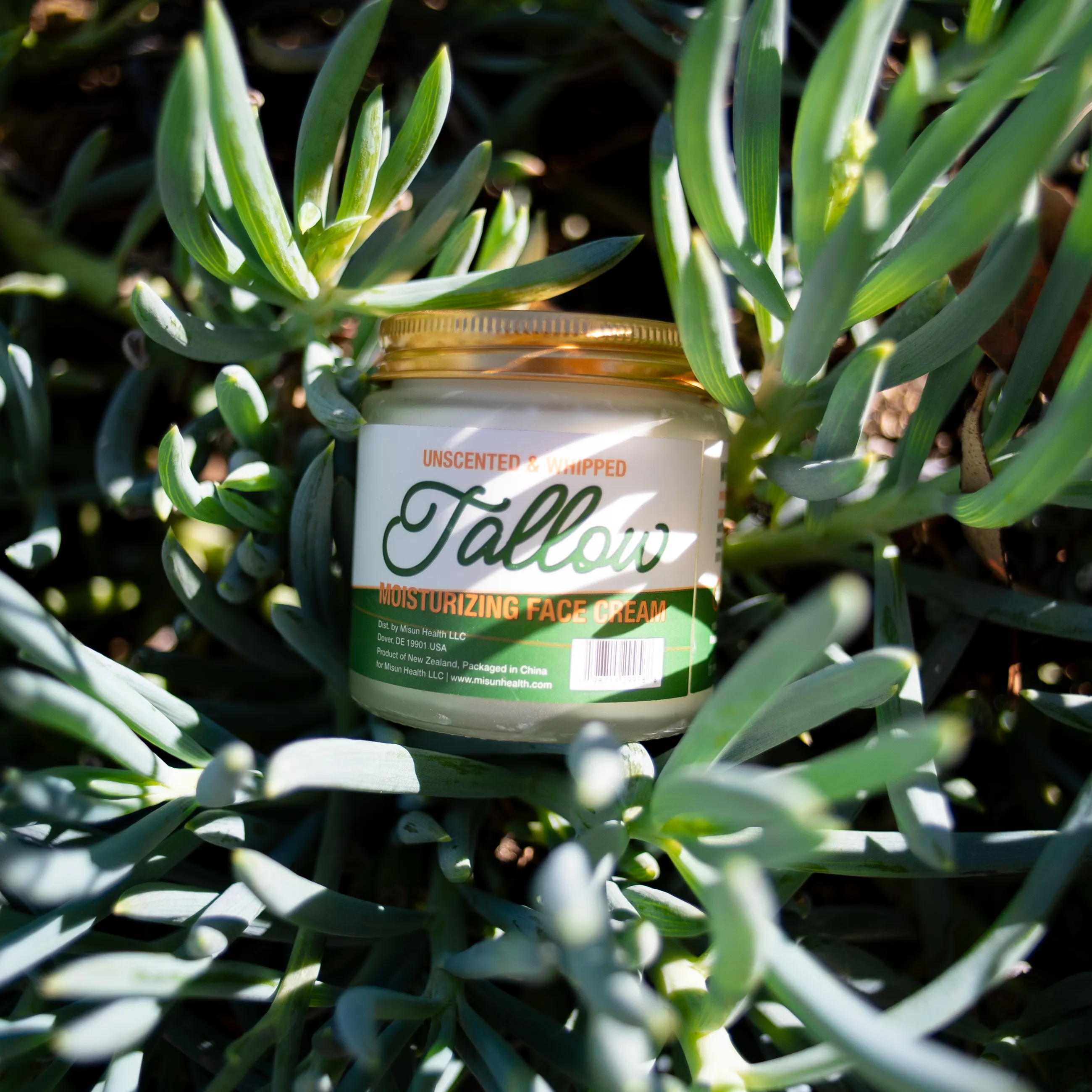
The simplest way around all of this is a moisturizer with almost nothing to decode. Misun Health makes two fragrance-free tallow products. Whipped Tallow Cream lists one ingredient, 100 percent grass-fed New Zealand beef tallow, and is labeled unscented and fragrance-free; with a single ingredient on the list, there is no fragrance, masking agent, essential oil or named fragrance allergen in it. Tallow is on neither the EU's original list nor the 2023 additions. The cream is whipped so a small amount spreads thin over the face, hands or body. Beef Tallow Balm is the denser of the two, made for small dry areas such as hands, heels, elbows and cuticles. Apply either one while your skin is still damp after a shower, a bath or hand washing, as the AAD advises.
FAQ
Common Questions
Is unscented the same as fragrance-free?
No. Unscented describes the smell, and the FDA notes that a manufacturer may add just enough fragrance to mask the smell of other ingredients. Fragrance-free is the label dermatologists recommend, according to the AAD, but neither term has a federal definition in the US, so read the ingredient list either way.
Can a fragrance-free moisturizer contain essential oils?
No US rule defines fragrance-free, so the label alone cannot rule them out. The AAD advises caution with products made with plant-based botanical ingredients because they may still have fragrance-related ingredients. Check the ingredient list for plant names such as lavender (Lavandula), citrus, peppermint (Mentha), rose (Rosa) or sandalwood (Santalum).
Why does my unscented lotion list fragrance?
Most likely to cover the smell of the other ingredients. The FDA says a manufacturer may add just enough fragrance to mask the unpleasant smell of other ingredients without giving the product a noticeable scent. If you are avoiding fragrance, choose a product labeled fragrance-free with no fragrance or parfum in its ingredient list.
Are linalool and limonene bad for your skin?
They are fragrance chemicals, and both are among the 24 fragrance allergens that EU labels already had to name when present above 0.001 percent in a leave-on product. AGES also lists both among the substances that can turn into known contact allergens when they oxidize. The European Commission notes that an ingredient appearing on the list does not mean the product is unsafe. If a dermatologist has confirmed you are allergic to either one, avoid products that list it.
When will US labels list fragrance allergens by name?
Not yet. Congress required it in December 2022, but the FDA first has to issue a regulation naming which substances count. Its 2026 regulatory agenda targets November 2026 for the proposal, and the law then gives the agency up to 180 days after the comment period closes to issue a final rule. Until a final rule takes effect, US labels can keep listing fragrance as one word.
Does hypoallergenic mean fragrance-free?
No. The FDA says there is no federal standard or definition that governs the use of hypoallergenic, fragrance-free or for sensitive skin in the US, so none of them tells you whether fragrance is in the jar. The ingredient list does.
What should I look for in an unscented moisturizer for sensitive skin?
A product labeled fragrance-free, with no fragrance, parfum, essential oils or individually named fragrance chemicals in the ingredient list, and as short a list as you can find. The AAD says creams and ointments add more moisture to skin and are more effective than lotions, and it advises applying moisturizer while skin is still damp.
Primary sources
Sources and evidence limits
- FDA: Fragrances in Cosmetics (content current as of February 28, 2022)
Source for some products labeled unscented containing fragrance ingredients because a manufacturer may add just enough fragrance to mask the unpleasant smell of other ingredients without giving the product a noticeable scent; fragrance and flavor ingredients being listable simply as Fragrance or Flavor; fragrance formulas being complex mixtures of natural and synthetic chemical ingredients that are the components most likely to be trade secrets; no regulatory definition for essential oils; plant ingredients being treated the same as those from any other source; and the advice to choose products that are fragrance free and check the ingredient list carefully.
- FDA: Allergens in Cosmetics (content current as of October 9, 2026)
Source for the ingredient declaration FDA requires under the Fair Packaging and Labeling Act; there being no federal standard or definition governing hypoallergenic, fragrance-free or for sensitive skin; fragrance ingredients being listable generally as fragrance or perfume; the 26 fragrance allergens in Annex III of the EU Cosmetics Directive, including linalool, d-limonene, citronellol, geraniol, citral, coumarin, eugenol and benzyl alcohol, two of which (HICC and Lilial) are no longer permitted in the EU; patch testing that covers allergens on the skin for 48 hours, is read after 72 to 96 hours and takes two to three office visits; and sensitivity to allergens becoming more severe over time.
- 21 CFR 701.3: Designation of ingredients
Requires ingredients to be declared in descending order of predominance except that fragrance or flavor may be listed as fragrance or flavor, allows ingredients present at not more than 1 percent to be listed without respect to order of predominance, and allows the phrase and other ingredients for an ingredient FDA has accepted as exempt from public disclosure under 21 CFR 720.8(a).
- FDA: Cosmetic Ingredient Names (content current as of February 25, 2022)
Source for US labels using English common or usual names, FDA not accepting Parfum as a substitute for Fragrance, and FDA not objecting to an alternative name in parentheses after the English name, with Fragrance (Parfum) and Sweet Almond (Prunus Amygdalus Dulcis) Oil among its examples.
- 21 U.S.C. 364e: Labeling, added by the Modernization of Cosmetics Regulation Act of 2022 (Cornell Legal Information Institute)
Subsection (b) requires the responsible person to identify on the label each fragrance allergen in a cosmetic product, with fragrance allergens determined by regulation; sets a proposed rule within 18 months after December 29, 2022 and a final rule within 180 days after the comment period closes; requires consideration of international, State and local requirements for allergen disclosure, including the substance and format of EU requirements; and permits threshold levels. Added by Pub. L. 117-328, div. FF, title III, sec. 3502, December 29, 2022.
- Unified Agenda, Spring 2025: Disclosure of Fragrance Allergens in Cosmetic Labeling (RIN 0910-AI90)
Lists the rule at the proposed rule stage, a statutory deadline of June 29, 2024 for the proposal, and a target of May 2026 for the proposal.
- Unified Agenda, 2026: Disclosure of Fragrance Allergens in Cosmetic Labeling (RIN 0910-AI90)
Lists the rule at the proposed rule stage with a target of November 2026 for the proposal and no Federal Register citation. The abstract says FDA is proposing to identify certain substances as fragrance allergens and to require the disclosure of fragrance allergens on the labels of cosmetic products.
- FDA: Modernization of Cosmetics Regulation Act of 2022 (MoCRA) (content current as of October 29, 2026)
Lists fragrance allergen labeling requirements among the regulations MoCRA requires FDA to establish.
- Commission Regulation (EU) 2023/1545 of 26 July 2023 as regards labelling of fragrance allergens in cosmetic products (Official Journal L 188, 27 July 2023)
The recitals estimate the share of the EU population allergic to fragrance allergens at 1 to 9 percent, note that a much lower concentration triggers symptoms once a person is sensitised, record that 24 fragrance allergens already had to be labelled individually and that the SCCS opinion of 26 and 27 June 2012 identified 56 additional fragrance allergens that have clearly caused allergies in humans, set individual labelling above 0.001 percent in leave-on and 0.01 percent in rinse-off products, and treat substances transformed into contact allergens by air oxidation or bioactivation as equivalent to fragrance allergens. The annex adds entries including menthol, vanillin, camphor, linalyl acetate and lavender, peppermint, spearmint, lemon, bergamot, orange peel, eucalyptus, clove, ylang-ylang, jasmine, rose, sandalwood, geranium and patchouli oils; applies the benzyl alcohol entry to purposes other than inhibiting the development of microorganisms; caps peroxide values for limonene, pinene, turpentine and several pine and cedar oils; and lets non-compliant products be placed on the market until 31 July 2026 and made available until 31 July 2028.
- European Commission: Fragrance allergens labelling
Source for the regulation introducing individual labelling requirements for 56 additional fragrance allergens, the 0.001 percent leave-on and 0.01 percent rinse-off thresholds, non-compliant products no longer being placed on the EU market since 31 July 2026 while products placed earlier remain available until 31 July 2028, labelling helping sensitised consumers identify products containing substances to which they may react, and an ingredient appearing in the list not meaning that the product is unsafe.
- AGES (Austrian Agency for Health and Food Safety): New fragrance regulation in cosmetics (last updated February 23, 2026)
Worked example of a product with 1.3 percent lavender oil whose oil is 45 percent linalool, giving 0.585 percent linalool, with both the lavender oil and the linalool to be declared. Also lists limonene, linalool and linalyl acetate as prehaptens that change through oxidation or hydrolysis, and cinnamyl alcohol, eugenol, isoeugenol and isoeugenyl acetate as prohaptens that change through metabolic transformation.
- American Academy of Dermatology: Dermatologists' top tips for relieving dry skin (last updated January 2, 2026)
Source for dermatologists recommending products labeled fragrance-free, a product labeled unscented possibly containing chemicals that neutralize or hide the odors of other ingredients, ointments and creams adding more moisture to skin and being more effective than lotions, and applying moisturizer while skin is still damp after a shower or bath and after washing your hands.
- American Academy of Dermatology: How to test skin care products (last updated August 10, 2021)
Source for the at-home test: the normal amount on a quarter-sized spot that will not be rubbed or washed away, such as the underside of the arm or the bend of the elbow, twice daily for seven to 10 days, washing the product off and not using it again if red, itchy or swollen skin develops; and for remaining cautious with products labeled unscented or with plant-based botanical ingredients, which may still have fragrance-related ingredients.
- Reeder et al., 2026: North American Contact Dermatitis Group Patch Test Results: 2023-2024 (Dermatitis)
Of 3,979 patients tested, the top allergens included nickel sulfate hexahydrate (26.4 percent), methylisothiazolinone (9.2 percent), cobalt chloride hexahydrate (8.8 percent), fragrance mix I (8.7 percent), hydroperoxides of linalool (8.7 percent), Myroxylon pereirae resin (7.6 percent) and methylchloroisothiazolinone/methylisothiazolinone (7.0 percent).
- American Contact Dermatitis Society: CAMP basics
Source for the Contact Allergen Management Program generating safe product lists based on patch testing results, free access for ACDS members and their patients, and the warning that manufacturers may change their ingredient lists.
Use the tools
Related skincare tools
- Fragrance Label CheckerPaste an ingredient list to check it for fragrance, perfume or parfum, the words a masking fragrance sits behind on a jar labeled unscented.Open tool
- Moisturizer Ingredient DecoderSort every ingredient in a moisturizer by role and see which ones are fragrance terms, named aromatic compounds or essential oils.Open tool
- Patch Test PlannerGet the site, the amount and the twice-daily schedule for testing a new moisturizer before you use it widely.Open tool
Keep reading
Related guides
Explore next
Related skin concerns
- Unscented Moisturizer for Sensitive Skin: How to Choose a Fragrance-Free Routine That Actually Feels ComfortableExplore concern
- Fragrance-Free Moisturizer for Dry Sensitive SkinExplore concern
- Unscented Moisturizer for Eczema-Prone Kids Dry SkinExplore concern
- Unscented Moisturizer for Perimenopause Dry SkinExplore concern
Shop the routine
Build your tallow routine
Shop the products that best match the concerns and routines covered in this guide.