High-intent product comparison
10 min read
Beef Tallow vs Hyaluronic Acid Serum for Dry Skin
Hyaluronic acid serum and beef tallow are not true substitutes. Hyaluronic acid is usually the better first step when skin feels dehydrated and dull, while tallow makes more sense when dryness keeps returning because the skin needs a richer, more protective finish.
Compare beef tallow vs hyaluronic acid serum for dry skin with clearer guidance on humectant hydration, sealing power, layering order, climate fit, and when each works best.
Quick summary
- Hyaluronic acid serum and beef tallow are not true substitutes. Hyaluronic acid is usually the better first step when skin feels dehydrated and dull, while tallow makes more sense when dryness keeps returning because the skin needs a richer, more protective finish.
- Hydration pull vs moisture seal: what each one actually does: Hyaluronic acid serum is usually used as a humectant step, which means it works best when there is some water present to hold near the skin. Beef tallow plays a different role. It is usually chosen for richer emollient and occlusive support that helps soften roughness and slow moisture loss after hydration is already in place. If your skin feels papery, tight again within an hour, or rough around the edges even after a light serum, that is often a sign the routine needs more sealing support rather than another watery layer by itself.
- When hyaluronic acid serum usually wins: Hyaluronic acid serum tends to fit best when dryness shows up more as dehydration than flaking. Think skin that looks flat, feels thirsty after cleansing, or gets midday tightness indoors but does not necessarily have thick rough patches. It usually makes the most sense under moisturizer or sunscreen in the morning, especially when you want a lighter feel and do not want a richer product sitting heavily under makeup or during a warm workday.
Why people choose this approach
- Hyaluronic acid serum is usually used as a humectant step, which means it works best when there is some water present to hold near the skin. Beef tallow plays a different role. It is usually chosen for richer emollient and occlusive support that helps soften roughness and slow moisture loss after hydration is already in place. If your skin feels papery, tight again within an hour, or rough around the edges even after a light serum, that is often a sign the routine needs more sealing support rather than another watery layer by itself.
- Hyaluronic acid serum tends to fit best when dryness shows up more as dehydration than flaking. Think skin that looks flat, feels thirsty after cleansing, or gets midday tightness indoors but does not necessarily have thick rough patches. It usually makes the most sense under moisturizer or sunscreen in the morning, especially when you want a lighter feel and do not want a richer product sitting heavily under makeup or during a warm workday.
Keep in mind
- Patch test first and increase use gradually based on comfort.
- Skincare supports moisture and comfort but is not a cure for medical conditions.
- If symptoms persist, worsen, or become painful, consult a licensed clinician.
Quick comparison
| Feature | Whipped Tallow Cream | Beef Tallow Balm |
|---|---|---|
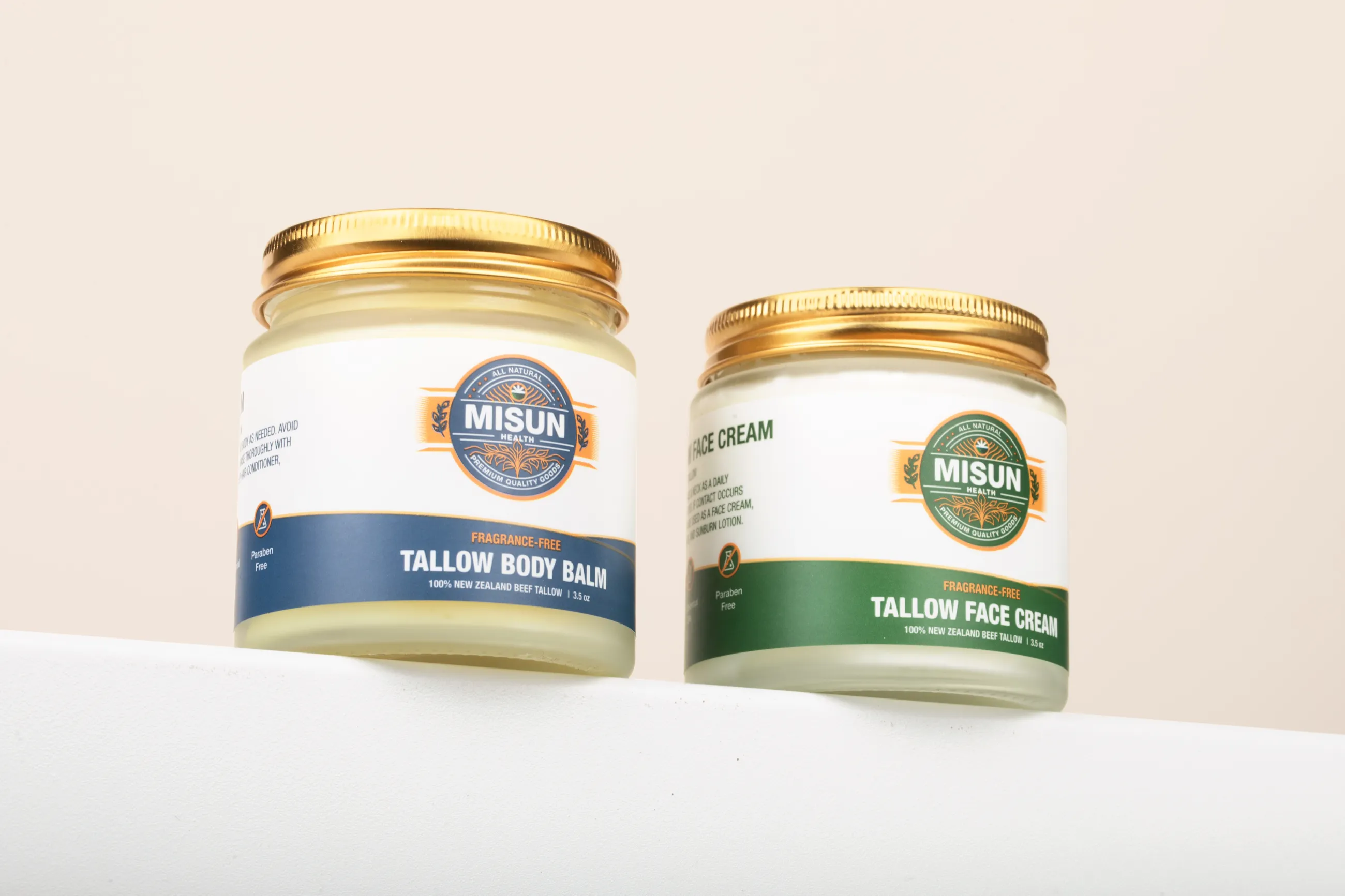
| Best use case | Daily face/body moisture with lighter spread | Targeted dry patches and high-friction zones |
| Typical routine timing | Morning + daytime maintenance | Night routine + targeted application |
| Texture feel | Lighter and easier to spread | Dense and more sealing |
Routine steps
Best layering order, and why damp skin matters
If you want to use both, the simplest order is hyaluronic acid serum first on slightly damp skin, then a thin layer of whipped tallow cream or a spot layer of balm on top. The serum goes first because humectant steps usually perform better closer to the skin, while tallow works better as the richer finishing layer. The common mistake is using too much serum on dry air days or applying it to already bone-dry skin and expecting it to fix everything. In that situation, the routine can feel tight again quickly unless there is enough moisture and enough sealing support afterward.
A realistic day-and-night routine that uses both well
For daytime, apply hyaluronic acid to slightly damp skin, wait a few seconds, then use a light tallow layer only where dryness usually rebounds first. For nighttime, you can simplify and lean richer: serum first if your skin likes it, then tallow over the full dry zone or only on the areas that wake up flaky by morning. If you are choosing only one for a minimal routine, serum usually wins for lightweight daytime hydration and tallow usually wins for overnight comfort or rough-patch support.
How to test the difference without confusing the result
Keep the rest of your routine boring for 7 to 10 days. Use the same cleanser, do not add new acids or exfoliants, and track the same zone every day. Test one approach as serum only, and the other as serum plus tallow or tallow alone depending on the question you are trying to answer. Then judge four things: how fast tightness returns, whether flaking is lower by midday, how much product you need to reapply, and whether the finish is pleasant enough to repeat. The winner is usually the routine you will actually keep using, not the one that sounds better in theory.
Hydration pull vs moisture seal: what each one actually does
Hyaluronic acid serum is usually used as a humectant step, which means it works best when there is some water present to hold near the skin. Beef tallow plays a different role. It is usually chosen for richer emollient and occlusive support that helps soften roughness and slow moisture loss after hydration is already in place. If your skin feels papery, tight again within an hour, or rough around the edges even after a light serum, that is often a sign the routine needs more sealing support rather than another watery layer by itself.
When hyaluronic acid serum usually wins
Hyaluronic acid serum tends to fit best when dryness shows up more as dehydration than flaking. Think skin that looks flat, feels thirsty after cleansing, or gets midday tightness indoors but does not necessarily have thick rough patches. It usually makes the most sense under moisturizer or sunscreen in the morning, especially when you want a lighter feel and do not want a richer product sitting heavily under makeup or during a warm workday.
When beef tallow usually works better
Beef tallow usually becomes more useful when the problem is not just missing water, but poor staying power. If skin gets rough around the nose, mouth, cheeks, knuckles, or other friction-prone zones, tallow often outperforms a serum-only routine because it leaves behind more cushion and a slower moisture-loss feel. It is also often the easier choice for nighttime or for body areas where a thin serum disappears too fast to feel meaningful on its own.
Best layering order, and why damp skin matters
If you want to use both, the simplest order is hyaluronic acid serum first on slightly damp skin, then a thin layer of whipped tallow cream or a spot layer of balm on top. The serum goes first because humectant steps usually perform better closer to the skin, while tallow works better as the richer finishing layer. The common mistake is using too much serum on dry air days or applying it to already bone-dry skin and expecting it to fix everything. In that situation, the routine can feel tight again quickly unless there is enough moisture and enough sealing support afterward.
Dry climate vs humid climate fit
Climate changes how this comparison feels in real life. In a drier indoor or winter environment, hyaluronic acid often needs help from a richer follow-up product or it may not feel like enough for long. In more humid conditions, a light serum can feel easier and more satisfying because there is less need for a dense finish on every area. That does not mean tallow is only for winter. It just means the richer product often works best when you use it more selectively in humid weather and more consistently in cold, dry, or over-conditioned spaces.
Face vs body, and where each fits better
On the face, many people use hyaluronic acid for broad lightweight hydration and reserve tallow for cheeks, around-the-mouth dryness, or nighttime use when comfort matters more than a weightless finish. On the body, the equation often shifts because a tiny serum layer can feel too insubstantial on arms, legs, or hands. Tallow is usually the more practical option there because it covers larger areas more meaningfully, while serum works better as a supporting step than a full answer.
A realistic day-and-night routine that uses both well
For daytime, apply hyaluronic acid to slightly damp skin, wait a few seconds, then use a light tallow layer only where dryness usually rebounds first. For nighttime, you can simplify and lean richer: serum first if your skin likes it, then tallow over the full dry zone or only on the areas that wake up flaky by morning. If you are choosing only one for a minimal routine, serum usually wins for lightweight daytime hydration and tallow usually wins for overnight comfort or rough-patch support.
How to test the difference without confusing the result
Keep the rest of your routine boring for 7 to 10 days. Use the same cleanser, do not add new acids or exfoliants, and track the same zone every day. Test one approach as serum only, and the other as serum plus tallow or tallow alone depending on the question you are trying to answer. Then judge four things: how fast tightness returns, whether flaking is lower by midday, how much product you need to reapply, and whether the finish is pleasant enough to repeat. The winner is usually the routine you will actually keep using, not the one that sounds better in theory.
 Misun Health
Common Questions
Is beef tallow better than hyaluronic acid serum for dry skin?
Not across the board. Hyaluronic acid is usually better when you want lightweight hydration and layering ease, while beef tallow is often better when dryness keeps returning because skin needs a richer, more protective finish. The better choice depends on whether your main problem is dehydration, roughness, or poor staying power.
Can I use hyaluronic acid serum and beef tallow in the same routine?
Yes. A practical order is hyaluronic acid first on slightly damp skin, then a thin tallow layer to help hold that comfort in place. Many people use this combination when serum alone feels too light and tallow alone feels too heavy as a first step.
Should I use hyaluronic acid or tallow in the morning?
For many people, hyaluronic acid is easier in the morning because it layers lightly under sunscreen or makeup. If your skin still feels tight by midday, add a very small amount of tallow on the driest zones instead of coating the whole face in a heavy layer.
Is hyaluronic acid enough without a moisturizer or tallow on top?
Sometimes, but often not for truly dry skin. Many people find a serum-only routine feels nice at first and then fades too fast, especially in dry climates or around rough patches. That is where a richer follow-up step usually matters more than adding extra serum.
Which is better for dry flaky patches?
Dry flaky patches often respond better to a richer finish like tallow because the problem is usually not just missing water. Those areas often need more cushioning and slower moisture loss, not only a light hydrating step.
Can I skip hyaluronic acid and just use beef tallow?
Yes, especially if your skin prefers a simpler routine or if the driest areas care more about comfort and staying power than a watery first layer. Some people do best with serum plus tallow, while others are happier using only a thin tallow layer on slightly damp skin and stopping there.
Build your routine
 Buy on Amazon
 Buy on Amazon
Related guides
More commercial pages
Explore similar commercial concerns or jump to the closest concern hub.
- Can You Bring Beef Tallow on a Plane? Carry-On Packing and Travel Dryness Routine
- Can You Put Beef Tallow on Your Lips? Dry Lips, Chapped Lips, and Lip-Line Flaking
- Unscented Moisturizer for Sensitive Skin: How to Choose a Fragrance-Free Routine That Actually Feels Comfortable
- Beef Tallow vs Lotion for Dry Skin
Related concern pages
Educational content only. This page is not medical advice and is not intended to diagnose, treat, cure, or prevent disease. If symptoms persist or worsen, consult a licensed clinician.