Informational + pregnancy skincare research · 13 min read
Beef Tallow for Stretch Marks: What It Can and Cannot Do in Pregnancy
No study has tested beef tallow on stretch marks, and two placebo-controlled trials of cocoa butter, the tested fat closest to tallow, found it did not prevent them. Tallow is a fragrance-free way to keep a stretching belly soft; age, family history and weight gain drive most of the risk.
Last updated November 25, 2026
Short answer: tallow moisturizes, it does not prevent stretch marks
Beef tallow keeps stretching skin on the belly, breasts, hips and thighs soft and comfortable, but there is no evidence that it prevents stretch marks or fades them. A PubMed search for tallow with striae or stretch marks returns no studies at all, and the tested fat closest to tallow, cocoa butter, made no significant difference in two placebo-controlled pregnancy trials. The Cochrane review of creams for preventing stretch marks in pregnancy, covering 6 trials and 800 women, found no high-quality evidence for any of them. Whether you get stretch marks depends mostly on things a jar cannot change: your age, your family history, how much weight you gain and how big your baby is. Tallow belongs in a pregnancy routine for a different reason. It is a fragrance-free fat that keeps dry, tight skin comfortable while it stretches.
What a stretch mark is
The American Academy of Dermatology (AAD) describes a stretch mark as a type of scar. When skin stretches or shrinks quickly, the abrupt change ruptures the collagen and elastin that support it, and the marks appear as the skin heals. New marks are red, purple, pink, reddish-brown or dark brown depending on your skin color, and they can feel slightly raised and itchy. Over months to years they fade into pale lines that sit slightly below the surface; dermatologists call the early stage striae rubrae and the late stage striae albae. Pregnancy is the best-known trigger, but the AAD also lists growth spurts in puberty, rapid weight gain or loss, fast muscle growth from weight training, long-term use of corticosteroid creams, and two medical conditions, Cushing's disease and Marfan syndrome.
How common they are
Between 55 and 90 percent of pregnant women develop stretch marks, according to a 2017 review in the International Journal of Women's Dermatology. In a survey of 161 women at Stanford's clinics, 89 had them. A study of 309 white first-time mothers in Salford, England, found them in 52 percent, and a study of 110 first-time mothers in Beirut found them in 61 percent, most often on the abdomen (48 percent), then the breasts and thighs (25 percent each).
Who is most likely to get them
In the Stanford survey, having a mother with stretch marks raised the odds about sevenfold, and non-white women had about four times the odds of white women. In Salford, young age was the strongest factor, with 14 of 71 teenagers developing severe marks, followed by a body mass index above 26, weight gain of more than 15 kilograms (33 pounds) and a heavier baby.
When they tend to appear
Stretch marks are usually reported in the late second and early third trimester, but they can come sooner: in the Stanford survey, 43 percent developed them before 24 weeks, the 2017 review notes. The trials in the Cochrane review started their creams anywhere from the first trimester to 20 weeks, and taken together they showed no clear benefit, so starting a belly moisturizer early is a matter of comfort rather than prevention. Timing matters more after the birth, because a mark is easiest to improve while it is still red or purple, before it turns pale.
Cocoa butter, the closest test of tallow
No one has run a trial of tallow on stretch marks, but cocoa butter has been tested twice, and of the fats in these trials it is the closest relative of tallow. Both are solid at room temperature and built mostly from the same three fatty acids: USDA lists 25.4 grams of palmitic, 33.2 grams of stearic and 32.6 grams of oleic acid per 100 grams of cocoa butter, against 24.9, 18.9 and 36.0 grams for beef tallow.
What the two cocoa butter trials found
In a double-blind trial in Beirut and Tripoli, Lebanon, published in 2008, 175 first-time mothers applied a cocoa butter lotion or a placebo lotion every day from the first trimester to delivery. Stretch marks developed in 45.1 percent of the cocoa butter group and 48.8 percent of the placebo group, and severity did not differ. A 2010 trial of 300 women in Kingston, Jamaica, found 44 percent against 55 percent, a gap that was not statistically significant, and its authors concluded that cocoa butter cream does not prevent stretch marks.
Olive oil, almond oil and vitamin E
The oils did no better. A 2015 review in the British Journal of Dermatology concluded that cocoa butter and olive oil are not effective for preventing stretch marks or reducing their severity, and the AAD says that in studies neither almond oil, cocoa butter, olive oil nor vitamin E prevented them. The Beirut study saw the same thing outside a trial. About six in ten of its mothers had used a cream or lotion during pregnancy, most often cocoa butter, baby oil or almond oil, and they were no less likely to have stretch marks than those who had not (64.2 percent against 55.8 percent), though the authors note that some may have started only after marks appeared.
One unconfirmed concern about almond oil
Almond oil carries one extra question. In a 2012 study of 700 new mothers in northern Italy, those who spread almond oil on their skin daily had more preterm births, 29 of 189 against 51 of 511 among non-users, an adjusted odds ratio of 2.09. The authors called the finding a hypothesis that needs confirmation in larger studies, not proof of harm.
The creams with a small positive signal
A few multi-ingredient creams have done better in small trials. In a double-blind trial of 80 pregnant women published in 1991, 34 percent of those using a cream with Centella asiatica extract, vitamin E and collagen-elastin hydrolysates (sold as Trofolastin) developed stretch marks, against 56 percent on placebo. A 1987 trial of 90 women found stretch marks in 10 percent of those using Alphastria, a hyaluronic acid cream, against 37 percent on placebo, and a 1992 trial of 50 women found 29 percent with Verum against 62 percent untreated.
How strong that evidence is
The AAD says products containing centella or hyaluronic acid may help prevent stretch marks, and the 2015 review rated the evidence for centella as limited and for hyaluronic acid as weak. When Cochrane pooled the active creams against placebo or no treatment, the risk ratio was 0.74 with a 95 percent confidence interval of 0.53 to 1.03, an interval that includes no effect at all. The Alphastria and Verum creams were also massaged in, which complicates the picture.
Massage may matter more than the jar
A 2012 trial in Turkey separated the oil from the rubbing. Among 141 first-time mothers, stretch marks developed in 20 percent of those who massaged bitter almond oil into their skin, 38.8 percent of those who applied the same oil without massage and 41.2 percent of those who did neither. The oil on its own made almost no difference, and the 2017 review suggests the massage itself may explain the benefit. That is still one small trial, not proof that massage prevents stretch marks.
Tallow as a massage fat
The AAD says that taking time to massage a product gently into your skin may make it more effective. A daily massage costs nothing, and since the Turkish trial does not show that the almond oil mattered, any oil or fat you tolerate can carry it. A fat that softens with the warmth of your hands, as tallow does, gives your fingers enough slip for several minutes of slow circles.
The one risk factor that is not fixed
Age, family history and skin type are settled before a pregnancy starts. Weight gain is not, and both the Salford and Beirut studies linked larger gains to stretch marks. In Beirut, women who developed them had gained 15.6 kilograms on average, against 12.5 kilograms for those who did not, and the authors singled out weight gain as the factor that can be modified. CDC publishes the Institute of Medicine's recommended gains for a pregnancy with one baby: 28 to 40 pounds if you start underweight, 25 to 35 pounds at a normal weight, 15 to 25 pounds if you start overweight and 11 to 20 pounds with obesity. Your clinician may set a different target for you, and that target comes first.
What tallow does for a stretching belly
Stretching skin often feels dry and tight, and moisturizing it is ordinary dry-skin care. Tallow does that job the way a rich fat does: it softens rough patches and leaves a film that slows the water skin loses to the air. The AAD's dry-skin advice favors ointments and creams over lotions, applied while skin is still damp from a shower or bath, with showers kept to five to ten minutes in warm rather than hot water.
Skipping fragrance while pregnant
The AAD also recommends products labeled fragrance-free, and pregnancy gives some people one more reason to follow that advice: a 2014 review in Frontiers in Psychology notes that many women report a heightened sense of smell during pregnancy, even though a 2022 meta-analysis in Chemical Senses found no difference in smell thresholds on formal tests. If a scent bothers you now, a jar with nothing added removes the question. Check belly butters and stretch-mark oils for fragrance, parfum or essential oils, which are there for their scent.
A belly routine with tallow
Use it once or twice a day: after a short, warm shower while your skin is still damp, and again at bedtime if your belly feels tight. Cover the places stretch marks most often appear, the abdomen, breasts, hips and thighs. Before the first full application, patch test: the AAD advises applying a new product to a quarter-sized spot on the underside of the arm or the bend of the elbow twice a day for 7 to 10 days. Keep tallow off broken or weeping skin.
How much to use on a belly
Dermatology's standard dose measure, the fingertip unit, puts the front of an adult trunk, chest and stomach together, at 6.7 units, and one unit weighs about half a gram, so one full coat of that area is roughly 3.4 grams for an average adult; a late-pregnancy belly has more surface. That figure comes from medicated creams and ointments. With a pure fat, start with a smaller scoop, warm it between your palms until it softens and massage it in with slow circles, and if your skin still feels greasy after a few minutes, use less next time. Let it settle before you dress.
Skip retinoids until after the baby
The AAD tells anyone who is pregnant or breastfeeding to check with a doctor before using a stretch-mark product, because some contain ingredients such as retinol that can harm a baby. Before you buy a stretch-mark cream, read the list for retinol and its relatives, names that start with retin such as retinyl palmitate, along with adapalene and tazarotene, and ask your clinician about any you find. A single-ingredient tallow cream has none of them on its list.
Tretinoin during pregnancy
Tretinoin is the prescription retinoid with the best evidence for early stretch marks, and it is the clearest case for waiting. MotherToBaby, the service of the Organization of Teratology Information Specialists that answers questions about exposures in pregnancy, says the safest approach may be to avoid tretinoin while pregnant: studies of normal skin use have not found a higher risk of birth defects, but there have been case reports of babies born with them. Its fact sheet adds that stopping a month before trying to conceive may be suggested.
When belly itch means calling your clinician
Itching is common in pregnancy. The Royal College of Obstetricians and Gynaecologists (RCOG) puts it at about 25 in 100 women, and most of it is harmless. One cause is not. Intrahepatic cholestasis of pregnancy (ICP) is a liver condition that affects about 1 to 2 in 1,000 pregnant women in the United States, according to March of Dimes. The RCOG says its itch usually begins after 28 weeks, may include the palms of the hands and soles of the feet, and comes with no rash.
Signs of cholestasis to report
March of Dimes links ICP to preterm birth, fetal distress and stillbirth, and tells you to call your provider about severe itching, dark urine, light-colored bowel movements, yellowing of the eyes or skin, loss of appetite, nausea or pain in the upper right belly. It also notes that corticosteroid creams and lotions do not relieve the itch of ICP. Diagnosis takes blood tests, and the RCOG says they may need repeating if the first results are normal and the itch continues.
A rash that starts in the stretch marks
Polymorphic eruption of pregnancy, also called pruritic urticarial papules and plaques of pregnancy (PUPPP), is an itchy, bumpy rash that starts in the stretch marks of the abdomen in the last three months of pregnancy, according to DermNet, the New Zealand dermatology reference. It affects about 1 in 160 pregnancies, is more common in a first pregnancy, does not cause problems for the baby and usually clears within 4 to 6 weeks after delivery. It still needs a diagnosis, because DermNet notes that a rash starting in the navel itself, or one that blisters, suggests pemphigoid gestationis, a different condition. If bumps appear inside your stretch marks late in pregnancy, show your clinician before you put anything new on them.
After the baby: what improves early marks
Treatment works best while marks are still red or purple. In a 1996 double-blind trial, 22 people with early stretch marks applied 0.1 percent tretinoin cream or a placebo cream every day for six months. Eight of the 10 on tretinoin improved clearly, against 1 of the 12 on placebo, and the treated marks got 14 percent shorter while marks on placebo grew 10 percent longer. In a 2001 open study of 20 women in Mexico City with stretch marks on the abdomen from pregnancy, the same strength for three months shortened the target mark by 20 percent. If you are breastfeeding, MotherToBaby notes that tretinoin has not been studied in nursing mothers, though little of it reaches the body through the skin, so ask your clinician first.
Procedures and self-tanner
The AAD lists in-office options, including chemical peels, lasers, microdermabrasion, radiofrequency and ultrasound, that make marks less noticeable without removing them, and says treatment seems to have little effect on mature marks. A self-tanner can camouflage early and mature marks alike. A real tan does the opposite, because stretch marks do not tan.
Misun Health's cream and balm
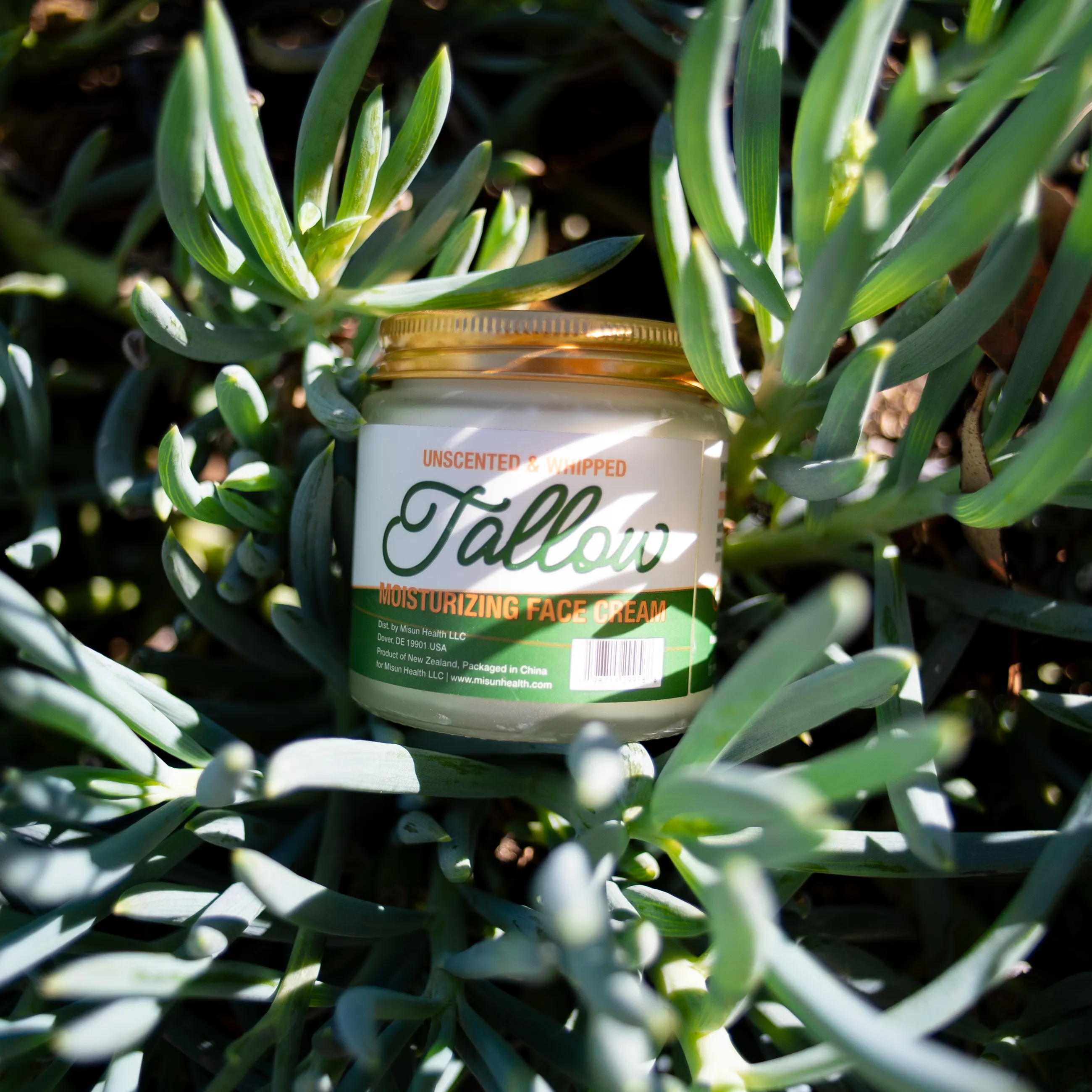
Misun Health makes two fragrance-free tallow moisturizers. Whipped Tallow Cream lists one ingredient, 100 percent grass-fed New Zealand beef tallow, and is labeled unscented and fragrance-free; it is whipped so a small scoop spreads thin over a large area, which suits a belly, breasts, hips and thighs. Beef Tallow Balm is the denser jar, made for targeted use on dry-feeling hands, elbows, heels and cuticles, and for any small patch that wants a heavier layer. Either one keeps stretching skin soft and comfortable through each trimester and after the birth.
FAQ
Common Questions
Does beef tallow prevent stretch marks?
There is no evidence that it does. No study has tested tallow on stretch marks, and two placebo-controlled trials of cocoa butter, the tested fat closest to tallow, found no significant effect. The Cochrane review of creams for preventing stretch marks in pregnancy found no high-quality evidence for any of them.
Can beef tallow fade stretch marks?
No study shows that it can. Tallow keeps the skin over a stretch mark soft, but the treatments shown to make early marks less noticeable are prescription tretinoin, studied at 0.1 percent for three to six months, and in-office procedures such as lasers and peels. The AAD says treatment seems to have little effect on mature marks.
Is it safe to use beef tallow on my belly during pregnancy?
Tallow has not been studied in pregnancy. The AAD's pregnancy warning for stretch-mark products names retinol, and a single-ingredient tallow cream has no retinoid on its list. Patch test it first, keep it off broken skin, and if you have alpha-gal syndrome, ask your allergist before using it, since CDC lists products made with mammal fat, like tallow, among those some people with the syndrome react to.
When should I start using a belly moisturizer?
Whenever your skin starts to feel dry or tight. Stretch marks usually appear in the late second or early third trimester, though in one Stanford survey 43 percent developed them before 24 weeks. Starting early is fine for comfort; it has not been shown to prevent them.
Why do my stretch marks itch?
New stretch marks can feel slightly raised and itchy, according to the AAD. Itching on the palms or soles, especially after 28 weeks, or itchy bumps inside the stretch marks late in pregnancy, are different and need your prenatal clinician.
Is tallow better than cocoa butter for stretch marks?
Neither has been shown to prevent them, so choose on texture and ingredients. The two fats are close chemical relatives, both solid at room temperature and built mostly from palmitic, stearic and oleic acids. If you want an unscented product, check the ingredient list for fragrance or parfum before you buy either.
Do stretch marks go away after pregnancy?
They fade but do not disappear. The AAD describes stretch marks as permanent scars that treatment can make less noticeable, and the 2017 review in the International Journal of Women's Dermatology describes red early marks fading over months to years into pale lines.
Primary sources
Sources and evidence limits
- Brennan M, Young G, Devane D. Topical preparations for preventing stretch marks in pregnancy. Cochrane Database of Systematic Reviews, CD000066
Six randomized or quasi-randomized trials with 800 women, trial search run to October 31, 2011, testing Alphastria, Trofolastin, Verum, olive oil and cocoa butter, all containing vitamin E. Against placebo or no treatment, five trials and 474 women gave an average risk ratio of 0.74 (95 percent confidence interval 0.53 to 1.03). Concludes there is no high-quality evidence to support any of the topical preparations for preventing stretch marks in pregnancy.
- American Academy of Dermatology: Stretch marks: Why they appear and how to get rid of them
Source for stretch marks as scars from ruptured collagen and elastin, their early colors and itch, the listed triggers, the advice to check with a doctor before using a product while pregnant or breastfeeding because some contain ingredients such as retinol, studies in which almond oil, cocoa butter, olive oil and vitamin E did not prevent stretch marks, centella and hyaluronic acid as ingredients that may help, massage, tretinoin used nightly for 24 weeks, in-office procedures, little effect on mature marks, self-tanner and tanning.
- Farahnik B, Park K, Kroumpouzos G, Murase J. Striae gravidarum: Risk factors, prevention, and management. International Journal of Women's Dermatology, 2017, volume 3, issue 2, pages 77 to 85
Gives prevalence of 55 to 90 percent, onset usually in the late second and early third trimester with 43 percent before 24 weeks in the Stanford survey, and red marks fading over months to years into pale lines. Summarizes the prevention trials, including Trofolastin (34 percent against 56 percent), Alphastria (10 percent against 37 percent on placebo), Verum (29 percent against 62 percent untreated) and the almond oil massage trial, and suggests massage may explain the benefit.
- Chang AL, Agredano YZ, Kimball AB. Risk factors associated with striae gravidarum. Journal of the American Academy of Dermatology, 2004, volume 51, issue 6, pages 881 to 885
Anonymous survey of 161 women at Stanford Ambulatory Clinics, 89 with stretch marks. A mother with stretch marks gave an odds ratio of 7.0 (95 percent confidence interval 2.7 to 18.6) and non-white race an odds ratio of 4.2 (1.9 to 9.6).
- Atwal GS, Manku LK, Griffiths CE, Polson DW. Striae gravidarum in primiparae. British Journal of Dermatology, 2006, volume 155, issue 5, pages 965 to 969
Found stretch marks in 52 percent (161 of 309) of white first-time mothers examined within 48 hours of delivery at Hope Hospital, Salford. Low maternal age was the most significant risk factor, with severe marks in 14 of 71 teenagers, followed by body mass index above 26, weight gain above 15 kilograms and high birth weight.
- Osman H, Rubeiz N, Tamim H, Nassar AH. Risk factors for the development of striae gravidarum. American Journal of Obstetrics and Gynecology, 2007, volume 196, issue 1, pages 62.e1 to 62.e5
Cross-sectional study of 110 first-time mothers in Beirut: 61 percent had stretch marks, on the abdomen in 48 percent and the breasts and thighs in 25 percent each. Women with stretch marks gained 15.6 kilograms against 12.5. About 61 percent had used a cream or lotion, most often cocoa butter, baby oil or almond oil, with no correlation between cream use and stretch marks (64.2 percent against 55.8 percent).
- Osman H, Usta IM, Rubeiz N, et al. Cocoa butter lotion for prevention of striae gravidarum: a double-blind, randomised and placebo-controlled trial. BJOG, 2008, volume 115, issue 9, pages 1138 to 1142
First-trimester first-time mothers in Beirut and Tripoli applied a cocoa butter lotion or a placebo lotion daily until delivery. Of 210 enrolled, 175 completed; stretch marks developed in 45.1 percent against 48.8 percent (P = 0.730), with no difference in severity.
- Buchanan K, Fletcher HM, Reid M. Prevention of striae gravidarum with cocoa butter cream. International Journal of Gynecology and Obstetrics, 2010, volume 108, issue 1, pages 65 to 68
Double-blind, placebo-controlled trial of 300 women at the University Hospital of the West Indies, Kingston, Jamaica: stretch marks in 44 percent with cocoa butter cream against 55 percent with placebo (P = 0.09). Concludes that cocoa butter cream does not prevent striae gravidarum.
- USDA FoodData Central: Oil, cocoa butter (FDC ID 171421, SR Legacy)
Lists 25.4 grams of palmitic acid (16:0), 33.2 grams of stearic acid (18:0) and 32.6 grams of oleic acid (18:1) per 100 grams.
- USDA FoodData Central: Fat, beef tallow (FDC ID 171400, SR Legacy)
Lists 24.9 grams of palmitic acid, 18.9 grams of stearic acid and 36.0 grams of oleic acid per 100 grams.
- PubMed search: tallow with striae, stretch marks or striae gravidarum (run November 25, 2026)
Returned no records.
- Korgavkar K, Wang F. Stretch marks during pregnancy: a review of topical prevention. British Journal of Dermatology, 2015, volume 172, issue 3, pages 606 to 615
Concludes that cocoa butter and olive oil are not effective for preventing stretch marks or reducing their severity, that there is limited evidence for centella and possibly massage with bitter almond oil, weak evidence for hyaluronic acid, and that reliable methods for preventing stretch marks are scarce.
- Mallol J, Belda MA, Costa D, Noval A, Sola M. Prophylaxis of Striae gravidarum with a topical formulation. A double blind trial. International Journal of Cosmetic Science, 1991, volume 13, issue 1, pages 51 to 57
Eighty pregnant women used a cream containing Centella asiatica extract, alpha-tocopherol and collagen-elastin hydrolysates or a placebo; stretch marks developed in 34 percent of the treated group against 56 percent on placebo.
- Timur Taşhan S, Kafkasli A. The effect of bitter almond oil and massaging on striae gravidarum in primiparaous women. Journal of Clinical Nursing, 2012, volume 21, pages 1570 to 1576
Trial of 141 first-time mothers in Turkey: stretch marks in 20 percent with bitter almond oil and massage, 38.8 percent with the oil alone and 41.2 percent in the control group.
- Facchinetti F, Pedrielli G, Benoni G, et al. Herbal supplements in pregnancy: unexpected results from a multicentre study. Human Reproduction, 2012, volume 27, issue 11, pages 3161 to 3167
Retrospective study of 700 women interviewed after delivery at three hospitals in northern Italy. Almond oil users had more preterm births (29 of 189) than non-users (51 of 511), adjusted odds ratio 2.09 (95 percent confidence interval 1.08 to 4.08); the authors say the finding only raises a hypothesis that requires confirmation.
- CDC: Weight Gain During Pregnancy (May 15, 2024)
Gives the Institute of Medicine's recommended total gains for a single baby by pre-pregnancy body mass index: 28 to 40 pounds underweight, 25 to 35 pounds normal weight, 15 to 25 pounds overweight and 11 to 20 pounds with obesity.
- American Academy of Dermatology: Dermatologists' top tips for relieving dry skin
Advises five to ten minute baths and showers in warm water, moisturizer applied while skin is still damp, ointments and creams over lotions, products labeled fragrance-free, and a humidifier.
- Cameron EL. Pregnancy and olfaction: a review. Frontiers in Psychology, 2014, volume 5, article 67
Notes that many women report a heightened sense of smell during pregnancy.
- Albaugh SL, Wu LL, Zhang D, et al. Olfaction in pregnancy: systematic review and meta-analysis. Chemical Senses, 2022, volume 47, bjac035
Included 13 studies and found no significant differences between pregnant women and controls in odor thresholds, discrimination or hedonics, with worse odor identification in pregnancy.
- Long CC, Finlay AY. The finger-tip unit: a new practical measure. Clinical and Experimental Dermatology, 1991, volume 16, issue 6, pages 444 to 447
One fingertip unit covers 286 square centimeters, and the front of the adult trunk takes 6.7 units.
- Long CC, Finlay AY, Averill RW. The rule of hand: 4 hand areas = 2 FTU = 1 g. Archives of Dermatology, 1992, volume 128, issue 8, pages 1129 to 1130
Sets two fingertip units at 1 gram, about half a gram per unit.
- American Academy of Dermatology: How to test skin care products
Advises applying a new product twice daily for seven to 10 days to a quarter-sized spot, such as the underside of the arm or the bend of the elbow, and washing it off if a reaction appears.
- MotherToBaby: Tretinoin (Retin-A) fact sheet (July 1, 2024)
Says the safest approach may be to avoid tretinoin during pregnancy, notes case reports of birth defects after use on the skin, says stopping 1 month before trying to get pregnant may be suggested, and says use during breastfeeding has not been studied, though the amount in breast milk would probably be small.
- Royal College of Obstetricians and Gynaecologists: Intrahepatic cholestasis of pregnancy, patient information (first published 2022, last updated April 2026)
Says itching affects 25 in 100 pregnant women, that ICP itching usually begins after 28 weeks, may include the palms and soles and comes with no rash, that itching can be the first sign and should be reported, and that blood tests may need to be repeated if itching continues.
- March of Dimes: Intrahepatic cholestasis of pregnancy
Puts ICP at about 1 to 2 in 1,000 pregnant women in the United States, lists preterm birth, fetal distress and stillbirth among its risks, says corticosteroid creams and lotions do not relieve its itch, and lists the signs to call a provider about.
- DermNet: Polymorphic eruption of pregnancy
Describes an itchy, bumpy rash that starts in the abdominal stretch marks in the last 3 months of pregnancy and usually resolves within 4 to 6 weeks after delivery, occurring in about 1 in 160 pregnancies, more often in a first pregnancy, without other problems for the baby; a rash starting in the navel or with blisters suggests pemphigoid gestationis.
- Kang S, Kim KJ, Griffiths CE, et al. Topical tretinoin (retinoic acid) improves early stretch marks. Archives of Dermatology, 1996, volume 132, issue 5, pages 519 to 526
Double-blind, vehicle-controlled trial of 22 patients using 0.1 percent tretinoin (10) or vehicle (12) daily for 6 months: 8 of 10 improved against 1 of 12, and target marks shrank 14 percent in length on tretinoin while growing 10 percent on vehicle.
- Rangel O, Arias I, García E, Lopez-Padilla S. Topical tretinoin 0.1% for pregnancy-related abdominal striae: an open-label, multicenter, prospective study. Advances in Therapy, 2001, volume 18, issue 4, pages 181 to 186
Twenty women applied tretinoin cream 0.1 percent daily for 3 months to pregnancy-related abdominal stretch marks; the target mark decreased in length by 20 percent.
- CDC: Fast Facts: Products That May Contain Alpha-gal (January 5, 2026)
Lists products made or cooked with mammal fat, like lard, tallow or suet, and notes that not all patients with alpha-gal syndrome react to these ingredients.
Use the tools
Related skincare tools
- Patch Test PlannerGet the test site, the dose and the twice-daily schedule before a new belly product goes on a large area of skin.Open tool
- Moisturizer Cost Per Use CalculatorPick chest and stomach as the area and enter 7 or 14 applications a week to see the grams one coat takes and how long a jar lasts.Open tool
- Fragrance Label CheckerPaste the ingredient list of a belly butter or stretch-mark oil to check for fragrance, perfume or parfum.Open tool
Keep reading
Related guides
Explore next
Related skin concerns
Shop the routine
Build your tallow routine
Shop the products that best match the concerns and routines covered in this guide.