Informational + routine planning · 14 min read
Tretinoin Dry Skin: How Long the Peeling Lasts and Where Moisturizer Goes
Tretinoin dryness and peeling usually begin in the first two weeks and peak around weeks two to three, then ease for most people, according to the trial data in its FDA labels. All five tretinoin labels we read make room for a moisturizer, and none puts it underneath: tretinoin goes on clean, completely dry skin, and moisturizer follows later that night or in the morning.
Last updated November 22, 2026
The short answer
Tretinoin dries skin because it disturbs the outer barrier while your skin adjusts, so more water escapes through it. In the drug's own trials, dryness and peeling were among the most common side effects, they peaked in the first two to three weeks, and then they declined, although in some people they lasted the whole 12 weeks of a trial. All five tretinoin labels we read make room for a moisturizer. The order that fits all of them is to wash with a mild cleanser, pat dry, wait until the skin is completely dry, apply a thin layer of tretinoin, give it time, then moisturize the dry areas, with moisturizer and sunscreen again in the morning. If you use tretinoin for breakouts, the labels and the American Academy of Dermatology point you to noncomedogenic moisturizers for the treated areas, and that decides where a rich fat such as beef tallow belongs.
How often it happens: the numbers in the labels
FDA labels print the trial counts, and the counts depend on who is doing the counting. In two trials of Atralin, a 0.05% tretinoin gel, 16 percent of 674 users reported dry skin and 12 percent reported peeling, scaling or flaking over up to 12 weeks, against 2 percent and 1 percent of 487 people using the same gel without tretinoin. In two 12-week trials of Altreno, a 0.05% tretinoin lotion, 4 percent of 767 users reported dryness as a side effect. When investigators examined the skin at each visit, though, 49 percent of Altreno users showed scaling at some point, against 30 percent on the plain lotion, and 30 percent had burning, against 14 percent. The Altreno label warns that rates from one drug's trials cannot be compared directly with another's, so treat the gap between 16 and 4 percent as a question for your prescriber about the base your tretinoin comes in, not as a ranking.
When it peaks and how long it lasts
The labels agree on timing. In the Retin-A Micro trials, irritation scores for redness, peeling, dryness, burning or stinging and itching peaked during the first two weeks and decreased after that. Among 225 people using the 0.04% strength, about half had some irritation at week 2, most of it mild; fewer than 10 percent had moderate irritation and none had severe irritation at that visit. The Atralin label says most skin reactions first appear in the first two weeks and peak around the second and third week, and that in some people they persist through the whole treatment period. The leaflet for Renova, a 0.02% tretinoin cream approved for fine facial wrinkles, says most patients report peeling, dry skin, burning, stinging, itching and redness, usually mild to moderate and early in treatment; in its controlled studies of 339 patients, about 4 percent stopped because of adverse reactions. Flaking in week two is the pattern the trials predict.
Why tretinoin leaves skin dry and flaky
A 2006 study in the journal Cutis, by dermatologist Zoe Diana Draelos with two Procter & Gamble employees, measured transepidermal water loss, the rate at which water evaporates out through the skin, in women starting tretinoin 0.025% cream. Once tretinoin began, water loss rose on both sides of the face compared with the start of treatment. The authors describe the dryness, peeling, stinging and redness of the first weeks, a phase they call facial retinization, as expected signs of damage to the stratum corneum, the outer layer of flattened cells and lipids that holds water in. The same paper notes what comes with it: in the first weeks the outer layer becomes more compact and the skin feels smoother, and fine wrinkles improve with longer use. In the study, the side of the face given a barrier-focused moisturizer kept its water loss at or below the level measured when the study began, while water loss on the other side stayed above it.
Why the labels ask for completely dry skin
The generic tretinoin cream label on DailyMed is specific. After washing, wait 20 to 30 minutes, because the skin needs to be completely dry to minimize possible irritation, then use about a half inch or less on a fingertip for the whole face. It adds a check worth keeping: the cream should become invisible almost immediately, and if it is still visible, you are using too much. Renova's label gives the same 20 to 30 minute wait. That runs against standard dry skin advice, since the American Academy of Dermatology tells people with dry skin to apply moisturizer while the skin is still damp after a shower or bath. On a tretinoin night, both instructions hold, for different skin. The treated area dries fully before the tretinoin goes on, and damp-skin moisturizing still works on your hands, your body and anywhere else you are not applying tretinoin.
Before or after tretinoin: what each label says about moisturizer
None of the five labels puts moisturizer under tretinoin on freshly washed skin. They differ on how soon it can follow. The Retin-A Micro leaflet says you may use moisturizers after applying it, and its prescriber section lists a topical moisturizer among the ways to reduce irritation. Renova's label advises waiting at least 1 hour after the cream before any other skin care product or cosmetic, for best results, and says skin moisturizers should be used at least every morning to protect treated skin from dryness. The generic cream label suggests a morning moisturizer, or a moisturizer with sunscreen, that will not aggravate your acne. Atralin's says a moisturizer during the day may help mild to moderate dryness, and Altreno's says a prescriber may tell you to use one. Follow the leaflet in your own box, since each product was approved with its own directions.
What happened when moisturizer went on over tretinoin
In the Draelos study, 50 women aged 35 to 55 with sun-damaged facial skin enrolled and 37 finished. After two weeks on the study moisturizers alone, they applied tretinoin 0.025% cream to the whole face each night for eight weeks. About 5 minutes later they spread one moisturizer over the tretinoin on one half of the face and a second moisturizer on the other half, and used both again each morning. Both carried SPF 15, and one added niacinamide, panthenol and vitamin E. Dryness and peeling rose on both cheeks early on, then returned to baseline by the end on the vitamin side while staying raised on the other. Signs of sun damage improved on both sides, more on the vitamin side: mottled pigmentation scores fell from 2.9 to 2.3 there and from 2.9 to 2.6 on the other half, on a 0 to 5 scale. Procter & Gamble, which makes the vitamin moisturizer, funded the work.
A second study, with the moisturizer in the morning
A 2012 split-face study in the Journal of Drugs in Dermatology, two of whose three authors worked for Galderma, tested a different timing. Adults with healthy skin applied Retin-A 0.05% cream to the whole face each evening, about 30 minutes after cleansing, and a Galderma facial moisturizer with SPF 30 to one randomly chosen side each morning for four weeks. Most participants had some irritation on both sides of the face. On the moisturized side it was predominantly mild, and their tolerability preferences favored that side. This study did not measure whether the tretinoin worked. The Draelos study is the one that shows tretinoin still improving the skin with moisturizer spread over it, though it had no side without moisturizer to compare against. In both studies the authors included employees of a company whose moisturizer was being tested, and neither used a tallow product.
The sandwich method has only lab data
We found no clinical trial of the sandwich method, where moisturizer goes on before tretinoin and again after it. The closest evidence is a poster at the American Academy of Dermatology's March 2025 meeting, sponsored by Kenvue and reported by Dermatology Times; we found no peer-reviewed paper of it. Researchers treated skin samples from one donor for 48 hours with tretinoin 0.025% cream or retinol 0.1% cream and measured a gene marker of retinoid activity. A moisturizer applied either before or after the retinoid left that marker at the level of the retinoid alone. Moisturizer on both sides cut it about threefold. One donor, four samples per group and a sponsor that sells moisturizers make this a weak signal. As a measure of activity, it favors one layer of moisturizer over two, and the labels put that layer after the tretinoin.
Why a thick layer right over tretinoin is not neutral
Covering the skin changes how much of a product gets in. A 2001 review by Zhai and Maibach found that occlusion changes the hydration of the stratum corneum and its permeability, and often, though not always, increases how much of an applied chemical is absorbed. A heavy balm spread over freshly applied tretinoin can therefore make the routine stronger than the one on the label, and Renova's label separately asks for an hour before the next product. We found no measurement of tretinoin absorption under beef tallow. The cautious version is to give the tretinoin its time, then put the heavier layer only where the skin is dry, rather than sealing the whole treated area every night.
Keep it off the corners of the nose and mouth
The labels name the same places to avoid. Altreno's lists the eyes, mouth, paranasal creases and mucous membranes. Retin-A Micro's lists the eyes, the mouth, the paranasal creases of the nose and mucous membranes, and the generic cream's says to keep it away from the corners of the nose, mouth, eyes and open wounds. Since the tretinoin is not meant to be there, those spots are the natural place for the heavier layer. After the tretinoin has gone on, a thin layer of balm on the lips, the corners of the mouth and the edges of the nostrils moisturizes skin the drug is not treating. We found no study of this step. It follows from the labels' own instruction and from the occlusion point above.
If you use tretinoin for breakouts
Four of the five labels we read are for acne, and their moisturizer advice reflects it. Atralin's says patients may use moisturizers that are noncomedogenic, the generic cream asks for one that will not aggravate your acne, and the American Academy of Dermatology's acne advice is to look for labels that say oil-free, non-comedogenic or won't clog pores. Beef tallow is a fat, so it is not oil-free, and a 2024 scoping review of 19 studies on rendered tallow and skin cited no test of tallow for clogged pores or breakouts. On breakout-prone areas, the choice that matches the labels is a moisturizer marked noncomedogenic. Tallow fits the dry skin that does not break out, and the lips, mouth corners and nostril edges that the tretinoin is not meant to reach.
The early flare makes a new moisturizer hard to judge
The acne labels also warn that acne can look worse during the early weeks of treatment, and they say that alone is not a reason to stop. MedlinePlus puts it in the first 7 to 10 days, with red, scaling skin and more acne sores, and says the sores should improve in 2 to 3 weeks of regular use, sometimes more than 6. If you start a new moisturizer in the same week as tretinoin, you cannot tell which one caused new bumps. Either keep the moisturizer you already use through the first month, or test a new one the way the AAD suggests for any skin care product: your normal amount on a quarter-sized spot that will not be washed off, such as the inside of the forearm or the crease of the elbow, twice a day for 7 to 10 days.
If you use tretinoin for fine lines on dry skin
Renova, the 0.02% cream approved for fine facial wrinkles, is the label most explicit about moisturizer. It asks for skin moisturizers at least every morning to protect treated skin from dryness, a moisturizing sunscreen of SPF 15 or more in the morning, and an hour after the evening application before any other product. MedlinePlus says fine wrinkles can take 3 to 4 months, or up to 6, to show improvement, so the routine has to be one you can keep for half a year. For dry skin that does not break out, the AAD's general advice adds two points that fit the label: ointments and creams are more effective than lotions, and gentle, fragrance-free products are the ones to choose.
Where Misun Health's tallow fits
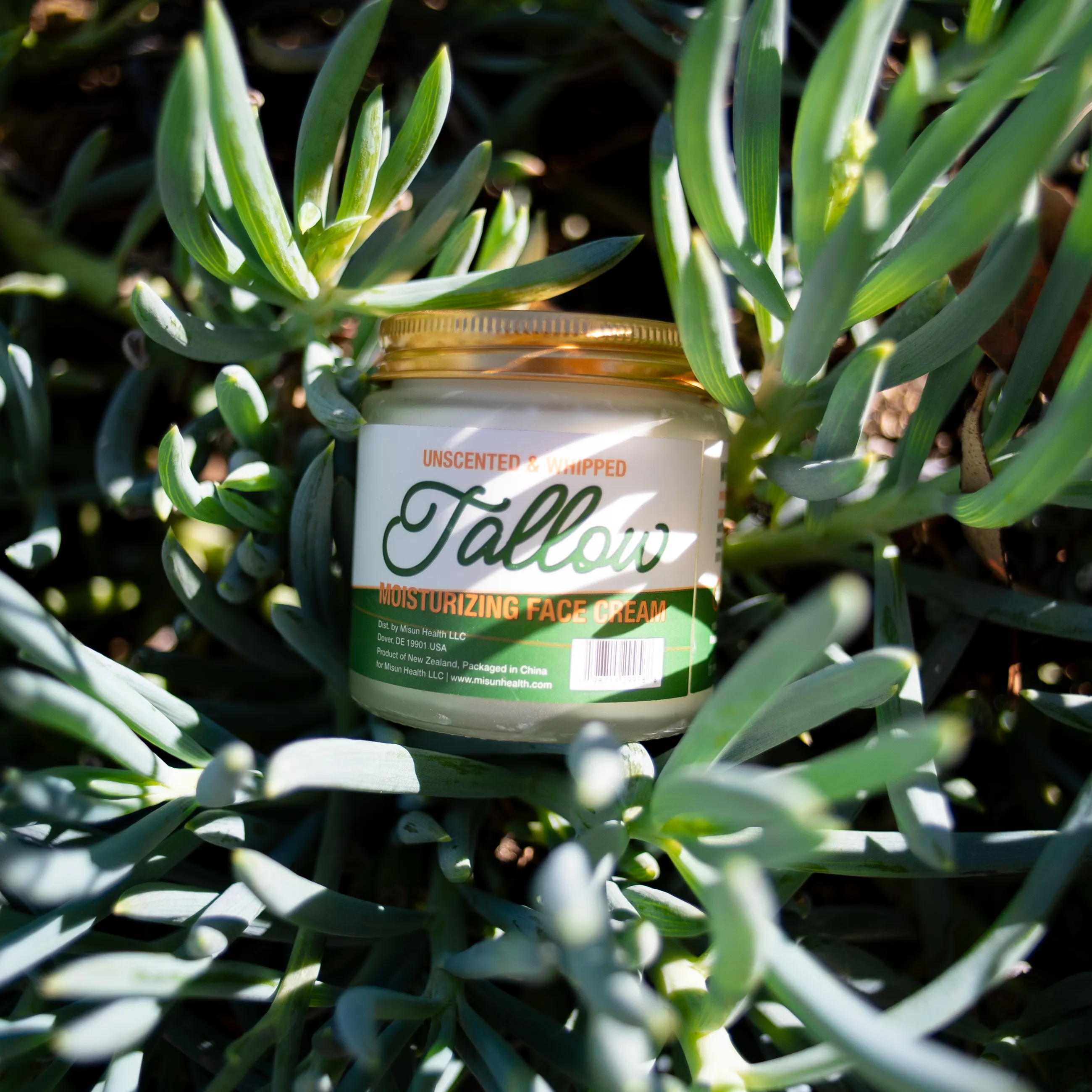
Misun Health makes two fragrance-free tallow moisturizers. Whipped Tallow Cream lists one ingredient, 100 percent grass-fed New Zealand beef tallow, and is labeled unscented and fragrance-free. It is whipped so a small scoop spreads thin, which suits the layer that follows tretinoin on dry skin that does not break out, and the morning layer under sunscreen. With one ingredient, the cream contains none of the additions the tretinoin labels single out, such as alcohol, astringents, spices or lime. Beef Tallow Balm is the denser jar, made for small dry areas such as hands, heels and cuticles, and on tretinoin nights it is the one for the lips, the corners of the mouth and the edges of the nostrils. We found no published study of tallow used alongside tretinoin, and the studies above used conventional moisturizers, so patch test it before it goes on your face.
What makes tretinoin dryness worse
The Retin-A Micro label asks you to wash treated skin gently with a mild, non-medicated soap, pat it dry, avoid washing too often or scrubbing hard, and skip medicated or abrasive cleansers, products with a strong drying effect, and products high in alcohol, astringents, spices or lime peels. It warns that over-the-counter acne products with benzoyl peroxide, sulfur, resorcinol or salicylic acid add to the risk of dryness, redness and peeling. Using more does not help either: applying it more than once a day, or in more than a thin layer, will not bring faster results and can cause marked redness, peeling or discomfort. Weather counts as well. The Retin-A Micro, Renova and generic labels all name wind and cold, and the Atralin leaflet says treated skin may dry out or get wind burned more easily.
Starting tretinoin in winter
If you start tretinoin between November and February, its peak weeks of dryness can fall in the cold, windy stretch the labels warn about, so the AAD's dry skin basics matter more than usual. It advises keeping baths and showers to five to ten minutes in warm water, using a mild cleanser sparingly rather than working up a thick lather, and running a humidifier, including a portable one in the bedroom overnight, cleaned regularly to prevent mold. None of these steps conflicts with any tretinoin label we read.
Sunscreen stays in the routine
Tretinoin makes skin more sensitive to sunlight. The Retin-A Micro label calls for daily sunscreen of SPF 15 or higher, plus protective clothing, when exposure to ultraviolet light cannot be avoided, even on days when it is not sunny, and the Altreno leaflet adds a wide-brimmed hat. Plain tallow is not a sunscreen and has no SPF, so it cannot stand in for that step. In the morning, moisturizer goes on first and sunscreen goes on last, as the outermost layer.
When dryness means calling the prescriber
Mild dryness and flaking in the first weeks are expected. Severe reactions are not. The generic cream label says the skin of certain sensitive people may become excessively red, swollen, blistered or crusted, and the Retin-A Micro label says to stop temporarily or permanently if severe irritation occurs. The labels also say not to apply tretinoin to sunburned skin or skin affected by eczema. The Altreno and Atralin labels let a prescriber cut back how often you apply it when irritation warrants, but the Atralin and Retin-A Micro labels both state that efficacy at reduced frequencies of application has not been established, which is why that change belongs to the prescriber. The generic label adds that all adverse effects of tretinoin reported to date have been reversible when treatment stopped.
A tretinoin night and morning, in order
In the evening, wash with a mild, non-medicated cleanser and pat dry. Wait 20 to 30 minutes, until the skin is completely dry. Apply a thin layer of tretinoin in the amount your label gives, keeping it away from the eyes, the corners of the nose and the mouth. Give it time: Renova's label asks for an hour before the next product, and the Retin-A Micro leaflet allows moisturizer after. Then moisturize, with a noncomedogenic moisturizer on breakout-prone skin, a richer fragrance-free layer such as whipped tallow on dry skin that does not break out, and balm on the lips, mouth corners and nostril edges. In the morning, wash gently, apply moisturizer and finish with sunscreen of SPF 15 or more.
FAQ
Common Questions
Can you use beef tallow with tretinoin?
Yes, as a moisturizer that goes on after it. Apply tretinoin to clean, completely dry skin, give it the time your label asks for, then use a thin layer of tallow on dry areas. If you use tretinoin for breakouts, keep tallow to dry skin that does not break out and to the lips, mouth corners and nostril edges, and use a moisturizer labeled noncomedogenic on breakout-prone skin, as the Atralin label and the AAD advise. We found no published study of tallow used with tretinoin, so patch test it first.
How long does tretinoin dryness last?
In the label trials, irritation peaked in the first two to three weeks and declined after that, though the Atralin label notes it persisted through the treatment period in some people. In the Draelos study, dryness and peeling were back to baseline by week 8 on the side of the face using a barrier-focused moisturizer and still above baseline on the other side.
Does tretinoin work on dry, flaky skin?
Dry, in the labels' sense, means not damp: they ask for clean skin that is completely dry after washing, and the generic cream label says to wait 20 to 30 minutes. Flakes are a different matter. Do not scrub them off before applying, because the Retin-A Micro label advises against scrubbing hard and against abrasive cleansers. The labels' answer to flaking is gentle washing and moisturizer, and the prescriber if it becomes severe.
Should moisturizer go on before or after tretinoin?
After, by the labels. The Retin-A Micro leaflet says you may use moisturizers after applying it, and Renova's label advises waiting at least an hour before another product. The only data on moisturizer first is a 2025 industry-sponsored lab poster: one layer before or after left a marker of retinoid activity unchanged, while layers on both sides cut it about threefold. Putting moisturizer on first departs from the labels, so ask your prescriber before you try it.
Is tretinoin peeling the same as purging?
No. Peeling and dryness are irritation of the skin's surface. What people call purging is the apparent worsening of acne that tretinoin labels describe in the early weeks, which MedlinePlus places in the first 7 to 10 days. The labels say that flare is not on its own a reason to stop. Severe redness, swelling, blistering or crusting is a reason to stop and call your prescriber.
Can I use tretinoin every other night to cut down on dryness?
Only if your prescriber agrees. The Altreno and Atralin labels allow a prescriber to reduce how often you apply it when irritation warrants, but the Atralin and Retin-A Micro labels state that efficacy at reduced frequencies of application has not been established.
Does the same advice apply to adapalene or retinol?
Partly. The AAD lists adapalene and tazarotene alongside tretinoin as acne treatments that tend to dry and irritate the skin, and says a daily moisturizer can help skin tolerate them. The directions here come from tretinoin labels, so follow the ones on your own product. The 2025 lab poster found the same before-or-after result for retinol 0.1% cream as for tretinoin 0.025% cream.
Primary sources
Sources and evidence limits
- Atralin (tretinoin) gel 0.05% prescribing information and patient information, DailyMed (revised February 2024)
Two randomized, controlled trials of up to 12 weeks. Source for dry skin in 109 of 674 users (16%) against 8 of 487 on vehicle (2%), peeling, scaling or flaking in 78 (12%) against 7 (1%), reactions first appearing in the first two weeks and peaking around the second and third week, persistence through treatment in some subjects, a daytime moisturizer for mild to moderate dryness, noncomedogenic moisturizers, wind burn, and efficacy at reduced frequencies not being established.
- Altreno (tretinoin) lotion 0.05% prescribing information, U.S. Food and Drug Administration (revised August 2018)
Two randomized, double-blind, vehicle-controlled 12-week trials. Source for application site dryness reported by 29 of 767 users (4%) against 1 of 783 on vehicle, scaling at any post-baseline visit in 49% against 30%, burning in 30% against 14%, areas to avoid, the prescriber instruction to use a moisturizer, reduce frequency or stop depending on severity, SPF 15 or more with a wide-brimmed hat, and the warning that rates cannot be compared across drugs' trials.
- Retin-A Micro (tretinoin) gel prescribing information and patient information, U.S. Food and Drug Administration (revised September 2025)
Source for irritation scores peaking during the first two weeks and decreasing thereafter, about half of 225 users of the 0.04% strength with irritation at week 2 (mostly mild, under 10% moderate, none severe), areas to avoid, applying a topical moisturizer, moisturizers after application, gentle washing and products to avoid, over-the-counter acne products, more than a thin layer or once daily not speeding results, weather extremes, daily SPF 15 or higher, and stopping for severe irritation.
- Renova (tretinoin cream) 0.02% prescribing information and patient information, DailyMed (Rev. 11/2025)
Source for use in mitigating fine facial wrinkles, the 20 to 30 minute wait after washing, waiting at least 1 hour before another skin care product or cosmetic, skin moisturizers at least every morning, a moisturizing sunscreen of SPF 15 or greater, wind and cold, 339 patients in controlled studies with about 4% stopping because of adverse reactions, and side effects described as usually mild to moderate and early in treatment.
- Tretinoin cream USP 0.025%, 0.05% and 0.1% prescribing information, DailyMed (label updated February 11, 2025)
Source for waiting 20 to 30 minutes after washing so the skin is completely dry, about a half inch or less on a fingertip, the cream becoming invisible almost immediately, keeping it away from the corners of the nose, mouth, eyes and open wounds, a morning moisturizer that will not aggravate acne, early apparent worsening of acne, weather extremes, excessively red, swollen, blistered or crusted skin in sensitive people, and adverse effects to date being reversible on stopping.
- MedlinePlus (U.S. National Library of Medicine): Tretinoin Topical (revised December 15, 2025)
Source for acne probably getting worse, with red, scaling skin and more acne sores, during the first 7 to 10 days, sores improving in 2 to 3 weeks and sometimes more than 6, fine wrinkles taking 3 to 4 months or up to 6 months, and not applying tretinoin to sunburned skin or skin affected by eczema.
- Draelos ZD, Ertel KD, Berge CA. Facilitating facial retinization through barrier improvement. Cutis, 2006, volume 78, pages 275 to 281
Fifty women aged 35 to 55 enrolled and 37 completed; two weeks of moisturizers alone, then eight weeks of nightly tretinoin 0.025% cream with each moisturizer applied over it about 5 minutes later and again in the morning. Source for water loss rising with tretinoin, dryness and peeling returning to baseline only on the niacinamide, panthenol and tocopheryl acetate side, and mottled pigmentation falling from 2.9 to 2.3 against 2.9 to 2.6. Funded by a Procter & Gamble grant; two authors were Procter & Gamble employees.
- Schorr ES, Sidou F, Kerrouche N. Adjunctive use of a facial moisturizer SPF 30 containing ceramide precursor improves tolerability of topical tretinoin 0.05%: a randomized, investigator-blinded, split-face study. Journal of Drugs in Dermatology, 2012, volume 11, pages 1104 to 1107
Retin-A 0.05% cream on the whole face each evening, about 30 minutes after cleansing, with a Galderma moisturizer SPF 30 on one side each morning for four weeks. Source for most participants having irritation on both sides, predominantly mild on the moisturized side, and tolerability preferences favoring that side. Two authors were affiliated with Galderma.
- Dermatology Times: "Open Sandwich" Moisturization Regimen Does Not Affect Bioactivity of Retinols and Retinoids (March 24, 2025)
A secondary source, used because we found no peer-reviewed paper of the poster it reports from the 2025 American Academy of Dermatology Annual Meeting. Source for the Kenvue sponsorship, skin samples from one donor with four per group treated for 48 hours, tretinoin 0.025% and retinol 0.1% creams, moisturizer before or after leaving a gene marker of activity comparable to the retinoid alone, and moisturizer on both sides reducing it about threefold.
- Zhai H, Maibach HI. Effects of skin occlusion on percutaneous absorption: an overview. Skin Pharmacology and Applied Skin Physiology, 2001, volume 14, pages 1 to 10
Source for occlusion changing stratum corneum hydration and barrier permeability and often, though not always, increasing percutaneous absorption of an applied chemical.
- Russell MF, Sandhu M, Vail M, Haran C, Batool U, Leo J. Tallow, Rendered Animal Fat, and Its Biocompatibility With Skin: A Scoping Review. Cureus, 2024, volume 16, article e60981
Nineteen studies met the inclusion criteria, most of them without human subjects. Source for the review citing no test of tallow for clogged pores or breakouts and calling for more controlled research on the side effects of topical tallow.
- American Academy of Dermatology: Moisturizer: Why you may need it if you have acne
Source for adapalene, tazarotene and tretinoin among acne treatments that tend to dry and irritate the skin, a daily moisturizer helping skin tolerate them, and looking for moisturizers labeled oil-free, non-comedogenic or won't clog pores.
- American Academy of Dermatology: Dermatologists' top tips for relieving dry skin (last updated January 2, 2026)
Source for applying moisturizer while skin is still damp after a shower or bath, ointments and creams being more effective than lotions, gentle, fragrance-free products, five to ten minute warm showers, using a mild cleanser sparingly, and a bedroom humidifier cleaned regularly.
- American Academy of Dermatology: How to test skin care products (last updated August 10, 2021)
Source for testing your normal amount on a quarter-sized spot that will not be rubbed or washed away, such as the inside of the forearm or the crease of the elbow, twice a day for 7 to 10 days.
Use the tools
Related skincare tools
- Skincare Layering Order PlannerPut your products in order for a retinoid night or an ordinary one, with the label's dry-down step before tretinoin and the moisturizer after it.Open tool
- Patch Test PlannerGet the site, the amount and the twice-daily schedule for testing a new moisturizer before it goes on your face.Open tool
- Indoor Humidity Calculator for Dry SkinEnter the outdoor temperature, outdoor humidity and your thermostat setting to see how dry your heated rooms get in winter.Open tool
Keep reading
Related guides
Explore next
Related skin concerns
Shop the routine
Build your tallow routine
Shop the products that best match the concerns and routines covered in this guide.